
The number usually quoted is “over 300”, and it is worth knowing where that comes from: nowhere in particular. Nobody has counted. What the figure actually represents is the number of local house-rule variants that have been written down at some point, and it is not a useful number for deciding what to play.
What is useful is that almost every domino game is built from three binary choices, and once you know them you can classify any variant you meet in about ten seconds.
The Three Choices That Generate Every Variant
Block or draw. In a block game, a player who cannot move simply passes. In a draw game, they take tiles from the unused pile, the boneyard, until they can move. Block games are tighter and faster; draw games are longer and more forgiving.
Count or no count. In a non-scoring game, the winner is whoever plays all their tiles first. In a scoring game, the board itself produces points, and the winner is whoever reaches a target. The two play completely differently: a non-scoring game is a race, a scoring game is a position battle.
Individual or partnership. Most domino games are individual. A few are played in pairs, and the partnership versions are the ones with the deepest strategy, because you are managing two hands rather than one.
Every game below is a combination of those three, plus whatever rule the local variant adds.
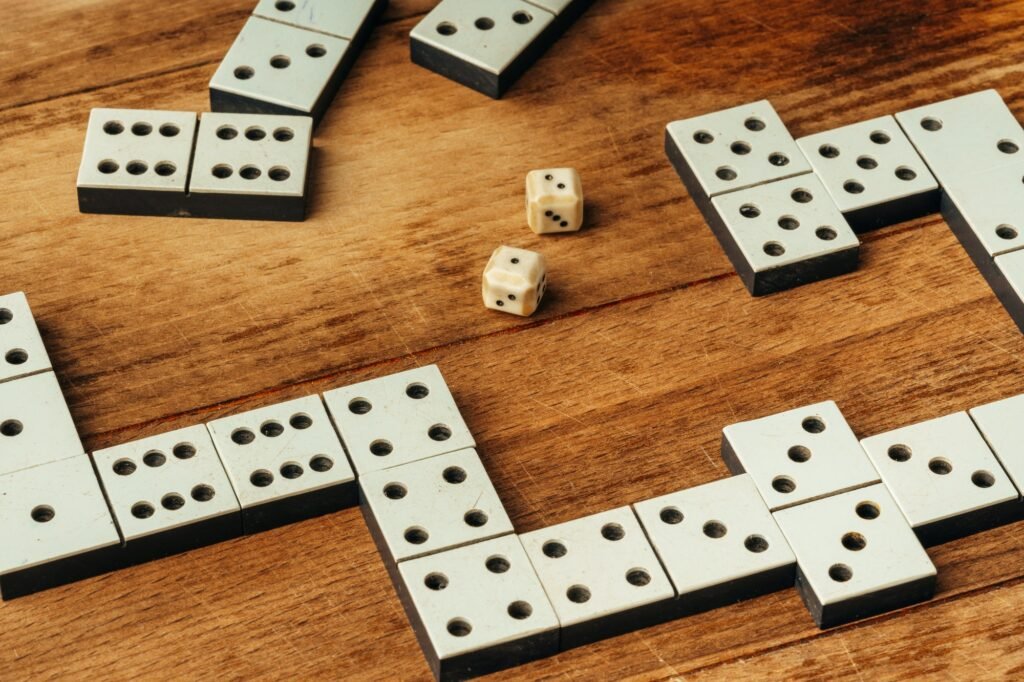
The Games Worth Knowing
| Game | Boneyard | Scoring | Players | What makes it different |
|---|---|---|---|---|
| Block | No | None | 2 to 4 | The base game; pass if you cannot play |
| Draw | Yes | None | 2 to 4 | Draw until you can play; longer and looser |
| All Fives | Yes | Board total | 2 to 4 | Score when the open ends total a multiple of five |
| Mexican Train | Yes | Pip count | 2 to 8 | Each player has a train; one shared train anyone can play on |
| Chickenfoot | Yes | Pip count | 2 to 8 | A double spawns three branches that must be filled |
| Bergen | Yes | None | 2 to 4 | Only doubles score, and only when covered |
| Matador | Yes | None | 2 to 4 | Open ends must total seven, not match |
Two of those deserve a note. All Fives is the game that turns dominoes into an arithmetic exercise, and it is the one most likely to hold a group of adults for an evening. Mexican Train is the one that works with a crowd, because it scales to eight players without anyone waiting long.
A Correction on “Double Six”
Double-six is not a game. It is a set, and the confusion is common enough to be worth clearing up.
A double-six set has 28 tiles, one for every combination of two numbers from zero to six, including the doubles. The number of tiles in any set is (n+1)(n+2)/2 where n is the highest number.
| Set | Tiles | Typical use |
|---|---|---|
| Double-six | 28 | The standard; block, draw, All Fives |
| Double-nine | 55 | Mexican Train, Chickenfoot |
| Double-twelve | 91 | Mexican Train with large groups |
| Double-fifteen | 136 | Specialist and tournament play |
Which set you need is decided by the game, not the other way round. Mexican Train and Chickenfoot are played on double-nine sets, and trying to play them on a double-six set produces a game that ends too quickly and feels wrong without anyone being able to say why.
The Rules That Catch Beginners
The spinner. In All Fives, the first double played becomes a spinner: it has four open ends rather than two, and all four count towards the total. Players who miss this lose most of the available points.
Doubles in Mexican Train. A double must be satisfied before play continues anywhere else. If you cannot satisfy it, you mark your train as open and other players can play on it, which is the mechanism that keeps the game moving and the reason the game is social rather than tense.
Chickenfoot’s three branches. A double of the matching number spawns three new branches that must each be started before play returns to normal. It is the most disruptive rule in the family and the reason the game is named after the shape it makes.
Who starts. Almost every variant has a different answer, and almost every argument is about this. Agree it before the first tile.
Playing Outdoors With Wooden Tiles
Dominoes works outdoors better than most board games, for one reason: the tiles are heavy and flat, so wind does not take them. But three things change.
- Tile thickness. Thin tiles are hard to pick up off grass or a textured table. 10 mm is the practical minimum outdoors; 8 mm is fine indoors.
- Surface. A slatted table is unplayable. A solid top or a cloth is required, and a cloth that does not blow away is worth carrying.
- Size. Standard tiles are 48 by 24 mm. Outdoors, with people standing around a table, that is small. Giant wooden dominoes at 100 by 50 mm are a different product and a better one for a garden.
What to Specify
- Tile dimensions in millimetres, and the tolerance on thickness. Tiles that vary in thickness do not stack flat and the layout drifts.
- Species and moisture content at machining, because a tile that dries after the pips are applied loses them at the end grain first.
- How the pips are marked: drilled and filled, printed, or burned. Drilled and filled survives; printed wears at the corners.
- Set size, and whether the box is a hinged case or a sliding lid. The box is half the product at retail.
- Whether the set includes a rule sheet, and which games it covers.
Minimum order 500 sets, samples 5 to 10 days, bulk production 30 to 45 days, quotation within 24 hours.
FAQs
How many domino games are there?
Nobody has counted. The “over 300” figure that circulates is not traceable to a source. What is true is that almost all of them are combinations of block or draw, scoring or non-scoring, and individual or partnership.
What is the most popular domino game?
Block, in most of Europe, and Mexican Train in North America. All Fives is the most popular scoring game.
What is the difference between a double-six and a double-nine set?
28 tiles against 55. Mexican Train and Chickenfoot need a double-nine set.
Can dominoes be played outdoors?
Yes, and better than most board games, because the tiles are heavy enough not to blow away. Use tiles at least 10 mm thick and a solid table.
What is the minimum order?
500 sets, with volume pricing at 500, 1,000 and 5,000 units.
Sourcing Wooden Garden Games in Bulk?
Kangjie is the direct manufacturer behind these games — no trading company, no middleman margin. We supply Kubb, Croquet, Molkky, Ring Toss, Tumble Tower, Cornhole and more to importers, retailers and brand owners worldwide.
- Factory-direct pricing with transparent volume tiers (500 / 1,000 / 5,000 units)
- OEM & ODM: logo, packaging, size and finish built to your specification
- EN71 & ASTM F963 compliant; FSC-certified timber
- Bulk lead time 30–45 days, quotation within 24 hours









