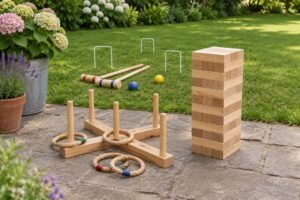
Five, and they are not variations on a theme. They use different equipment, different courts and different rules, and a set bought for one is not much use for another.
The confusion in this category is almost always the same: someone plays golf croquet at a hotel, buys a garden set, and finds that the hoops are 30 mm too wide and the mallets are a foot too short. The game they played and the product they bought were never the same thing.
Here are the five versions, what each one is for, and the two dimensions that tell you which one you are looking at.
The Five Versions
| Version | Equipment | Court | Players | A game takes |
|---|---|---|---|---|
| Association croquet | 6 double-tapped hoops, 4 balls | 32 x 25.6 m | Singles or doubles | 1.5 to 3 hours |
| Golf croquet | 6 hoops, 4 balls | Same court | Singles or doubles | 20 to 40 minutes |
| American six-wicket | 6 wickets, 2 stakes | 32 x 25.6 m | Singles or doubles | 45 to 90 minutes |
| Nine-wicket | 9 wire wickets, 2 stakes | No standard, roughly 20 x 25 m | 2 to 6 | 20 to 40 minutes |
| Garden / simplified | 4 hoops, 4 mallets, 2 stakes | Whatever lawn exists | 2 to 4 | 10 to 20 minutes |
First, a Size Correction
Croquet courts are often described as “about the size of a tennis court”. They are not close. A regulation croquet court is 32 by 25.6 metres, about 820 square metres. A tennis doubles court is 23.77 by 10.97 metres, about 260 square metres.
Croquet needs roughly three times the area. That single fact rules out most gardens for the first three versions on the list, and it is why the nine-wicket and garden versions exist.
Association Croquet
The full game, and the one played competitively in the countries where croquet is a serious sport. Six hoops, four balls, and a turn that continues as long as you keep scoring.
That last rule is what makes it long and tactical. A good player can hold a turn for ten minutes, and a game can turn on one mistake in the middle of it. It is closer to snooker than to a garden game.
Two details define it: the hoops are double-tapped (set to a width barely wider than the ball), and the balls are 92 mm and 453 g. A regulation hoop opening is 95 mm, which is 3 mm of total clearance.
Golf Croquet
The same court, the same six hoops, a completely different game. Every player aims at the same hoop, in order, and the first to score it wins the hoop. No continuation turns, no tactical lay-ups, no long waits.
This is the version to recommend to almost anyone. It uses proper equipment, so it feels like croquet, and a game finishes in half an hour. The trade is that it loses most of the tactical depth, which is exactly why it finishes in half an hour.
American Six-Wicket
Six wickets in a double-diamond layout with two stakes, played on the same 32 by 25.6 metre court. It sits between the other two: shorter than association, more tactical than golf croquet.
The distinctive feature is the double-banked option — two games running on the same court at once, in opposite directions, with different coloured sets. It is how a club gets twice the capacity out of one lawn.
Nine-Wicket
The American backyard version: nine wire wickets in a double-diamond, two stakes, and no standardised court. It scales to six players, which is the reason it survives.
Nine-wicket is the version most families actually want. It needs a lawn, not a court, and the equipment is cheap to make because the wickets are bent wire rather than sawn and tapped hardwood.
Garden Croquet
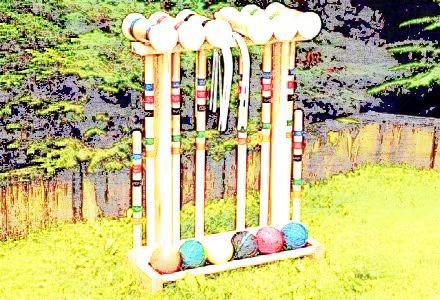
Four hoops, four mallets, four balls, two stakes. It is a toy, and it is a good toy.
What it is not is croquet. The hoops are 110 to 130 mm wide against a 92 mm ball, the mallets are 750 to 900 mm, and the balls are lighter than regulation. That is a deliberate design decision: a 95 mm gap is hard, and a hard game does not sell to a family with a seven-year-old.
Buying one and expecting the game you played on a hotel lawn is the most common disappointment in this category. The product is fine. The expectation was wrong.
The Two Dimensions That Identify Any Set
Ignore the box. Measure these two things.
| Measurement | Regulation | Garden set | What it tells you |
|---|---|---|---|
| Hoop gap | 95 mm on a 92 mm ball | 110 to 130 mm | The gap decides whether the game is croquet or putting |
| Ball diameter | 92 mm, 453 g | 80 to 100 mm, lighter | Smaller and lighter balls make long shots much easier |
| Shaft length | About 915 mm | 750 to 900 mm | Decides whether an adult can stand up straight |
| Hoop count | 6 (or 9 for nine-wicket) | 4 | Decides which code the set can actually play |
A set with a 95 mm gap, 92 mm balls and 915 mm shafts is a croquet set. A set with a 120 mm gap, 90 mm balls and 800 mm shafts is a garden game that uses the word croquet. Both are legitimate products. Only one of them is the sport.
Conclusion
Five versions, and the choice comes down to two questions: how much lawn do you have, and how long do you want a game to take.
A full court and an afternoon: association croquet. A full court and half an hour: golf croquet. A garden and a family: nine-wicket. A garden and small children: a garden set, and call it what it is.
FAQs
1. Which version should a beginner play?
Golf croquet. It uses proper equipment, the rules take five minutes, and a game finishes in half an hour.
2. Is a garden croquet set the same game?
No. The hoops are 30 mm wider, the mallets are shorter and the balls are lighter. It is a simplified game, not a smaller court.
3. How big is a croquet court?
32 by 25.6 metres for association, golf and six-wicket. About three times the area of a tennis court.
4. What is the difference between nine-wicket and six-wicket?
Nine-wicket uses nine wire wickets and has no standard court; six-wicket uses six hardwood wickets on a regulation court.
5. Why are regulation hoops so narrow?
95 mm on a 92 mm ball is 3 mm of clearance. That is the difficulty of the sport, and it is the first thing a garden set gives up.
Sourcing Wooden Garden Games in Bulk?
Kangjie is the direct manufacturer behind these games — no trading company, no middleman margin. We supply Kubb, Croquet, Molkky, Ring Toss, Tumble Tower, Cornhole and more to importers, retailers and brand owners worldwide.
- Factory-direct pricing with transparent volume tiers (500 / 1,000 / 5,000 units)
- OEM & ODM: logo, packaging, size and finish built to your specification
- EN71 & ASTM F963 compliant; FSC-certified timber
- Bulk lead time 30–45 days, quotation within 24 hours