
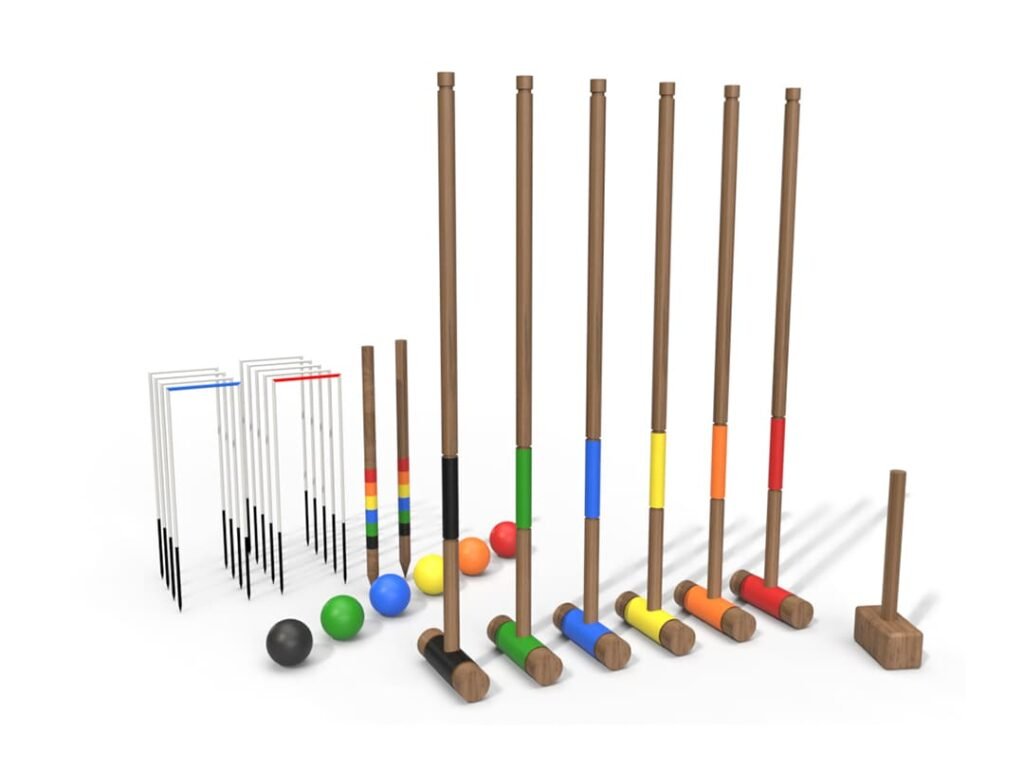
A standard six-player croquet set has 23 pieces: 6 mallets, 6 balls, 9 wickets and 2 end stakes. Add a carry bag, a rules card and scorecards and the count goes to about 26.
The number itself is simple. What matters for a buyer is which of those pieces are most likely to be missing or wrong on arrival, and which ones determine whether the set is playable at all.
The Piece Count
| Component | Standard quantity | Notes |
|---|---|---|
| Mallets | 6 | One per player. 4-mallet sets are sold for family play. |
| Balls | 6 | One per mallet, colour-matched. |
| Wickets (hoops) | 9 | The nine-wicket backyard layout. Association croquet uses 6. |
| End stakes | 2 | Start and finish posts. |
| Carry bag | 1 | Optional but effectively required at this size. |
| Rules card | 1 | Include it; the layout varies by region. |
| Scorecards | 1 set | Optional. |
Total: 23 playing pieces, or about 26 with accessories.
What Each Part Does
Mallets
The part that decides whether the set feels like a toy or a piece of equipment. Ash and beech are the sensible species: dense enough to transfer force, straight-grained enough to stay true.
The failure mode is not the head, it is the joint. A mallet head that loosens after a season is a gluing and pinning problem, and it is the single most common complaint on croquet sets. Specify a pinned and glued head, not a screwed one.
Balls
Six, colour-matched to the mallets. Composite balls roll true and last; cheap moulded balls develop flat spots and start wobbling within a season. Ball diameter should match the wicket gap — a set where the balls barely fit through the hoops is a set that will be returned.
Wickets
Nine in the standard backyard layout. Metal, and the coating matters: powder-coated wickets resist rust far better than painted ones, and rust is what turns a croquet set into scrap after a wet summer.
Check the gauge. Thin wire wickets bend when a ball hits them; the set then plays badly and the customer blames the balls.
End Stakes
Two, marking the start and finish. Trivial components and impossible to play without. Specify a pointed base so they can be driven into a lawn without a mallet.
Where Sets Go Wrong
- Wicket count. Nine is the backyard standard; six is association croquet. A set sold as “croquet” with six wickets is a different game, and a buyer who does not check will discover it from a customer.
- Ball and hoop mismatch. Balls too large for the wickets is the most common specification error, and it makes the set unplayable rather than merely awkward.
- Mallet heads loosening. A joint problem, not a design problem. Ask how the head is fixed.
- Rust. Painted wickets, not powder-coated, in a damp climate.
- Bag quality. A bag with a single thin strap and no internal dividers will fail within a season on a 23-piece set.
Why the Count Matters Commercially
- Incomplete sets are the top return reason in this category. A missing ball or a short wicket count turns a sale into a return and a review.
- It is the easiest thing to verify. Count the pieces against the packing list before the carton is sealed, and photograph the contents. That single step removes most of the risk.
- It defines the carton. 23 pieces need a bag with compartments and a carton sized for the mallets. Getting that wrong shows up as freight cost and damaged goods.
- It defines the price point. A 4-mallet set and a 6-mallet set are different products for different markets, and the difference is not just two mallets.
Configuration Options
- 4-mallet family set — lower price point, smaller bag, suits gift retail.
- 6-mallet standard set — the volume product for garden centres and online retail.
- 8-mallet set — for events and rental. Needs a heavier bag and a bigger carton.
- Association-style 6-wicket set — a different market and a different rules card.
Customisation That Is Worth Doing
- Colour matching. Mallets and balls in a brand palette. This is the highest-impact change and it costs almost nothing.
- Engraved logo on the mallet heads. Visible in use, and it does not interfere with play.
- Branded bag. The bag is what the customer keeps, so it carries the brand longer than the set does.
- Printed rules card. The cheapest place for a logo and the one that gets read.
What we would not recommend is specifying rosewood or another CITES-listed species for a “luxury” version. The trade restrictions and paperwork make it impractical at volume, and beech or ash finished well looks better than most buyers expect.

Sourcing Notes
- Species: ash or beech for mallets and stakes; composite for balls.
- Wickets: powder-coated steel, with the gauge specified.
- Finish: water-based lacquer; EN71 and ASTM F963 compliance for anything sold as a toy.
- FSC-certified timber available on request, with chain-of-custody documentation.
- Minimum 500 sets; samples 5–10 days; production 30–45 days after approval.

Conclusion
23 pieces in a standard set: 6 mallets, 6 balls, 9 wickets, 2 stakes. The count is easy; the details that decide quality are the mallet joint, the wicket coating and whether the balls fit through the hoops.
Tell us the mallet count, the market and the price point, and we will quote the configuration with the piece list and carton dimensions included.
FAQs
How many wickets are in a croquet set?
Nine in the standard backyard set, which is the layout most people play. Association croquet uses six, and the two are not interchangeable.
Can I order a 4-mallet set?
Yes. It is the common configuration for family and gift retail, with a smaller bag and a lower price point.
What wood are the mallets?
Ash or beech. Both are dense enough to transfer force and stable enough to stay straight. The head joint matters more than the species.
Are the wickets rustproof?
Powder-coated steel resists rust well. Painted wickets do not, and rust is the most common reason a croquet set is thrown away.
What is the minimum order?
500 sets. Four- and six-mallet configurations can be combined within one order.
Sourcing Wooden Garden Games in Bulk?
Kangjie is the direct manufacturer behind these games — no trading company, no middleman margin. We supply Kubb, Croquet, Molkky, Ring Toss, Tumble Tower, Cornhole and more to importers, retailers and brand owners worldwide.
- Factory-direct pricing with transparent volume tiers (500 / 1,000 / 5,000 units)
- OEM & ODM: logo, packaging, size and finish built to your specification
- EN71 & ASTM F963 compliant; FSC-certified timber
- Bulk lead time 30–45 days, quotation within 24 hours









