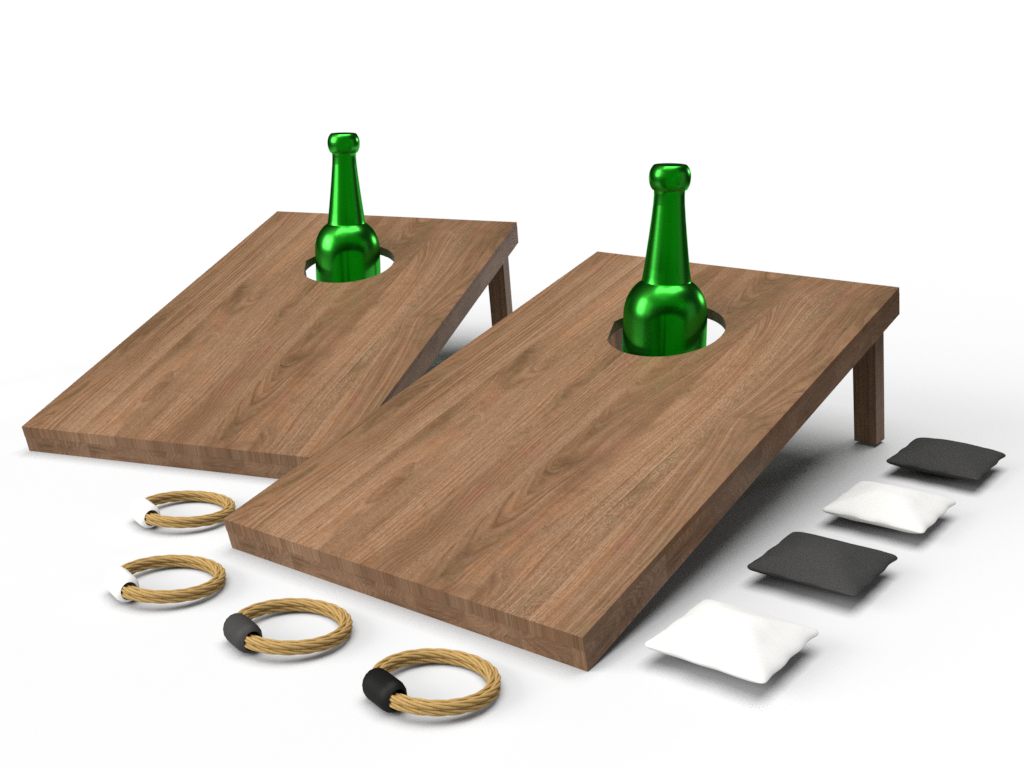
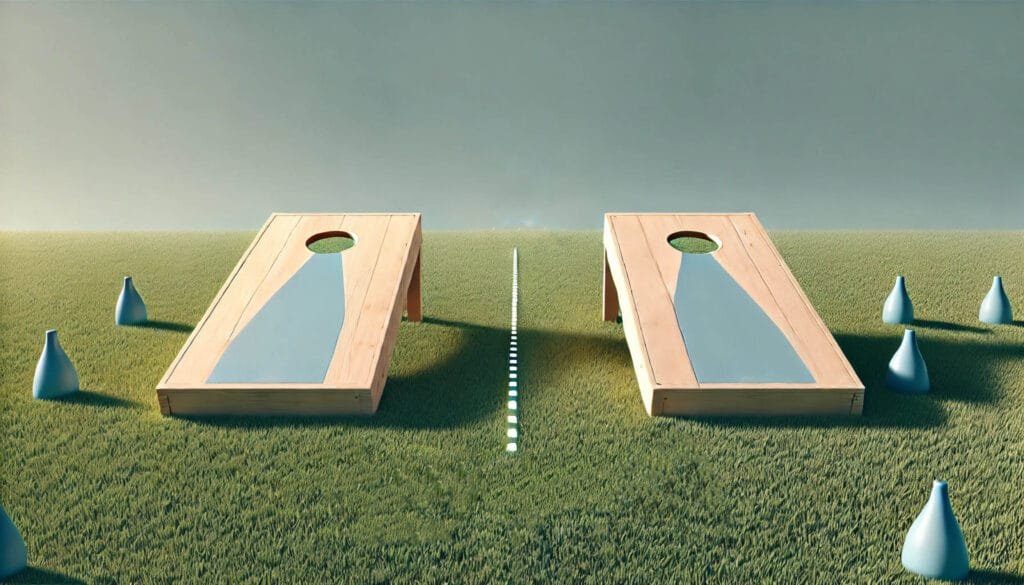
Twenty-seven feet, measured from the front edge of one board to the front edge of the other. That is the regulation distance, it is 8.23 metres, and it is the number every other cornhole question depends on.
Most backyard games are set up far too short, because 27 feet looks like a lot when you are standing at one end with a bag in your hand. It is supposed to. The distance is what turns a toss into a game.
The Short Answer: 27 Feet, Front Edge to Front Edge
The regulation specification, as used by the American Cornhole League and every serious tournament:
| Measurement | Regulation | Metric |
|---|---|---|
| Board to board, front edge to front edge | 27 ft | 8.23 m |
| Board length | 48 in | 1220 mm |
| Board width | 24 in | 610 mm |
| Board height at the back edge | 12 in | 305 mm |
| Board height at the front edge | 3 to 4 in | 76 to 102 mm |
| Hole diameter, centre 9 in from the back edge | 6 in | 152 mm |
| Pitching box, behind each board | 3 ft wide x 4 ft deep | 914 x 1220 mm |
| Bag size | 6 x 6 in | 152 x 152 mm |
| Bag weight | 15 to 16 oz | 425 to 454 g |
Why Front to Front and Not Board to Board
Because the front edge is the only reference that stays constant. The foul line in cornhole is the front edge of the board, so the distance that matters for a legal throw is the distance from the back of the pitching box to the front edge of the far board, and the distance between the two foul lines is fixed.
Measuring from back edge to back edge, or from the hole to the hole, introduces the board length into a number that should not depend on it. On a 48 inch board, hole-to-hole is 27 feet plus 39 inches, which is a completely different game.
The Distances People Actually Play At
Regulation is not always the right answer. What matters is matching the distance to the group, and being explicit about it rather than letting it drift.
| Distance | Metric | Who it suits | What changes |
|---|---|---|---|
| 27 ft | 8.23 m | Adults, competitive play | Full game: push shots, blocked holes, defensive bags |
| 24 ft | 7.32 m | Adults, casual | Noticeably easier; aces become common |
| 21 ft | 6.40 m | Mixed ages, family | Still rewards aim, but nobody is embarrassed |
| 15 ft | 4.57 m | Children under 10 | A game rather than a lesson in failure |
| 12 ft | 3.66 m | Indoors, small spaces | Almost no arc; the bag barely rises |
At 27 feet, a 450 g bag thrown at a comfortable release angle has to travel about 8.5 metres and rise 1.5 to 2 metres at the apex. That arc is what makes the game work: it gives the bag time to settle, it makes a flat throw useless, and it is why the push shot exists at all. Shorten the distance and the arc flattens, the bag arrives faster and flatter, and the game turns into target practice.
Measuring Without a Tape Measure
You can pace it, if you accept a margin of error.
An adult walking pace is roughly 0.75 m, so 8.23 m is about 11 paces. That is accurate enough to within half a metre, which is fine for a garden and not fine for a league.
Better methods, in order of precision:
- An 8 m tape plus 23 cm. Two people, one measurement, done in a minute.
- A pre-cut string. Cut a length of builder’s line to 8.23 m once, mark the ends with tape, and keep it in the bag. This is what tournament organisers do.
- Marked ground. If the boards live in the same garden, put a small stake or a buried tile at each front edge position. Setup becomes a 30 second job and the distance never drifts.
Ground Conditions That Break the Distance
A correct measurement on the wrong surface still produces a bad game.
- Slope. Boards set on a slope are at different heights and the bags behave differently at each end. Put the lower board downhill, not across the slope.
- Soft ground. A board that moves on impact is worse than a board at the wrong distance. The front edge lifts on every bag that hits it, which changes the effective angle of the board. Stake it, or use boards with rubber feet.
- Grass length. A bag landing in long grass stops dead. Mow the landing zone to the same height as the rest of the court, or the game has two different surfaces.
- Wind. A 450 g bag with a 15 cm profile catches wind. On an exposed lawn the game is genuinely different, which is a reason to play along a hedge rather than across an open field.
What the Distance Does to the Game
At the regulation distance, three things become possible that are not possible closer in.
The push shot. Landing a bag on the board and sliding it into an opponent’s bag to knock it off. It requires the bag to arrive with enough forward momentum but not enough to bounce, which is only achievable over 8 metres.
The block. Placing a bag in front of the hole to deny a direct line. At shorter distances a good player simply throws over it.
The airmail. Throwing directly into the hole without touching the board. At 27 feet it is a low-percentage shot; at 15 feet it is a routine one, which is why children’s games are full of them.
Specifying Boards for Retail
If you are buying rather than playing, these are the numbers that decide whether the product is a real cornhole set or a decoration.
- Board 1220 x 610 mm, 18 mm plywood top, solid timber frame.
- Back edge 305 mm above ground, front edge 76 to 102 mm, giving the regulation pitch.
- Hole 152 mm diameter, centred 229 mm from the back edge.
- Pair weight 9 to 12 kg. Below 8 kg the boards move on impact.
- Bags 425 to 454 g, double-stitched, with a filler that does not compact.
- Folding legs with a positive lock, because a leg that folds under a bag is the most common complaint in the category.
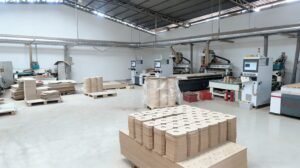
Minimum order 500 sets, samples 5 to 10 days, bulk production 30 to 45 days. Ocean freight adds about 30 days to the US west coast.
FAQs
How far apart are cornhole boards?
27 feet, or 8.23 metres, measured from the front edge of one board to the front edge of the other.
Is 27 feet the same as 8 metres?
Close but not exact. 27 feet is 8.23 m, so a 24 foot measurement is 3 percent short and a 25 foot measurement is 8 percent short. For a garden that does not matter; for a league it does.
How far apart for children?
15 feet, or 4.57 m. At regulation distance most children under ten cannot reach the board, and a game nobody can score in does not get played twice.
How high off the ground should the board be?
305 mm at the back edge and 76 to 102 mm at the front. The pitch is what makes a bag settle rather than bounce.
Do you make cornhole boards?
Yes, in plywood with a solid timber frame, to the dimensions above, with printed or engraved graphics and a choice of bag weights. Minimum order 500 sets.
Sourcing Wooden Garden Games in Bulk?
Kangjie is the direct manufacturer behind these games — no trading company, no middleman margin. We supply Kubb, Croquet, Molkky, Ring Toss, Tumble Tower, Cornhole and more to importers, retailers and brand owners worldwide.
- Factory-direct pricing with transparent volume tiers (500 / 1,000 / 5,000 units)
- OEM & ODM: logo, packaging, size and finish built to your specification
- EN71 & ASTM F963 compliant; FSC-certified timber
- Bulk lead time 30–45 days, quotation within 24 hours