
Giant yard dice are one of the simplest products in the garden game category and one of the easiest to get wrong, because a die that is not a true cube and does not have opposite faces summing to seven is not a die, it is a block with dots on it.
This guide covers what to buy, five games that work with oversized dice, the scoring for each, and the two quality checks that separate a real set from a decorative one.
What You Need to Start
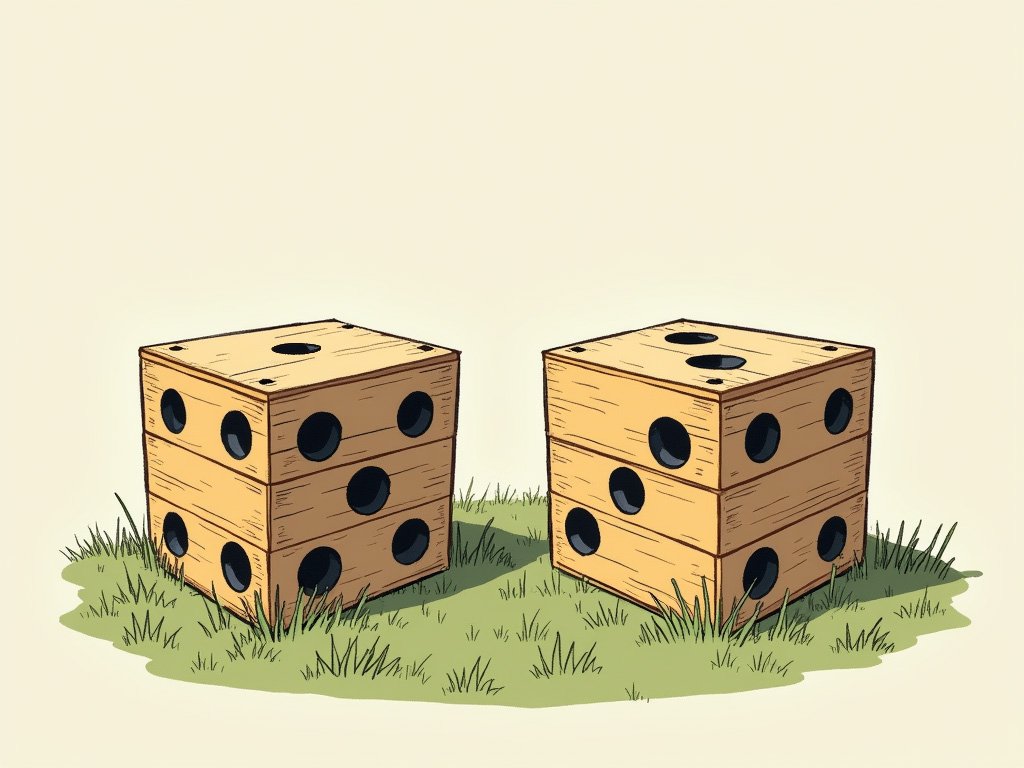
Five dice for most games, six for the running-total games. That is the only equipment decision that matters at the start, because a set of five cannot play the six-dice games and a set of six plays everything.
| Size | Solid pine weight | Solid beech weight | Best for |
|---|---|---|---|
| 65 mm (2.5 in) | 0.14 kg | 0.20 kg | Tabletop, children |
| 89 mm (3.5 in) | 0.35 kg | 0.51 kg | The standard garden size |
| 115 mm (4.5 in) | 0.76 kg | 1.10 kg | Large garden, adults |
| 152 mm (6 in) | 1.76 kg | 2.53 kg | Photo opportunity, not really playable |
The 152 mm size is worth a note. A solid die at that size weighs two and a half kilos in beech, which nobody can throw comfortably and which will damage whatever it lands on. Oversized sets at that scale are either hollow or made from a light softwood, and a hollow die sounds wrong when it lands, which players notice immediately.
The Two Quality Checks
Before anything else, do these two things with any set you are considering.
Check that opposite faces sum to seven. One opposite six, two opposite five, three opposite four. This is the definition of a die, and a set where it fails is not random in the way a die has to be. It is the single fastest test and it catches most cheap sets.
Check that it is a cube. Measure all three dimensions. A tolerance of plus or minus 0.5 mm is fine. Above 1 mm the die will favour a face, and the bias is large enough to be visible over a few dozen throws.
Two more, if you have time. Roll one die fifty times on a hard floor and count the results; a fair die will not produce a perfectly even distribution in fifty throws, but a badly biased one will be obvious. And drop it on a corner from waist height: a solid hardwood die dents, a hollow one splits at the joint.
Five Games That Work
1. The five-dice scoring game. The category classic. Roll up to five dice, keep what you want, reroll the rest, up to three rolls per turn. Score into a card with a box for each combination: three of a kind, four of a kind, full house, small straight, large straight, five of a kind, plus the totals of ones through sixes. Highest total after all thirteen boxes are filled wins. It works at any size because the rules live on the scorecard, not the dice.
2. Running total, six dice. Roll all six. Score only the dice that count, set them aside, and choose whether to roll the remainder or bank the turn total. Rolling and scoring nothing ends the turn and loses the total. First to 10,000 wins.
| Combination | Score |
|---|---|
| Single 1 | 100 |
| Single 5 | 50 |
| Three of a kind, 1s | 1,000 |
| Three of a kind, 2s to 6s | Face value x 100 |
| Four of a kind | 1,000 |
| Five of a kind | 2,000 |
| Six of a kind | 3,000 |
| Three pairs | 1,500 |
| Straight, 1 to 6 | 1,500 |
3. Chicago. Six dice, and the target is a 1, then a 2, then a 3, up to 6. Each turn you roll all six, keep any dice that match the current target, and reroll the rest. Score the total of the dice that matched. A player who completes all six rounds scores a bonus. It is the best game on this list for a mixed group, because the target does the work and nobody has to learn a scoring table.
4. Ship, captain, crew. Five dice, three rolls. You need a 6 (the ship), then a 5 (the captain), then a 4 (the crew), in that order, before the remaining two dice count as cargo. Simple, quick, and it produces a lot of near misses, which is what makes it fun.
5. Dice bowling. Six or ten empty bottles as pins, and the dice become the ball. Best for children, and the only game here that needs a flat surface and a bit of length.
How to Roll Them
Underhand, from waist height, with a gentle lob. Not overhand, and not a bowl along the ground.
The reason is that a large die landing flat does not bounce unpredictably, but a large die landing on an edge does, and it does so in a way that damages the edge. An underhand lob lets the die land on a face and settle. An overhand throw puts a corner down first and chips it.
Surface matters more than people expect. Short grass is fine up to about 5 cm. Longer grass stops a die dead and makes the roll non-random. A patio or deck is ideal, provided the die is solid rather than hollow, because a hollow die on a hard surface is loud and eventually splits.
Scoring Without a Scorecard
Two options that work. A printed scorecard is the traditional answer and it doubles as packaging artwork, which is worth considering if you are sourcing sets for retail. The practical alternative is a small chalkboard or a dry-wipe sheet, because the running-total games need a column per player and people lose paper.
Whatever you use, agree the scoring before the first roll. Most arguments in dice games are about whether a combination counted, not about the dice.
With Children
Oversized dice are genuinely good for children because the numbers are readable at arm’s length and the physical act of throwing is the game. Two adjustments make it work:
- Drop the running-total games. The risk decision in a running-total game is the interesting part for adults and the frustrating part for a seven-year-old. Chicago or the five-dice card works better.
- Use the 89 mm size. A 115 mm solid beech die at over a kilogram thrown by a child is a hazard to windows and to feet.
On age grading: a die below 31.7 mm is a small part under EN 71-1 and 16 CFR 1501. Nothing in this product range is close to that, so the small-parts question does not arise. What does arise is impact, and the assessment is about weight and edge treatment rather than choking.
Making Your Own
It is a reasonable project and the results are usually better than expected, provided you accept one constraint: you need a true cube, which means a saw and a way to check square, not just sandpaper.
- Six hardwood blocks at 89 mm, cut from square stock and checked on all three dimensions.
- Sand to 180 grit and chamfer every edge by about 2 mm. A sharp edge chips and the chip is permanent.
- Mark the pips with a template, not by eye, and check that opposite faces sum to seven before you paint.
- Paint the pips with a hard-wearing paint rather than a marker, then seal the whole die with a water-based clear coat.
The step people skip is the chamfer. It takes two minutes per die and it is the difference between a set that lasts five years and one that looks beaten up after a month.
Storage
Dry, and off the ground. Wooden dice absorb moisture and swell, and a die that has swelled unevenly is no longer a cube. A cotton bag inside a lidded box is enough. Do not store them in a plastic bag that traps condensation, and do not leave them out through a winter.
Buying Notes
- Specify the size in millimetres and the tolerance on all three dimensions.
- Specify the species and the moisture content at machining.
- Specify how the pips are applied: printed, engraved and filled, or branded. Engraved and filled survives; printed wears at the corners first.
- Specify the edge chamfer. It is a small line on a drawing that removes most quality complaints.
- Specify the bag and the carton. Six 89 mm dice are a heavy, dense parcel and the carton needs to be sized to them.
Minimum order 500 sets, samples 5 to 10 days, bulk production 30 to 45 days.
FAQs
How many dice do I need?
Six. Five plays most games and six plays all of them, including the running-total games that need the extra die.
What size are giant yard dice?
89 mm (3.5 in) is the standard garden size. 115 mm is available for adults and 152 mm is a display piece rather than a playable die.
How do I check the quality of a set?
Check that opposite faces sum to seven, and measure all three dimensions. A die that fails either test is not a die.
Can they stay outside?
No. Wooden dice absorb moisture and swell, and a die that has swelled unevenly no longer rolls fairly. Store them dry and bring them in for winter.
What is the minimum order?
500 sets, with volume pricing at 500, 1,000 and 5,000. Quotation within 24 hours of a clear brief.
Sourcing Wooden Garden Games in Bulk?
Kangjie is the direct manufacturer behind these games — no trading company, no middleman margin. We supply Kubb, Croquet, Molkky, Ring Toss, Tumble Tower, Cornhole and more to importers, retailers and brand owners worldwide.
- Factory-direct pricing with transparent volume tiers (500 / 1,000 / 5,000 units)
- OEM & ODM: logo, packaging, size and finish built to your specification
- EN71 & ASTM F963 compliant; FSC-certified timber
- Bulk lead time 30–45 days, quotation within 24 hours









