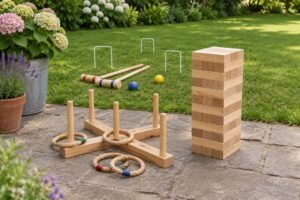
A garden party stalls for a predictable reason: once the food is out and the drinks are poured, guests have nothing to do with their hands. Conversation carries a group for about forty minutes. After that, people start checking their phones, and the event quietly deflates.
Games fix that, but not any games and not in any arrangement. The difference between a set of games that gets used all afternoon and a pile of equipment that stays in the box comes down to four practical things, which are set out below along with a lineup that covers a whole party and the layout that makes it work.
What Makes a Game Work at a Party
It has to be teachable in under a minute. If explaining the rules takes longer than the first round would, guests will drift away rather than learn. This is why tumble tower, ring toss and cornhole get played and why anything with a scoring sheet does not.
It has to have short turns. A game where four people watch one person think is a game that dies. Turns of ten to twenty seconds keep a group involved.
It has to work across ages. At most gatherings there will be a seven-year-old and a seventy-year-old. A game that can be adjusted for both covers the whole party; a game that only works for adults splits it.
It has to be visible from a distance. The best party game is the one a guest can see across the garden and walk towards. Size and colour do real work here, which is why oversized versions of familiar games outperform compact ones at events.
A Lineup That Covers a Whole Party
- Tumble tower. Two to eight players, small footprint, ten second rules. This is the anchor and the game that gets the most use.
- Cornhole. Two to four players, needs eight to ten metres. The most recognised game for a North American guest list, and the one people gravitate to first.
- Ring toss. Two to six players, tiny footprint, works for the youngest guests. Useful as the game for children while adults are eating.
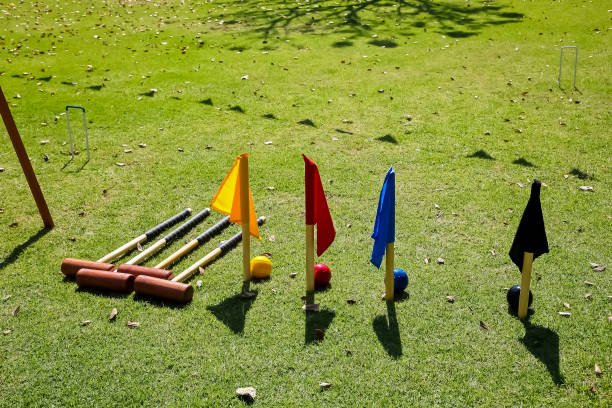
- Croquet. Two to six players, needs a long lawn. This is the game that occupies a group for an hour rather than ten minutes, and it looks good set up.
- Bocce. Two to eight players, needs a long narrow strip. Good for a mixed group because the strategy is obvious after one round.
- Skittles or a bowling set. Two to ten players, small footprint, and it works for a wide age range with the distance adjusted.
Four games is enough for a party of thirty. More than that and none of them gets played properly, because guests spread too thin to finish a round.

Layout: Stations and Flow
The single biggest improvement to a game setup costs nothing: put the games where people already are, not in a separate area.
Place games along the edge of the gathering, not in the middle. A game in the centre of the space forces guests to walk around it and makes non-players feel in the way. Along an edge, people can join and leave without disrupting anything.
Separate the loud games from the quiet ones. Tumble tower produces a crash and a cheer every few minutes. Croquet produces long silences. Putting them next to each other makes both worse.
Leave throwing room. Cornhole, bocce and skittles all need clear space in front of them. A board placed with a table two metres in front of it will not be used.
Put the children’s game near the food. Not for the children, but for the adults, who will be there anyway.
Rules That People Actually Follow
Printed rulebooks do not get read at parties. Two things work instead.
A single line on a small sign. “Top rung three, middle two, bottom one, first to twenty-one.” That is enough for almost every game in this category, and it removes the need for anyone to explain anything.
One person who knows the game. Not an official, just someone who can answer a question in ten seconds. At a corporate event that is usually the person who set the games up; at a private party it is whoever owns them.
Everything beyond that is optional. Score sheets, tournaments and prizes are all fine, but they are additions to a working setup rather than substitutes for one.
What Breaks at Events
Games used by a family are handled carefully. Games used by a party are not, and the failure points are consistent.
- Thin panels. A cornhole board that flexes under a leaning guest will eventually crack at the leg joint. Specify panel thickness, not finished weight.
- Glued joints. Screwed joints with pilot holes survive being knocked over. Glued dowels do not.
- Soft parts. Bags, bolas, rings and pins wear out long before the wood does. If you cannot reorder spares, every worn part becomes a lost set.
- Loose pieces. At an event, pieces get scattered. A set with a bag or a crate is a set that is still complete at the end of the day.
- Weather. Wood moves with humidity and no finish makes it suitable for permanent outdoor exposure. Have somewhere dry to put everything at the end, and plan for it before the event rather than during.
DIY or Buy
Both are legitimate, and the choice depends on what the games are for.
DIY makes sense for a one-off private party, for a themed game that does not exist commercially, and for anyone who enjoys the making. A painted plywood board and a set of bean bags will get a party through an afternoon.
Buying makes sense when the games will be used more than once, when they are part of a venue or a hire fleet, or when they will carry branding. The difference is not just finish quality; it is consistency, because a set of six identical games behaves predictably and a set of six homemade ones does not.
What does not work is buying cheap equipment for commercial use. A set that survives a family for five years may survive a venue for one season, and the failure usually happens in front of guests.
Sourcing Notes
- Minimum order. Around 500 sets per design for a custom run. Mixed containers are common, and the constraint is per design rather than per shipment.
- Sampling. Five to ten days after the specification is agreed. On a product judged by feel, a physical sample is not optional.
- Production. Thirty to forty-five days after sample approval.
- Compliance. EN 71 for Europe and ASTM F963 for the United States, with test reports from a recognised laboratory. FSC covers the timber supply chain, not product safety.
- Customization. Engraved or printed branding, custom colours, branded carry bags and custom cartons. All are cheap at the manufacturing stage and all are visible before purchase, which is what matters.
Frequently Asked Questions
How many games do I need for a party of thirty?
Four. Two anchors with short turns, one long game like croquet, and one small game for children. More than that spreads the group too thin for anyone to finish a round.
Which game gets played most?
Tumble tower, in almost every setting, because the rules take ten seconds and the tension is visible from across the garden.
Do I need to provide prizes?
No. A scoreboard or a running tally does more than a prize, because it keeps the group involved between rounds without turning a party into a competition.
What about indoor versions?
Tabletop versions of tumble tower and compact ring toss work indoors. Anything with hard projectiles, including steel washer toss, is a poor choice for a room with breakables.
Can the games carry our branding?
Yes. Engraving on tumble tower blocks, printing on cornhole board faces, branded bags and custom cartons are all standard. For a corporate event the engraving is usually the option that gets used, because it turns the game into a gift at the end of the day.
Sourcing Wooden Garden Games in Bulk?
Kangjie is the direct manufacturer behind these games — no trading company, no middleman margin. We supply Kubb, Croquet, Molkky, Ring Toss, Tumble Tower, Cornhole and more to importers, retailers and brand owners worldwide.
- Factory-direct pricing with transparent volume tiers (500 / 1,000 / 5,000 units)
- OEM & ODM: logo, packaging, size and finish built to your specification
- EN71 & ASTM F963 compliant; FSC-certified timber
- Bulk lead time 30–45 days, quotation within 24 hours