
A lawn gets used for about four months a year, and for most of that time it is looked at rather than used. The reason is rarely a lack of space. It is that the equipment for using it either lives in a shed and never comes out, or requires a level of commitment – a net, a pitch, a team – that a family afternoon cannot supply.
Lawn games work because they are the opposite of that: they set up in under a minute, need no athletic ability, and let a seven-year-old and a seventy-year-old play the same game with a real chance of winning.
Below is a selection organised by what each one is actually good for – mixed ages, moving around, thinking, or a large gathering – with the equipment details that decide whether it lasts more than one summer.
Why Lawn Games Work for Mixed Ages
Four properties, and all of them are about design rather than about the game being fun.
- A low skill floor. Anyone can throw a bag. The first throw is usually not embarrassing, which is what keeps a reluctant player in the game.
- Handicapping is built in. Move the throwing line back for the adults and forward for the children and the game becomes competitive without anyone being told they are being given an advantage.
- No fixed team size. Two players or eight, the same equipment works.
- Short rounds. A game that takes fifteen minutes gets played. One that takes an hour gets abandoned.
That combination is why these games survive generations while more elaborate garden equipment does not.
Classic Lawn Games
The formats that most people already know, which matters: a game that needs explaining loses half the group before the first round.
Cornhole
Toss bags at a slanted board with a hole. Three points for a bag in the hole, one for a bag on the board, played to 21 in teams of two. The scoring rule that makes it good is cancellation – a bag on the board cancels an opponent’s bag on the board – so a round stays live until the last throw.
Equipment matters more than people expect. Bags should be filled with synthetic pellets rather than corn or beans, because organic fill degrades and attracts pests. Boards should be plywood with sealed edges, since an unsealed edge wicks moisture and delaminates. A board that flexes underfoot is a board that will not last a season.
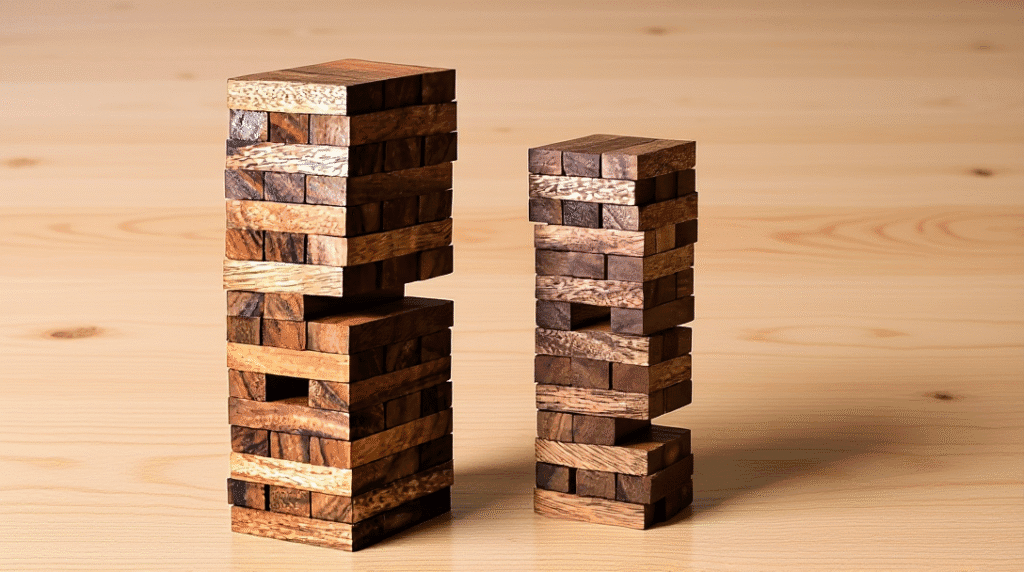
Giant Tumble Tower
Jenga at garden scale, with blocks large enough that the collapse is part of the entertainment. The whole product is the tolerance: blocks that vary in thickness stack badly, and a set that wobbles on a flat surface will not build a stable tower.
It needs a flat, firm surface – grass is too soft for the taller builds, so a patio or a board is better. Storage is the practical issue: a carry crate is not a luxury on a 50-block set, it is how the set survives the winter.
Ladder Toss
Bolos – two balls joined by a cord – thrown at a three-rung ladder. Points by rung, usually to exactly 21. The satisfying part is the wrap, and the failure mode is the bolo: a cord that frays or balls that split end the game permanently.
Look for a ladder with a wide base and a bolo with a cord that is spliced rather than knotted. It packs down small, which makes it the best of these games for a beach or a park.
Games That Get People Moving
For groups that will not stand still, and for the point in the afternoon when the sitting games have run out.
Backyard Bowling
Pins and a ball, on grass or a patio. The version that works best with children uses lightweight wooden pins and a ball heavy enough to roll straight but light enough not to hurt. A ball that bounces is a ball that misses.
Setting the pins up is half the activity for younger children, which is worth knowing before you decide the game is too simple.
Sack and Three-Legged Races
Almost no equipment and a guaranteed reaction. The practical requirements are a clear course with no trip hazards, and a surface that is neither slippery nor full of stones. Burlap sacks last longer than pillowcases and grip better.
Giant Tic-Tac-Toe
A grid on the ground – chalk, rope or a wooden frame – and nine large pieces. It is the best game on this list for the widest age range, because the rules need no explanation and the physical demand is minimal.
The wooden-disc version is the one that survives: painted discs blow away, and inflatable pieces puncture. A folding frame that stores the pieces inside itself is the version that actually gets used.
Strategic and Skill-Based Games
For groups who want something to think about, and for adults playing without children present.
Kubb
A Swedish game sometimes described as Viking chess. Throw batons to knock over the opponent’s kubbs, then the king. The strategy is real: knocked-over kubbs are thrown back into your half and become obstacles you have to clear before you can attack.
It needs a flat area roughly five by eight metres, which is more than most of the games here. A hardwood set makes a difference – the sound and the way the pieces sit after a hit are part of why people keep playing.
Bocce
Throw a small target ball, then take turns rolling larger balls to get closest. It is the gentlest game on this list and the best one for a group with mixed mobility, because the throw is underarm and short.
Ball quality is the whole experience. Composition balls roll predictably; cheap hollow ones do not, and the game becomes random rather than skillful.
Washer Toss
Washers thrown into boxes with scored holes. It is cornhole’s more portable relative, and the metal on wood sound is the appeal. Boxes need a deep enough pit that washers do not bounce out, which is the one design detail that separates a working set from a frustrating one.
Games for Big Gatherings
When the group is too large for a two-player game, the format has to change rather than the equipment.
Capture the Flag
Two teams, two flags, one objective. It uses the whole garden and needs nothing but two markers and a set of boundaries. Define the boundaries clearly before the first round – most disputes in this game are about where the line was, not about whether someone was tagged.
Water Balloon Toss
Partners toss a balloon and step back after each catch. It ends when the balloon does, which is the point. Thicker balloons survive one or two more rounds, and a refill station within reach keeps the game going.
DIY or Buy
Both are legitimate, and the choice depends on how many sets you need.
- DIY – a pallet cornhole board or a painted block tower is a good weekend project and gives a custom look. It is time-consuming, needs tools and a workspace, and the durability of the result depends entirely on how the timber was finished.
- Buying – consistent dimensions, a proper finish system, and no weekend lost. The upfront cost is higher and the failure rate is lower.
For a household, DIY is a reasonable hobby. For anyone supplying sets to other people, it is not: identical dimensions across a batch are what a customer notices, and they are hard to achieve by hand.
Why Wood Rather Than Plastic
- Weight. Wood stays put in wind and feels substantial in the hand. Plastic boards skate across a patio.
- Repairability. A scratched wooden board can be sanded and re-oiled. A cracked plastic one cannot.
- Finish options. Stain, oil, paint and engraving all work on timber, which is what makes branding possible.
- Weathering. Untreated timber greys rather than failing, which is a different outcome from plastic becoming brittle in UV.
The caveat is moisture. Outdoor timber should be dried to roughly 8–12% before assembly, and end grain should be sealed, or the board will cup within a season regardless of how thick it is.
Customisation for Retail
For anyone selling rather than playing, four changes move a product into a different price tier without changing how it plays.
- Stain and paint – matches a brand palette or a room, and is the cheapest visible differentiation.
- Laser engraving – a logo, a name, a date. Durable, no plate cost, and the main reason corporate buyers order. Detail below roughly 8 mm closes up, so artwork has to be simplified for the production size.
- Size variants – a tabletop version for small retail footprints, a full-size version for garden centres, from the same construction.
- Packaging – a printed box with a rules card turns a game into a gift. It is the largest single lever on retail price and the one most often left until too late.
Conclusion
The best lawn games are the ones that get set up, which means low skill floor, short rounds and no fixed team size. Cornhole, tumble tower, ladder toss and giant tic-tac-toe cover most gatherings; Kubb, bocce and washer toss suit groups who want something to think about.
Whatever the format, the equipment decides whether it lasts. Sealed edges, synthetic bag fill, consistent block thickness and a proper finish system are unglamorous details that separate a set used for a decade from one replaced after a season.
Supplying lawn games to retail?
We manufacture direct in Guangzhou: 500-set minimum, quotes within 24 hours, samples in 5–10 days, production in 30–45 days, EN71 and ASTM F963 compliance, FSC-certified timber: contact us
FAQs
1. What is the easiest lawn game for young children and grandparents to play together?
Giant tic-tac-toe or a simple bag toss. Both need no explanation, neither requires a hard throw, and both can be handicapped by moving the line rather than by changing the rules.
2. What works on a small patio rather than a full lawn?
Tabletop versions of cornhole, tumble tower and Kubb, plus washer toss boxes, which are compact and need only a short throwing distance. Bocce also works on a narrow strip because the throw is underarm and low.
3. Do backyard games need official rules?
No, but a printed rules card is worth including in a retail product. House rules are part of the appeal at home; a customer buying a gift wants to know how it is played without searching for it.
4. How should wooden lawn games be stored over winter?
Clean and dry them completely, then store somewhere dry and ventilated rather than in a damp shed or basement. A light coat of oil before storage helps, and a carry crate prevents the warping that comes from boards being stacked under weight.
5. Why choose custom-branded wooden games over standard ones?
Branding moves a product out of price comparison. A stock set competes with every identical set on the shelf; the same construction with a specified finish, an engraved mark and printed packaging competes on fit, which supports a higher price.
Sourcing Wooden Garden Games in Bulk?
Kangjie is the direct manufacturer behind these games — no trading company, no middleman margin. We supply Kubb, Croquet, Molkky, Ring Toss, Tumble Tower, Cornhole and more to importers, retailers and brand owners worldwide.
- Factory-direct pricing with transparent volume tiers (500 / 1,000 / 5,000 units)
- OEM & ODM: logo, packaging, size and finish built to your specification
- EN71 & ASTM F963 compliant; FSC-certified timber
- Bulk lead time 30–45 days, quotation within 24 hours









