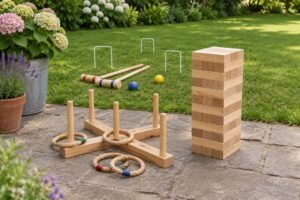
No, and the usual explanation for why is wrong. People say a croquet mallet is not built to take an impact, which misses the point: a croquet mallet head is struck on the end grain, and end grain is exactly the right orientation for impact. That is why wooden mallets exist in the first place.
The real reasons are mass, length and the joint. A croquet mallet is a long, light, two-handed pendulum tool. A hammer is a short, heavy, one-handed one. Those are different machines, and the mallet loses on all three counts.

A Mallet Is a Hammer, Just Not That Hammer
A carpenter’s mallet and a croquet mallet are close relatives. Both have a hardwood head with the striking faces on the end grain, both are swung rather than driven, and both are designed to deliver a blow without damaging what they hit.
The difference is the job. A carpenter’s mallet strikes a chisel or a joint: a wooden tool against a wooden workpiece, at short range, with a 500 to 700 gram head on a 300 mm handle. A croquet mallet strikes a ball at ground level, with the head 900 mm from the hands, in an arc.
Four Reasons It Fails
| Property | Croquet mallet | Hammer | What happens |
|---|---|---|---|
| Head mass | 350 to 500 g | 450 to 700 g | Not enough energy per swing for a nail |
| Handle length | Around 900 mm | Around 300 mm | You cannot aim the head; the arc is too long |
| Head fixing | Screwed, glued, or wedged on a slim shaft | Tapered eye with a steel wedge | The joint works loose, then the head leaves |
| Striking face | Finished, often painted, 55 to 60 mm across | Hardened steel, 25 to 30 mm across | Face dents and mushrooms, and cannot reach a recessed nail |
The joint is the one that matters for safety. A croquet mallet head is held on a shaft that is 25 to 30 mm across, and the fixing is designed for the load of hitting a ball at the end of a swing, which is a compression load along the shaft. Hammering adds a lateral component and a vibration the joint was never designed for. When it lets go, a 400 gram hardwood cylinder leaves at speed, and it does not travel in a straight line.
Two-piece and telescoping mallets fail first, because the ferrule or the locking collar takes the shock. If the mallet has an adjustable shaft, do not hit anything with it.
The Advice That Is Actively Dangerous
The common fallback is “use the side of the head instead of the striking face”. Do not. The striking faces are end grain, which resists impact by compressing. The side of the head is long grain, which resists nothing in that direction and splits along the fibre. A mallet struck on the side is a mallet with a split down its length, and the split is invisible until the head fails.
What to Use Instead
Two tools, two jobs, and the distinction is worth keeping straight:
- A steel hammer for nails, into wood or masonry. This is the only thing on the list designed to hit steel.
- A wooden mallet for chisels, joints, tent pegs and stakes. Wood on wood, or wood on a soft metal chisel handle.
What you should not do is use a wooden mallet on a steel nail head. It works once, and then the face is mushroomed and every subsequent strike glances off. A wooden mallet that has been used on nails is a wooden mallet that has been ruined, and the damage shows up as a chewed face and a ball that no longer runs true.
What This Says About Mallet Specification
If you are buying or making croquet mallets, four numbers separate a real mallet from a decorative one:
- Head mass of 350 to 500 g. Under 300 g and the ball does not travel; over 600 g and the game becomes a test of strength rather than aim.
- Head diameter of 55 to 60 mm, with a flat face. A domed or rounded face turns the ball offline on any off-centre hit.
- Shaft of 25 to 30 mm in ash or hickory, one piece. Two-piece shafts are a travel convenience and a durability compromise.
- A mechanical fixing, not glue alone. Screw plus glue, or a wedged eye. Glue alone fails at the first wet season.
The joint is also the first thing to check on a returned set. A mallet head that has started to turn on its shaft is a warranty claim, and it is almost always the same failure.
FAQs
Can a croquet mallet drive a nail in an emergency?
It can, badly, once. The head is too light and the handle too long to aim, and the impact works the head loose on the shaft. The damage to the mallet is permanent.
Why can a wooden mallet take impact but a croquet mallet cannot?
It is not the impact, it is the joint and the geometry. A carpenter’s mallet has a heavy head on a short handle with a wedged fixing. A croquet mallet has a lighter head on a long shaft with a glued or screwed joint.
Is the side of a croquet mallet head stronger?
No, it is weaker. The striking faces are end grain and take impact well; the side is long grain and splits along the fibre.
What is a croquet mallet head made of?
Traditionally ash, hickory or hornbeam, turned as one piece. Ash and hickory give the best shock resistance; hornbeam is denser and heavier but harder to source in clear lengths.
Can I use a rubber mallet on a croquet ball?
No. A rubber face absorbs the energy the shot depends on, and it marks the ball. Use the mallet the set came with, or a hardwood mallet of the correct mass.
Conclusion
A croquet mallet is a hammer in the sense that a chisel is a screwdriver: same family, wrong member. The head is end grain and would take the blow; the shaft length, the head mass and the glued joint would not. Use the side of the head and you split it along the grain, which is worse than denting the face.
Wooden mallets are for striking wood. Steel hammers are for striking steel. A croquet mallet is for striking a ball, and it is very good at that.
Sourcing Wooden Garden Games in Bulk?
Kangjie is the direct manufacturer behind these games — no trading company, no middleman margin. We supply Kubb, Croquet, Molkky, Ring Toss, Tumble Tower, Cornhole and more to importers, retailers and brand owners worldwide.
- Factory-direct pricing with transparent volume tiers (500 / 1,000 / 5,000 units)
- OEM & ODM: logo, packaging, size and finish built to your specification
- EN71 & ASTM F963 compliant; FSC-certified timber
- Bulk lead time 30–45 days, quotation within 24 hours