Yes, and the grid is not the compromise people expect it to be. English draughts, which is what most of North America calls checkers, is an eight by eight game. A chessboard is eight by eight. The squares line up exactly.
What is a compromise is the square size. A chessboard is built for pieces that stand up; a draughts board is built for pieces that slide and stack. Put standard draughts pieces on a tournament chessboard and they look lost, because the board is roughly a third larger than the game wants.

Why the Grid Is Not the Problem
Draughts is played on the dark squares of an eight by eight grid, twelve men per side, three rows deep. That is thirty-two dark squares, twelve of them occupied on each side, eight empty in the middle. A chessboard has exactly the same thirty-two dark squares in exactly the same arrangement.
The only thing the board cannot tell you is which colour is “yours”, and that does not matter, because both players use the same dark squares and simply start at opposite ends.
Setup in Four Lines
- Turn the board so each player has a dark square in the near left corner. This is the standard orientation for both games, and it is the one thing worth getting right.
- Place twelve pieces on the dark squares of the three rows nearest you.
- Leave the two middle rows empty. That is the playing space.
- The player with the darker pieces moves first. Men move one square diagonally forward; captures are compulsory in English draughts; a man reaching the far row is crowned and becomes a king.
The crowning rule is where substitute pieces fall apart, and it is the reason a chess set is a poor stand-in rather than a clever one.
The Real Mismatch: Square Size and Piece Diameter
This is the number that decides whether a set feels right, and almost nobody publishes it. A draughts piece should occupy roughly three quarters of the square it sits on: enough clearance to slide, not so much that the board looks empty.
| Board | Square | Piece diameter | Ratio | How it feels |
|---|---|---|---|---|
| Tournament chessboard | 57 mm | 32 mm | 0.56 | Pieces look small, long slides |
| Standard draughts board | 44 mm | 32 mm | 0.73 | Correct |
| Travel draughts board | 32 mm | 22 mm | 0.69 | Cramped but playable |
| Chessboard, oversized pieces | 57 mm | 44 mm | 0.77 | Correct feel, wrong look |
So a chessboard works, and it works best with pieces larger than a standard draughts set. If you are buying a board to play both games, that is the number to design around rather than the grid.
If You Are Using Chess Pieces
Pawns are the obvious substitute and the worst one. Three problems, in order of how quickly they show up:
- They do not stack. Crowning a man means putting a second piece on top of it. A pawn balanced on a pawn falls over the first time the board is nudged, and then the position is lost.
- They are unstable. A pawn is roughly twice as tall as its base is wide, which is a bad ratio for a piece that gets slid across a board.
- They are not distinguishable once mixed. Two colours of pawn are fine until someone reaches for a rook because it was closer.
Coins, bottle caps, wooden discs and poker chips all work better than chess pieces, because all of them stack. The only real requirement is that each side has twelve identical, stackable, flat objects.
The Variants That Do Not Fit
Three draughts variants use different boards, and this is where the chessboard answer changes from yes to no:
| Variant | Board | Pieces | Fits a chessboard |
|---|---|---|---|
| English draughts / checkers | 8 x 8 | 12 each | Yes, exactly |
| International draughts | 10 x 10 | 20 each | No |
| Canadian draughts | 12 x 12 | 30 each | No |
| Turkish draughts | 8 x 8 | 16 each | Grid yes, rules no |
Turkish draughts is the interesting one: the board fits and the game does not. Men move orthogonally rather than diagonally, there are sixteen per side, and the back row starts occupied. It is a good reminder that matching the grid is necessary and not sufficient.
If You Are Specifying a Board
Dual-purpose boards sell, and they are cheap to make, because the second game is a print, not a part. Three decisions decide whether the result is good:
- Square size. Chess wants 50 to 58 mm, draughts wants 40 to 45 mm. Split the difference at 48 to 50 mm and both games are playable; optimise for one and the other feels wrong.
- Piece diameter for the draughts set. 0.75 of the square, with a flat face and a recessed centre so stacked pieces seat instead of sliding.
- Which face is which. Print chess on one side and draughts on the other, and put the same orientation mark on both, or every game starts with an argument about which corner is dark.
FAQs
Do you use all the squares in checkers?
Only the dark ones. Thirty-two squares are in play, twelve occupied per side at the start, and the eight in the middle rows are empty.
Can I use chess pawns as checkers?
You can, but they do not stack, which breaks the crowning rule, and they are unstable when slid. Coins or wooden discs are a better substitute.
Is a chessboard the same size as a checkers board?
The grid is identical at eight by eight. The board is larger, because chess squares are around 57 mm against 44 mm for draughts, which makes standard draughts pieces look undersized.
Can you play draughts on a Go board?
No. A Go board is a nineteen by nineteen grid of intersections, not squares, and it has no dark-square pattern to play on.
What is the difference between checkers and draughts?
The same game under two names, with a regional rule difference: English draughts, played in the US and UK, uses eight by eight and twelve pieces. International draughts uses ten by ten, twenty pieces, and flying kings.
Conclusion
Checkers on a chessboard is not a hack, it is the same game on a larger board. The grid is right, the dark squares are right, and the only thing that changes is the ratio of piece to square. Use something flat that stacks, keep twelve a side, and the game plays exactly as it should.
The variants are where it stops working: ten by ten and twelve by twelve draughts need their own boards, and no amount of imagination fixes a missing two rows.
Sourcing Wooden Garden Games in Bulk?
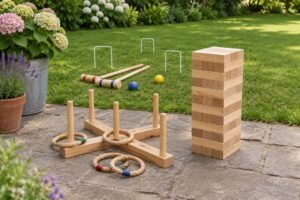
Kangjie is the direct manufacturer behind these games — no trading company, no middleman margin. We supply Kubb, Croquet, Molkky, Ring Toss, Tumble Tower, Cornhole and more to importers, retailers and brand owners worldwide.
- Factory-direct pricing with transparent volume tiers (500 / 1,000 / 5,000 units)
- OEM & ODM: logo, packaging, size and finish built to your specification
- EN71 & ASTM F963 compliant; FSC-certified timber
- Bulk lead time 30–45 days, quotation within 24 hours