
The reason to look past a single dice game is not that it is a bad product. It is that one product cannot cover a shelf, and the category around it is much larger than most buyers assume – provided the distinction between games that can be manufactured and games that cannot is understood before an order is placed.
Traditional games with no rights holder can be made, branded and sold freely. Modern published games cannot be reproduced at all, however good the commercial argument looks.
Below: the formats that are genuinely open, what the modern designs teach a buyer without being copyable, and where wood actually has an advantage.

Why One Game Is Not a Range
A retailer’s game shelf needs three things a single product cannot supply: a price ladder, a reason for a customer to return, and coverage of more than one occasion.
A dice game covers one occasion and one price point. A range that includes a cheap entry item, a mid-price gift and a premium boxed set covers a birthday, a Christmas present and a self-purchase, which is three separate buying decisions from the same customer base.
That structure is what a wooden range can offer, and it is the argument for building one rather than adding a second dice game.
Public-Domain Games You Can Manufacture
These are traditional formats with no active rights holder. They are the practical core of a wooden game range, and each occupies a different price tier.
Chess

The premium end of the range and the most giftable product in it. A wooden chess set sells into gift retail, homeware and corporate channels that a dice game never reaches.
The board is the product. Square size against piece base diameter is the specification that decides whether the set feels correct, and it is the first thing an experienced buyer checks. Inlay quality, hinge quality and the weight of the pieces set the price tier.
The commercial advantage is the reversible board: chess on one side, checkers on the other. One product, two games, and a stronger reason to buy.
Checkers
The entry price point, and the easiest product in the range to manufacture well. Simple rules, universal recognition, and a compact board that ships cheaply.
A folding board with pieces stored inside is a complete product at a low unit cost, which makes it the item that gets a customer into the range. It also works as the second game on a reversible chess board, which is how most wooden board sets are actually sold.
Backgammon
A game with a long history and a committed adult following, and the most premium product on this list. The board carries the value: inlay, the feel of the checkers, the hinge, and the closure.
It is also the most channel-specific. Backgammon sells to gift retail and homeware rather than to toy buyers, which makes it useful for a buyer whose existing range is aimed at children and who wants a second channel.
Dominoes
Matching ends, scoring points, graspable in one sentence. Double-six is the standard set; double-nine supports more players and a larger box.
This is one of the few products where the tactile quality is the entire selling proposition – the weight, the sound, the flatness of the face. Pips should be burned or engraved rather than painted, because painted pips wear at the edges first.
Mancala
A family of counting games with ancient origins across Africa and Asia, played with seeds or stones in rows of pits. The rules vary by region, which is commercially useful: it can be positioned as a cultural object as well as a game, and museum and educational channels buy it on that basis.
Manufacturing is simple – a carved or drilled board plus playing pieces – which makes it the lowest-cost item in a wooden range and a natural add-on at the till.
Shut the Box

Numbered flaps in a tray, two dice, and a rule about closing tiles that sum to the roll. A pub game with an adult audience, which means it escapes toy classification and the testing burden attached to it.
The hinged lid that doubles as storage separates a gift item from a pub supply item. A felt-lined base is worth the small cost because it quietens the dice, and the sound is a large part of why the game is satisfying.
Tic-Tac-Toe
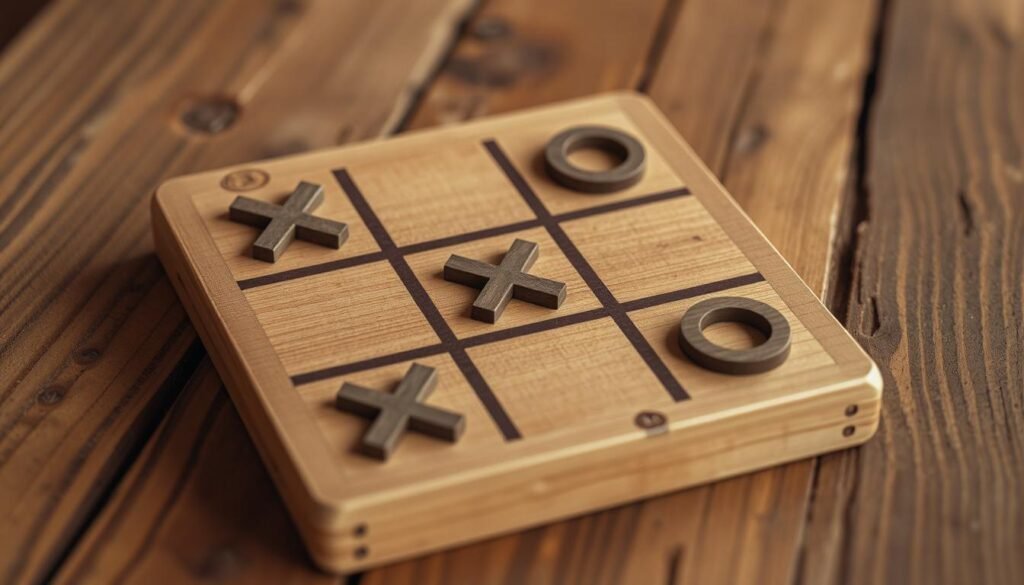
The cheapest product in the range and the one with the widest age reach. Rules need no explanation and a round takes under a minute.
Its value is entirely in the object rather than the game. A folding hardwood board with pieces that store inside sells as a desk accessory; the same grid on a pine offcut sells as a toy. It is also the strongest corporate gifting item in the range, because the branding area is large and the unit cost is low.
Modern Designs: What to Learn, What Not to Copy
This is the part that sourcing advice usually omits, and it is where a container can be lost.
A published modern game is a protected work. The rules text is a literary work, the artwork is copyright, the name is a trademark, and the components may carry design registration. Catan, Ticket to Ride, Codenames, Dixit, Pandemic and Forbidden Island all sit inside that protection, as do Hive, Qwirkle and Santorini.
A wooden version of any of them is not a product variation. It is a copy, and the exposure falls on the importer as well as the manufacturer – the importer is holding the goods when the complaint arrives.
What those games are genuinely useful for is reading the market. Each one demonstrates a mechanic that customers respond to:
- Resource trading and board development – the appeal is that every turn has a choice with a visible consequence.
- Route building and blocking – the appeal is direct interaction without conflict.
- Word association under a time limit – the appeal is that it works with a large, mixed group.
- Narrative interpretation – the appeal is that it produces laughter from the content the players create, not from the design.
- Cooperative survival – the appeal is that the group wins or loses together, which is why it sells to corporate and team-building buyers.
Those mechanics are categories rather than properties, and building an original game around one is legitimate. What cannot be copied is the specific expression: the rulebook, the iconography, the board layout, the component shapes and the name.
The practical test before commissioning anything is whether the product would be recognisable to someone who owns the original. If it would, it is a copy.
Where Wood Actually Fits
Wood is the right material for boards, blocks, tiles, pieces and any component where mass and rigidity matter. It is the wrong material for anything requiring elastic response, consistent low weight, or a single moulded form.
Three genuine advantages, and two costs worth stating.
Advantages. Weight, which keeps pieces in place and makes the object feel substantial. Repairability, because a scratched board can be sanded and re-oiled where a cracked plastic one cannot. Finish flexibility, because stain, oil, paint and engraving all work on timber, which is what makes private label possible at a small scale.
Costs. Maintenance, since an untreated board greys and needs oiling periodically. And moisture, since timber that goes into production wet will move after assembly and the board will cup weeks after delivery. Outdoor pieces should be dried to roughly 8–12%; indoor pieces to 6–8%.
Choosing a Supplier
- A realistic minimum. 500 sets is roughly where setup cost is covered while the unit price still competes with a stock item.
- A production-line sample. 5–10 days, built on the line rather than by hand, with the charge credited against the order.
- Certification on request. EN71 for the EU, ASTM F963 and CPSIA for the US, FSC chain-of-custody where certified timber is specified.
- An NDA before drawings. Signed before design files are exchanged, not after a sample has been quoted.
- A second source. Qualifying one costs a sample and a fortnight, and it is the cheapest insurance in a seasonal category.
Conclusion
A game range needs a price ladder, and the public-domain classics supply it: checkers at the entry point, tic-tac-toe and dominoes in the middle, backgammon and chess at the premium end, with mancala and shut the box filling the gift and adult channels.
Modern published games are useful as market research and unavailable as products. Their mechanics can inform an original design; their rules, artwork, components and names cannot be reproduced.
Building a wooden game range?
We manufacture direct in Guangzhou: 500-set minimum, quotes within 24 hours, samples in 5–10 days, production in 30–45 days, EN71 and ASTM F963 compliance, FSC-certified timber: contact us
FAQs
1. Which board games can I manufacture without a licence?
Traditional games with no active rights holder: chess, checkers, backgammon, dominoes, mancala, shut the box, tic-tac-toe, Nine Men’s Morris and peg solitaire. These can be made and branded freely.
2. Can I make a wooden version of a modern published game?
No. The rules text, artwork, component shapes and name are protected, and the importer carries exposure as well as the manufacturer. An original design built around the same mechanic is a different thing and is legitimate.
3. What is the minimum order?
500 sets for a variant or a new tabletop design. Below a few hundred sets the setup cost per unit rises to where the price stops competing with a stock item.
4. How fast can samples be produced?
5–10 days to produce plus 3–7 days in transit, built on the production line, with the charge credited against the production order.
5. Which certifications are needed?
EN71 for the EU, including EN71-3 for coating migration, with CE marking on the declaration of conformity. ASTM F963 and CPSIA for the US. Which applies depends on the market and the age grading of the product.
Sourcing Wooden Garden Games in Bulk?
Kangjie is the direct manufacturer behind these games — no trading company, no middleman margin. We supply Kubb, Croquet, Molkky, Ring Toss, Tumble Tower, Cornhole and more to importers, retailers and brand owners worldwide.
- Factory-direct pricing with transparent volume tiers (500 / 1,000 / 5,000 units)
- OEM & ODM: logo, packaging, size and finish built to your specification
- EN71 & ASTM F963 compliant; FSC-certified timber
- Bulk lead time 30–45 days, quotation within 24 hours









