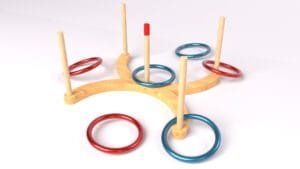
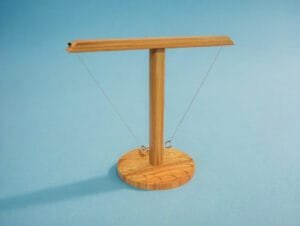
A hook and ring game is a plank, a hook, a ring and a string. It costs very little to make and the geometry is the only hard part, which is why so many home-made versions end up unplayable.
This is the build, with the numbers that actually decide whether the ring lands on the hook or swings past it forever.
The Geometry Is the Game
The ring hangs from an anchor at the top of the board and swings in an arc. The hook sticks out below it. For the game to be playable, the ring’s arc has to pass over the tip of the hook at a point where the ring can drop onto it.
Get this wrong in either direction and the game is dead: too far and the ring never reaches the hook, too close and the ring hits the board instead of the hook.
The Three Numbers
| Dimension | Working value | What happens if it is wrong |
|---|---|---|
| Anchor to hook, vertical | Hook 100 to 150 mm below the anchor | Less and the arc is too flat; more and the ring swings past below the hook |
| Anchor to hook, horizontal | Anchor set back 100 to 150 mm from the hook tip | The ring approaches on the upswing rather than the bottom of the arc |
| String length | 400 to 500 mm | Short strings swing fast and wild; long strings lose energy before the ring arrives |
| Ring inner diameter | 50 to 65 mm | Must be comfortably larger than the shank and smaller than the return of the hook |
| Hook height from ground | 1,500 to 1,700 mm | Below chest height players hunch; above eye level they cannot judge the arc |
The 100 to 150 mm offset is the number that matters. It is why the ring arrives at the hook on the upswing, which is the only part of the arc slow enough to catch. A ring that arrives at the bottom of its arc is moving fastest and will bounce off.
Materials
Wood
Three sensible choices and one common mistake.
- Cedar or redwood. Naturally rot-resistant, stable, light enough to hang on a post. The default for outdoor use.
- Thermowood or accoya. Heat-treated or acetylated timber, both genuinely rot-resistant without chemical treatment. More expensive and better in wet climates.
- Pressure-treated pine. Cheap and effective, but it needs a finish and it moves more than cedar as it dries.
- Oak is the mistake. It is not rot-resistant enough for permanent outdoor use, it moves a great deal across the seasons, and its tannic acid reacts with steel fasteners to stain the wood black and corrode the fixing. It is a good furniture wood and a poor choice here.
Hook and Fastener
This is where home builds fail. A screw-in cup hook has almost no pull-out resistance in a plank, and the load on this game is a repeated outward pull at the top of every swing.
Use an eye bolt or a hook bolt with a machine thread, through the board, with a washer and nut on the back. If the board is mounted on a post, bolt through both. A screw-in hook will work loose within a season and then pull out.
Stainless or hot-dip galvanised. A plain zinc-plated hook on a wet cedar board rusts within a year.
Ring
Brass or galvanised steel, 50 to 65 mm inner diameter, and heavy enough to swing predictably. A light aluminium ring is at the mercy of every gust and feels wrong in the hand. A plastic ring is worse: it cracks in cold weather and it does not make the sound the game is built around.
String
Braided polyester cord, 3 to 4 mm. Natural fibre rots, and nylon stretches. The string takes the entire load of every swing and it is the first thing to fail, so make it replaceable: a small eye screw at the anchor and a knot at the ring.
Build Steps
- Cut the board. 600 to 900 mm long, 120 to 150 mm wide, 20 mm thick. A wider board is more stable on a post; a narrower one swings less in wind.
- Sand every edge. The ring hits the board constantly, and a sharp arris becomes a dented ring and a splintered edge within a month.
- Drill for the eye bolt at the hook position, through the board, and fit with a washer and nut on the back.
- Fit the anchor eye at the top, offset back by 100 to 150 mm as measured against the hook tip.
- Finish before assembly. Two coats of a penetrating oil on all faces and the end grain. Oil rather than a film finish, because a film will crack where the ring hits it.
- Tie the ring. 400 to 500 mm of cord, and make the length adjustable with a cord lock so the game can be tuned.
- Mount. Bolt the board to a post or a wall, hook at 1,500 to 1,700 mm.
Realistic time for one unit, including drying between coats: an afternoon plus overnight. The build is about an hour of work and the finish is the rest of it.

Mounting and Setting Up
- Firm ground. Players stand and swing; soft grass makes the stance unstable and the throw inconsistent.
- Face away from windows and paths. A missed swing sends the ring outward at speed, and a brass ring at head height is a real hazard.
- One board per player, or one shared. A single board is a turn-taking game. Two boards side by side makes it simultaneous and much better at a party.
- Height for children. The hook at 1,500 mm is right for an adult. A second mounting point at 1,100 mm costs one bolt hole and makes the game playable by a seven-year-old.
Scoring That Works
Simplest version: first to 21, one point per catch. Better version, because it creates pressure:
- One point for a catch.
- Three consecutive catches score five instead of three.
- A miss resets the streak to zero.
The streak rule is what turns it from a game of luck into a game of nerve, because the third throw in a row is the one people miss.
DIY or Buy
Be honest about the economics. For one unit, the material cost of a good build is close to the retail price of a decent set, and the time is an afternoon. DIY is worth doing because you want a specific size, a specific wood, or a specific finish, not because it saves money.
Where DIY genuinely wins is the second and third unit: once the jig is set up, the marginal cost collapses, which is exactly why this game is made in batches rather than one at a time.
Conclusion
The build is trivial and the geometry is not. Anchor 100 to 150 mm above and behind the hook, string 400 to 500 mm, ring 50 to 65 mm, and a hook that goes through the board rather than into it.
Get those four right and the game works. Get any one of them wrong and it is a plank with a hook on it.
FAQs
1. What is the best wood for a hook and ring game?
Cedar, redwood, thermowood or accoya. Oak is a poor choice: it moves, it is not rot-resistant enough outdoors, and its tannins stain and corrode steel fixings.
2. How high should the hook be?
1,500 to 1,700 mm for adults, measured to the hook. Add a second mounting point at about 1,100 mm for children.
3. Why does my ring keep missing?
Almost always the anchor position. If the anchor is directly above the hook the ring arrives at the bottom of its arc, which is its fastest point. Move the anchor 100 to 150 mm back.
4. Can I use a screw-in hook?
Not for long. The load is a repeated outward pull. Use an eye bolt through the board with a washer and nut.
5. How long does it take to build one?
About an hour of work, plus drying time between finish coats. An afternoon in total.
Sourcing Wooden Garden Games in Bulk?
Kangjie is the direct manufacturer behind these games — no trading company, no middleman margin. We supply Kubb, Croquet, Molkky, Ring Toss, Tumble Tower, Cornhole and more to importers, retailers and brand owners worldwide.
- Factory-direct pricing with transparent volume tiers (500 / 1,000 / 5,000 units)
- OEM & ODM: logo, packaging, size and finish built to your specification
- EN71 & ASTM F963 compliant; FSC-certified timber
- Bulk lead time 30–45 days, quotation within 24 hours