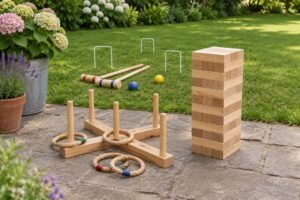
Ask a group of adults what they played outside as children and the answers cluster around a handful of games: a stacking tower, a throwing game, something with a ball and a target. Almost none of them involve a screen, and almost all of them are still being manufactured today.
That is not nostalgia for its own sake. It is a merchandising signal, and it explains why the outdoor games category keeps returning to the same designs while everything around it changes.
Why These Games Survived
- They need no explanation. A stacking tower, a throwing game, a target. The rules fit on a card because there are only three of them.
- They work with any number of people. Two players or twelve. That flexibility is why they come out at every gathering rather than once.
- They are physical. The appeal is partly the object: weight, sound, texture. A wooden block that clacks is a different experience from a screen.
- They scale. The same game works at table size and at event size, which means one design serves several markets.
We would not put a number on how many adults prefer simple games, or claim a percentage lift in retention from nostalgia. Those figures circulate widely and none of them can be traced to a methodology. The observation is enough on its own: these games keep selling because they keep being played.
The Games People Name
- Tumble tower — the stacking game. The one people describe with their hands before they remember the name.
- Cornhole — two boards and eight bags. Now the default garden game at events in North America.
- Ring toss — pegs and rings, the fairground version at scale.
- Four in a row — the vertical grid, remembered from childhood and now sold at life size.
- Kubb and Mölkky — less familiar in the English-speaking market, which is exactly why they stand out on a shelf.
- Skittles and croquet — the two that grandparents name first.

Why Nostalgia Is a Real Commercial Lever
The mechanism is straightforward and does not need research to explain.
- It removes the learning cost. A buyer already knows what the game is, so there is no explanation needed at the point of sale and no risk that it will not get played.
- It gives a gift a reason. “We had one of these” is a better purchase justification than a feature list.
- It sells to two generations at once. The adult is buying their own memory and handing it to a child, which is the strongest position a family product can be in.
- It photographs well. Familiar objects read instantly in an image, which matters more than it used to.
What nostalgia does not do is compensate for a bad product. A wooden game that splinters or warps is a disappointment twice over, because it fails the memory as well as the expectation.
Turning It Into a Range
- Lead with one familiar product. Cornhole or tumble tower, because those are the names customers search for.
- Add one unfamiliar product. Kubb or Mölkky gives the range a reason to be looked at rather than passed over.
- Keep species and finish consistent. A range that looks like a range sells as a set; ten unrelated products do not.
- Offer one giant version. It is the display piece, and it is what gets photographed at events.
Branding Without Spoiling the Memory
Customisation on a nostalgia product has one rule: put the brand where it does not interfere with the object people remember.
- On the bag or the box — always safe, and seen every time the game is stored.
- On a base or a frame — good, because it is flat and not handled.
- On the playing pieces — risky. A logo burned into every block of a tower changes the thing the customer remembers.
- On the rules card — the cheapest placement and the one that gets read.
Naming
Several of these games are known by brand names that belong to someone else. The tower game and the four-in-a-row game are both registered trademarks, and neither should appear on your product, your packaging or your listing. Sell them as a tumble tower and as four in a row.
The traditional games — Kubb, Mölkky, croquet, skittles — are a different situation. The games are public domain; some of the names are not. Check before printing.
Conclusion
The games people remember from childhood are still being made because they still work: simple, physical, and playable by any number of people. That is a merchandising advantage, not a marketing trick.
Tell us which of them fits your market and the price point, and we will quote a starting range at 500 sets per product.
FAQs
Which outdoor game sells best?
Cornhole, because it is the one customers search for by name and it suits every occasion. Tumble tower is the strongest second product.
Is nostalgia a real sales driver?
Yes, for a specific reason: it removes the learning cost. The buyer already knows what the game is, so there is no risk that it will go unplayed.
Can these games be branded?
Yes, but place the branding on the bag, the box, the frame or the rules card rather than on the playing pieces.
What is the minimum order?
500 sets per product. A mixed range can be ordered together as long as each product reaches a workable run.
How long does production take?
Samples in 5–10 days after the specification is agreed, and production in 30–45 days after sample approval.
Sourcing Wooden Garden Games in Bulk?
Kangjie is the direct manufacturer behind these games — no trading company, no middleman margin. We supply Kubb, Croquet, Molkky, Ring Toss, Tumble Tower, Cornhole and more to importers, retailers and brand owners worldwide.
- Factory-direct pricing with transparent volume tiers (500 / 1,000 / 5,000 units)
- OEM & ODM: logo, packaging, size and finish built to your specification
- EN71 & ASTM F963 compliant; FSC-certified timber
- Bulk lead time 30–45 days, quotation within 24 hours