
Kubb is a throwing game from Gotland, a Swedish island in the Baltic, where it appears in the early twentieth century. It is not a Viking game and it is not ancient, despite what a lot of packaging says. It is a modern game with a clear rule set, and the part that confuses newcomers is not the rules but the order of work inside a turn.
This is the game from setup to a finished point, with the three things most descriptions get wrong.
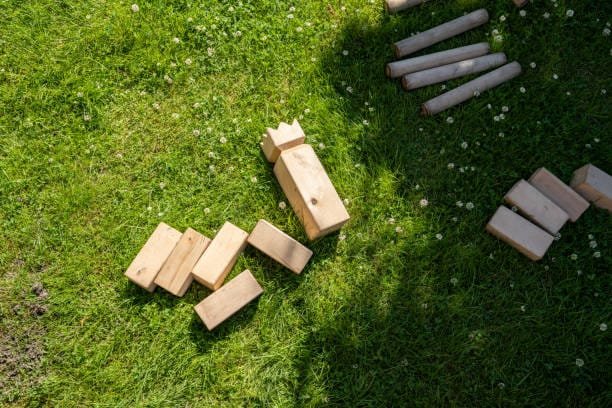
The Pitch
The official pitch is 5 m by 8 m, which is about 16 by 26 feet. Each baseline carries five kubbs, evenly spaced across the width, and the king stands in the centre, on the midline between the two baselines.
| Part | Count | Position |
|---|---|---|
| Baseline kubbs | 5 per team | Across each baseline, evenly spaced |
| King | 1 | Centre of the pitch, on the midline |
| Batons | 6 per team | Thrown each turn |
| Throwing line | 1 per team | The team baseline |
| Pitch | 5 x 8 m | About 16 x 26 feet |
Setup
- Mark the two baselines 8 m apart, with stakes at the corners.
- Place five kubbs evenly along each baseline.
- Place the king on the midline, in the centre.
- Each team takes six batons.
Deciding Who Starts
Each team tosses one baton toward the king from its baseline. The team whose baton lands closest without knocking the king over throws first. If a baton knocks the king over, that team loses the toss and the other team chooses to go first.
A Turn, Step by Step
- The throwing team stands behind its baseline and throws its six batons at the opponent’s baseline kubbs.
- Every kubb knocked down is picked up and thrown by the opponent into the throwing team’s half. These become field kubbs.
- The throwing team must knock down all field kubbs before it may attack the opponent’s baseline kubbs.
- Only once all baseline kubbs are down may the team throw at the king.
- The first team to clear the opponent’s baseline and topple the king wins.
That order – field first, baseline second, king last – is the whole game. The team that forgets step three and throws at the baseline while a field kubb stands has wasted a baton.
The Field-Kubb Rule
Field kubbs are what make Kubb a strategy game rather than a throwing contest, and they are the part most people explain backwards.
When you knock down the opponent’s kubbs, the opponent throws them back into your half, and you must clear them before doing anything else. Two consequences follow:
- Where you throw them matters, and spreading is the object. A tight cluster is a gift, because one baton can clear several. Throw them as far apart and as deep as the half allows, and keep them away from the king.
- The penalty line. If a team has field kubbs it cannot clear, the throwing team may advance to a line level with the nearest field kubb and throw from there. This rule exists so a team cannot be trapped forever by a kubb it cannot reach.
Three Things Commonly Misstated
1. “Aim for the middle when you throw the kubbs back”
Wrong. A middle cluster is the easiest thing in the world to clear in one throw. Spread them.
2. “You can only throw at the king from the baseline”
You throw at the king from your normal throwing line, which may be the penalty line if you have field kubbs outstanding. The point is that the king is the last target, not that it has a special line.
3. “Knocking the king early loses”
This one is right. The king may only be attacked after every baseline kubb is down. Touch it before then and you lose immediately, which is the only self-inflicted loss in the game.
The Dimensions
| Part | Size |
|---|---|
| Kubb | About 15 cm tall, roughly square in section |
| King | About 30 cm tall (roughly twice the kubb) |
| Baton | About 30 cm long |
| Material | Hardwood, usually birch, ash or beech; painted faces |
If You Are Specifying a Set
Four numbers decide whether a Kubb set is usable rather than decorative:
- Kubb height 15 cm, king 30 cm, baton 30 cm. A king that is not roughly twice the kubb looks wrong and plays wrong.
- Rounded edges on the kubbs. Sharp edges splinter on the first season of play.
- Straight grain and a sealed end. Kubbs take impact on the end grain, which absorbs water fastest, so the base must be sealed or the kubb splits.
- Paint that survives the ground. Kubbs lie on grass and get kicked; a printed face that wears off makes the set unreadable in a season.
For buyers selling into the EU or US child market, the test is EN 71 or ASTM F963. Kubb parts are large enough that small-parts rules are not the issue; the finish and the splinter resistance are.
FAQs
How long does a game of Kubb take?
Two players, about fifteen minutes. A full team game with six a side can run forty minutes. The length is set by how often the field kubbs get cleared, not by the clock.
Can children play Kubb?
Yes. The parts are large and there are no small pieces. Shorten the pitch for younger players rather than move the kubbs closer together.
Is Kubb a Viking game?
No. It appears in Gotland in the early twentieth century and was commercialised in the 1980s and 1990s. There is no medieval or Viking evidence for it.
How many people can play?
Officially two teams of one to six. The game scales well because every added player adds field kubbs to clear, which is more work, not more rules.
What happens if a thrown kubb lands outside the pitch?
The receiving team may place it anywhere in its half, but not within one baton length of the king. This is the rule that stops a kubb being hidden next to the king.
Conclusion
Kubb is a modern Gotland game, not an ancient one, and its rules fit in five steps: throw at the baseline, clear the field kubbs you receive first, then the baseline, then the king. The strategy lives in where you throw the kubbs back – spread them, do not cluster them – and in never wasting a baton on a target you are not yet allowed to attack.
The specifications are simple: kubbs 15 cm, king 30 cm, batons 30 cm, hardwood with sealed ends. Get those right and the game plays exactly as it should.
Sourcing Wooden Garden Games in Bulk?
Kangjie is the direct manufacturer behind these games — no trading company, no middleman margin. We supply Kubb, Croquet, Molkky, Ring Toss, Tumble Tower, Cornhole and more to importers, retailers and brand owners worldwide.
- Factory-direct pricing with transparent volume tiers (500 / 1,000 / 5,000 units)
- OEM & ODM: logo, packaging, size and finish built to your specification
- EN71 & ASTM F963 compliant; FSC-certified timber
- Bulk lead time 30–45 days, quotation within 24 hours









