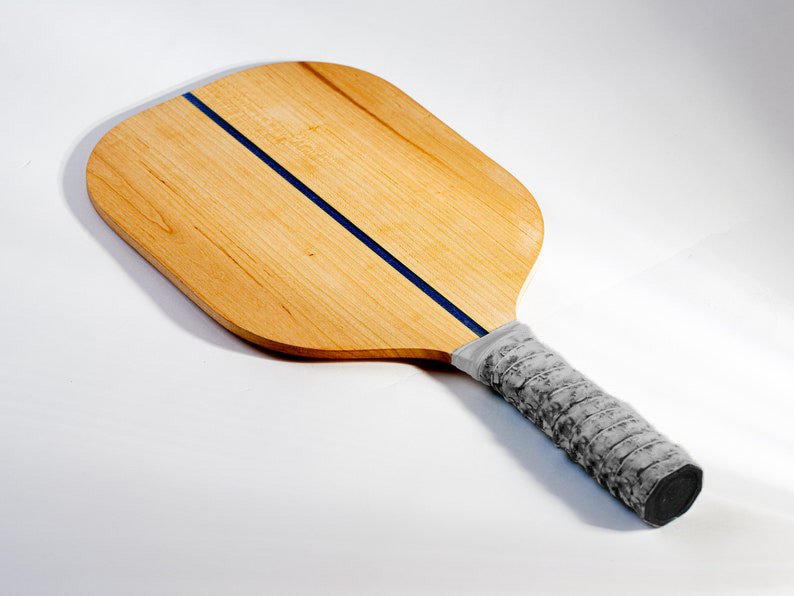
The question assumes a paddle is a piece of wood with a shape cut out of it. It is not. Every production wooden paddle is plywood, and the species of the face veneer matters far less than the number of plies and the glue between them.
That changes the answer completely. Birch is not the best wood because it is the hardest or the prettiest. It is the best wood because it is available as void-free 1.5 mm veneer, which is what a paddle actually needs.
No Paddle Is One Piece of Wood
A solid timber paddle fails for a reason that has nothing to do with strength. Wood moves across the grain as humidity changes, roughly twice as much tangentially as radially, so a flat panel cut from a single board cups. A paddle face that is cupped by two millimetres is a paddle that hits the ball somewhere other than where the player aimed.
Plywood solves this by alternating grain direction. Each ply restrains the one below it, and a balanced layup – odd number of plies, symmetrical about the centre – moves almost not at all. That is why every paddle you have ever seen is a ply stack.
The Species Table
| Wood | Hardness | How it behaves in a paddle | Verdict |
|---|---|---|---|
| Birch (Baltic) | Medium-hard, around 1200 lbf Janka | Void-free 1.5 mm plies, tight and uniform, glues well | The standard. Use it |
| Maple | Hard, around 1450 | Denser and heavier, more power, harder to press thin | Good for a heavy power paddle |
| Basswood | Soft, around 400 | Light and easy to press, dents at the edge, dead face | Only as an inner ply |
| Cedar | Very soft, around 350 | Light but dents, and the oils interfere with glue | Not suitable |
| Bamboo | Hard, around 1400 | Strand or strip construction, splits along the fibre at thin sections | Risky in a 10 mm face |
| Radiata pine | Soft, around 700 | Cheap, knotty, inconsistent density | Not suitable for a face |
Two entries deserve comment. Cedar is recommended in a lot of online guides because it is light and rot-resistant, and both facts are true and irrelevant: a paddle face is not exposed to rot, and cedar is soft enough that the ball dents it. Its natural oils also fight the adhesive, which is a manufacturing problem before it is a playing problem.
Bamboo is the opposite case. It is hard and it is a genuinely sustainable material, but a 10 mm section of strip-glued bamboo has no cross-grain reinforcement in the way plywood does, and it fails by splitting along the fibre when the edge takes a knock.
Why Ply Count Beats Species
A paddle face of 10 mm built from 1.5 mm plies has seven layers. The same thickness built from 3 mm plies has three. The seven-ply face is stiffer, flatter and far more resistant to cupping, because each layer is doing work restraining the one below.
Three numbers describe a good layup:
- 1.5 mm nominal ply thickness, which is what allows seven to eleven plies in a paddle-sized section.
- Void-free, meaning no gaps or knots in the inner plies. A void is a stress concentration, and a paddle with voids fails at the void.
- Odd, balanced construction. An even number of plies, or a layup that is not symmetrical about the centre, will warp. This is the single most common manufacturing error in cheap paddles.
The Glue Is the Durability Story
Wooden paddles do not wear out from hitting balls. They fail at the edge, after water gets in, and the glue is what decides how fast that happens.
| Adhesive | Water resistance | Use |
|---|---|---|
| PVA | Interior only | Cheap paddles, and the reason they delaminate |
| Urea-formaldehyde | Limited | Common in furniture plywood, not appropriate here |
| Melamine-urea-formaldehyde | Good | Acceptable for a paddle that stays dry |
| Phenolic | Boiling water resistant | Marine grade; the correct choice |
A phenolic-bonded birch ply with a sealed edge will survive being left out in the rain. A PVA-bonded one will not survive a damp car boot, and the failure will start as a two-millimetre lift at one corner that nobody notices until the face separates mid-rally.
The Numbers to Specify
If you are ordering paddles rather than buying one, five lines cover almost everything:
- Plywood: 1.5 mm birch, void-free, phenolic bond, 7 to 9 plies.
- Finished thickness: 9 to 11 mm.
- Weight: 280 to 350 g assembled, which is the range that keeps the paddle playable without feeling hollow.
- Face: 400 by 200 mm nominal, edge radius 3 mm, sealed with a water-based finish rather than a film.
- Flatness: within 1 mm across the face at packing, measured after acclimatisation, not straight off the press.
That last line is the one that prevents returns. A paddle that leaves the factory flat and arrives cupped has absorbed moisture in transit, which is a packing problem rather than a ply problem.
FAQs
What is the best wood for a pickleball paddle?
Birch, as a void-free 1.5 mm plywood rather than a solid board. It is uniform, glues well, and allows enough plies to keep the face flat.
Is maple better than birch?
It is harder and heavier, which gives more power and less control. For most paddles birch is the better balance; maple suits a deliberately heavy power paddle.
Why not use cedar if it is light?
Because it is soft enough to dent, and its oils interfere with the adhesive. Light weight is not useful if the face deforms.
How thick should a wooden paddle be?
9 to 11 mm finished. Thinner plays livelier and fails sooner; thicker is durable and dead.
Why do cheap wooden paddles warp?
Unbalanced ply construction, usually an even number of plies or a layup that is not symmetrical, combined with interior-grade glue and no edge seal.
Conclusion
The best wood for a pickleball paddle is not a species, it is a specification: void-free 1.5 mm birch veneer, seven to nine plies, phenolic glue, 9 to 11 mm finished, sealed on the edge. Maple is a reasonable alternative for a heavier paddle. Cedar and basswood are not, for opposite reasons – one is too soft and fights the glue, the other is too soft and dents.
Get the ply count and the adhesive right and the species argument mostly disappears.
Sourcing Wooden Garden Games in Bulk?
Kangjie is the direct manufacturer behind these games — no trading company, no middleman margin. We supply Kubb, Croquet, Molkky, Ring Toss, Tumble Tower, Cornhole and more to importers, retailers and brand owners worldwide.
- Factory-direct pricing with transparent volume tiers (500 / 1,000 / 5,000 units)
- OEM & ODM: logo, packaging, size and finish built to your specification
- EN71 & ASTM F963 compliant; FSC-certified timber
- Bulk lead time 30–45 days, quotation within 24 hours