Shipping bulk wooden games is not complicated, but it is unforgiving of small mistakes. A carton that is 4 cm too long can double the freight cost. A missing ISPM 15 stamp can hold a container at the port. An Incoterm chosen without reading it can put a five-figure liability on the wrong party.
This page covers the parts of the process that actually decide the cost and the delivery date, from the factory gate to your warehouse.
Start With the Incoterm
The Incoterm decides who pays for what and where risk transfers. Getting it wrong is the most expensive mistake in the whole process, and it is usually made by copying the term from a previous order without checking it.
- EXW (Ex Works) — the buyer collects from the factory. Everything after that — inland haulage, export clearance, freight, insurance — is the buyer’s responsibility and risk. Cheapest on paper, and the one that most often goes wrong for a first-time importer, because the buyer has no presence at origin.
- FOB (Free On Board) — the seller delivers the goods to the named port and loads them on board the vessel. Risk passes to the buyer once the goods are on board. This is the most common term for container shipments and the one we quote by default.
- CIF (Cost, Insurance and Freight) — the seller pays freight and insurance to the destination port. Note that risk still passes when the goods are loaded at origin, so CIF is not the same as “seller is responsible until it arrives”.
- DAP (Delivered At Place) — the seller delivers to a named address, with the buyer handling import clearance and duty.
- DDP (Delivered Duty Paid) — the seller handles everything including duty. Convenient, and usually the most expensive option once the seller prices in the risk.
If a quotation does not state the Incoterm and the named port, it is not a price you can compare with anything.

Volume, Not Weight, Is What You Are Paying For
Wooden garden games are light and bulky, which is the worst combination for freight. Carriers charge on the greater of actual weight and volumetric weight, and volumetric weight is calculated from carton dimensions. A set of 90 cm pegs weighs a few kilos and occupies a great deal of space.
Three design decisions reduce the bill without changing the product:
- Two-section construction for anything over about 80 cm. A ferrule joint halves the carton length.
- Nesting rather than bundling. Rings, hoops and boards should stack flat inside one another.
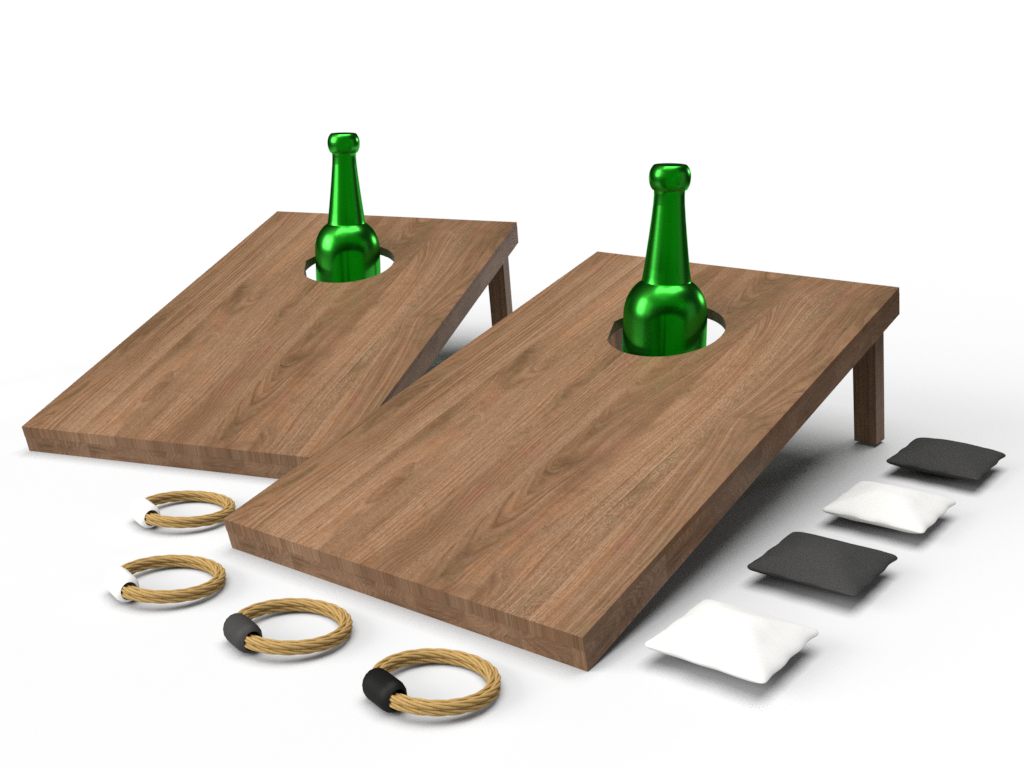
- Knock-down frames. Cornhole boards that bolt together pack into roughly half the volume of a fixed board.
Ask for the carton dimensions and the carton count per pallet before you accept a freight quote. If the forwarder has not asked for them, the number is an estimate.
HS Codes and Duty
Duty is set by the HS code of the product and the tariff schedule of the importing country, and the correct code is not always obvious for a wooden game. A game can be classified as a toy, as a wooden article, or as sports equipment, and the rates differ.
Rather than quote a percentage — which will be wrong for someone — the practical approach is:
- Ask your customs broker to confirm the code against the actual product description before the first shipment, not after.
- In the EU, check the code in TARIC; in the United States, in the Harmonized Tariff Schedule. Both are public and searchable.
- Keep the classification consistent across shipments. Changing codes between orders is the fastest way to trigger a review.
- Remember that duty is only part of the landed cost: VAT or sales tax, anti-dumping measures and any applicable fees all sit on top.
ISPM 15: The Rule People Forget
Solid wood packaging — pallets, crates, dunnage — must be treated and marked under ISPM 15 before it can enter most countries. The mark is a stamp showing the country code, the registration number of the treatment provider and the treatment method, usually heat treatment (HT).
This applies to the packaging, not the product. A wooden game does not need an ISPM 15 stamp; the pallet it sits on does. A shipment arriving with unmarked solid wood packaging can be refused, fumigated at the importer’s cost, or returned.

Packaging That Survives a Container
A container is not a gentle environment. Cartons are stacked four high, the floor vibrates for weeks, and the box is dropped at least twice between the factory and the warehouse.
- Internal bracing. Long pieces need a block or a folded insert at each end, not just padding. A hardwood peg is a lever, and it snaps at the grain when the carton lands on its end.
- Double-wall corrugate for anything over about 5 kg or 60 cm. Single-wall is fine for small sets and inadequate for large ones.
- Moisture protection. A container can sweat. A liner bag or a desiccant sachet costs very little and prevents the mould that ruins an otherwise perfect shipment.
- Drop testing. Ask whether the packaging has actually been drop tested, and to what height. A factory that has run the test knows the answer immediately.
The Document Checklist
Missing paperwork is the most common cause of a delayed shipment, and every item on this list is the buyer’s or the seller’s responsibility to agree in advance:
- Commercial invoice, with the HS code and the Incoterm stated.
- Packing list, with carton dimensions, weights and counts.
- Bill of lading or sea waybill.
- Certificate of origin, if the destination requires one or if a trade agreement reduces duty.
- Test reports and certificates — EN71, ASTM F963, FSC chain of custody — as required by the destination market.
- Fumigation or ISPM 15 documentation for the packaging.
Send the destination market and the product to your forwarder before production starts, not after. Compliance requirements can change the finish or the packaging, and discovering that at the port is expensive.
Insurance
Cargo insurance is cheap relative to the value of a container and almost never bought until after the first loss. Note that carrier liability is limited by convention and is far below the value of the goods; it is not insurance.
Under CIF the seller arranges minimum cover, which is usually enough to satisfy a contract and not enough to replace a loss. If the goods matter, buy your own cover from the point of loading.
Where Delays Actually Come From
- Production finishing late. The most common cause, and the one the factory controls. Build a buffer between the production date and the vessel cut-off.
- Documentation errors. A mismatch between the invoice and the packing list can hold a container for a week.
- Port congestion and blank sailings. Outside anyone’s control. The answer is a schedule with slack, not a promise to a customer you cannot keep.
- Customs inspection. Random, but more likely on a first shipment or a new classification.
Conclusion
Agree the Incoterm and the port in writing, design the packaging for volume rather than for looks, confirm the HS code before the first shipment, and make sure the pallets are ISPM 15 marked. Those four things prevent most of the problems that make international shipping feel unpredictable.
We quote FOB by default, provide carton dimensions with every quotation, and can work with your forwarder or recommend one. Tell us the destination port and the volume and we will give you a landed-cost estimate you can actually use.
FAQs
Which Incoterm should I use for a first order?
FOB is the usual starting point: the seller handles export and loading, and you control the freight and insurance from there. EXW looks cheaper and is usually harder to manage without a presence at origin.
Do wooden games need fumigation?
The product does not. The solid wood packaging does — pallets and crates must be ISPM 15 treated and stamped. Plywood and processed board packaging are exempt.
How do I calculate freight for bulky games?
Use volumetric weight from the carton dimensions rather than the actual weight. A forwarder will do this for you, but only if you give them the carton size, count and total volume.
Can you ship to my warehouse directly?
We can quote DAP to a named address, or FOB to the port of your choice. For a first order, FOB plus your own forwarder usually gives you more control over cost and timing.
What lead time should I plan for?
Production is 30–45 days after sample approval. Add sea freight and clearance on top, which varies by route and season, and keep a buffer before any retail delivery date you have committed to.
Sourcing Wooden Garden Games in Bulk?
Kangjie is the direct manufacturer behind these games — no trading company, no middleman margin. We supply Kubb, Croquet, Molkky, Ring Toss, Tumble Tower, Cornhole and more to importers, retailers and brand owners worldwide.
- Factory-direct pricing with transparent volume tiers (500 / 1,000 / 5,000 units)
- OEM & ODM: logo, packaging, size and finish built to your specification
- EN71 & ASTM F963 compliant; FSC-certified timber
- Bulk lead time 30–45 days, quotation within 24 hours