The short answer is that there is no difference. Cornhole and bean bag toss are two names for the same game, played with the same boards, the same bags and the same scoring. If you have been trying to work out which one to buy or stock, you can stop looking for a rule difference, because there is not one.
What does differ is the vocabulary, and vocabulary matters commercially. The name on your packaging decides who finds your product in a search, and the name on the box decides whether a customer recognises it on a shelf. Below is where each term comes from, what the actual specification looks like, and how to avoid the confusion that trips up bulk buyers.
They Are the Same Game
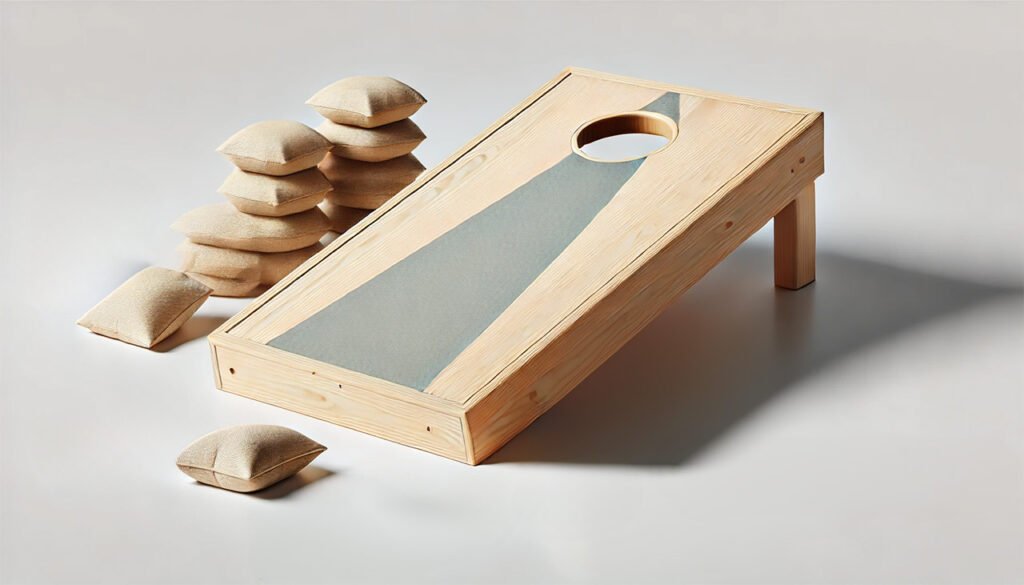
Two raised boards with a hole near the top, eight bags, players throwing from beside one board at the other. A bag in the hole scores three, a bag resting on the board scores one, and the first side to twenty-one wins. That is cornhole. It is also bean bag toss.
The rules do not change with the name. What changes is where you are standing when you say it.

Where the Confusion Comes From
Three things create the impression that these are different products.
Regional vocabulary. Cornhole is the dominant term in the American Midwest and in the organised tournament scene. Bean bag toss, bag toss and bags are all used elsewhere, and the choice of words often tracks family or local habit rather than any rule difference.
The generic name problem. Cornhole is a specific, slightly odd word that does not describe the game. Bean bag toss does describe it. So retailers and manufacturers who want a name that explains itself use bean bag toss, while players and leagues use cornhole.
Genuinely different games with similar names. There are other bag-throwing games that get sold under the bean bag toss label, and those really are different. They are covered below, and they are the only case where the distinction matters.
The Specification That Actually Matters
Since the rules are fixed, the thing worth arguing about is the specification. These are the numbers that decide whether a set plays properly.
| Item | Standard | Why it matters |
|---|---|---|
| Board size | 24 x 48 in (61 x 122 cm) | Smaller boards change the difficulty and read as a toy rather than a game |
| Hole diameter | 6 in (15 cm) | A smaller hole is the most common cost-cutting trick and players notice immediately |
| Hole centre from top | 9 in (23 cm) | Affects the angle of the landing zone |
| Board top height | 12 in (30 cm) at the back | Sets the playing arc |
| Throwing distance | 27 ft (8.2 m) board front to board front | Tournament standard; shorten it for family play |
| Bag size | 6 x 6 in (15 x 15 cm) | Larger bags are more forgiving and better for children |
| Bag weight | 15 to 16 oz (425 to 450 g) | Lighter bags blow around and feel wrong in the hand |
If a supplier quotes a 5-inch hole or a 12-inch board height without being asked, they are building to a price rather than to the game. That is a legitimate choice for an entry-level product, but it should be a choice, not a surprise.
Regional Names You Will Meet
If you are writing product copy for more than one market, these are the terms in circulation:
- Cornhole — dominant in the United States, and the term used by the organised tournament circuit.
- Bean bag toss — the descriptive generic, widely understood and useful for search.
- Bag toss, bags, corntoss — regional variants in North America.
- Cornhole is also occasionally written as two words. Both forms appear in search data.
For an English-language listing, using both terms in the title and description costs nothing and captures both search patterns. There is no downside.
Other Games Sold as Bean Bag Toss
This is the only place where the names point to genuinely different products, and it is worth knowing about if you are specifying an order.
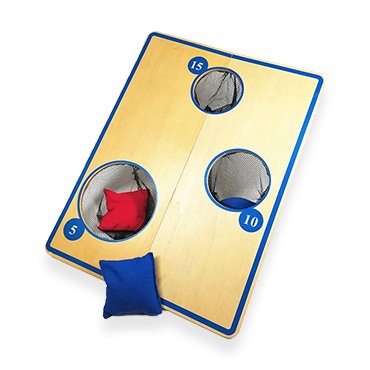
Multi-hole board games. Some products sold as bean bag toss use a board with several holes of different sizes, each worth a different score. The throwing action is similar but the game is different, and it is usually aimed at children.
Bucket or can toss. Bags thrown into open containers rather than through a hole. Cheaper to make, easier to pack, and a different product category in most buyers’ minds.
Tic-tac-toe bag toss. A board divided into a grid, where the aim is to place bags in a line rather than to score points. Popular as a two-in-one product because the same board can carry a cornhole hole at the other end.
If your specification says “bean bag toss” without a drawing, you may get any of these. Always order against a dimensioned drawing.

What to Specify for a Bulk Order
Most problems on a cornhole order trace back to a specification that was agreed verbally. These are the items worth putting in writing.
- Board construction. Plywood is the usual choice for a consistent playing surface. Solid timber looks better but moves more with humidity. MDF should be avoided for anything used outdoors, because it swells permanently once it takes on water.
- Frame and legs. Ask how the legs are attached. A screwed joint with pilot holes holds; a stapled joint works loose after a season of people leaning on the board.
- Finish. Specify the type and the number of coats. A printed vinyl wrap and a painted and sealed surface are different products at different price points, and both are legitimate as long as you know which you are buying.
- Bag filling. Corn kernel filling is traditional and plays well but attracts pests and degrades if it gets wet. Synthetic filling is more durable and pest-resistant. Ask which, and state it on the packaging.
- Bag stitching. Double-stitched seams are the difference between a bag that lasts two seasons and one that splits in a month.
- Carton cube. Boards are bulky. Freight is charged on volume, so the packed dimensions matter more than the unit price.
Customization
Cornhole is one of the easiest products in the category to customize, because the board face is a large flat printable surface. The options that sell are logo printing on the board, custom bag colours, a printed carry bag and a retail-ready carton.
The one thing to check before committing to a design is how the face is applied. A direct print or a laminated wrap will survive weather far better than a vinyl decal, and the price difference is smaller than the difference in how the product is judged after one summer.
Frequently Asked Questions
Is cornhole the same as bean bag toss?
Yes. Same boards, same bags, same rules. The names are regional, not technical.
Which name should go on the packaging?
Both, if the market is the United States. Cornhole is what players search for; bean bag toss explains what the product is to someone who has not seen it. Using both captures both.
What is the standard throwing distance?
27 feet from the front edge of one board to the front edge of the other. For children or casual play, shorten it — 15 to 20 feet is a common family setting.
What is the standard board size?
24 by 48 inches, with a 6-inch hole centred 9 inches from the top edge, and the back of the board standing 12 inches high.
Are your boards suitable for outdoor use?
They are made for outdoor play with an exterior-grade finish, but no wooden board should be left out in rain or stored damp. The finish buys you time in a shower, not a season in the weather.
What is the minimum order?
Around 500 sets per design for a custom run. Stock designs with your branding applied are available at lower quantities.
Sourcing Wooden Garden Games in Bulk?
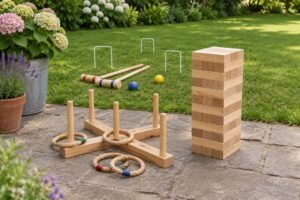
Kangjie is the direct manufacturer behind these games — no trading company, no middleman margin. We supply Kubb, Croquet, Molkky, Ring Toss, Tumble Tower, Cornhole and more to importers, retailers and brand owners worldwide.
- Factory-direct pricing with transparent volume tiers (500 / 1,000 / 5,000 units)
- OEM & ODM: logo, packaging, size and finish built to your specification
- EN71 & ASTM F963 compliant; FSC-certified timber
- Bulk lead time 30–45 days, quotation within 24 hours