
Yard dice is the simplest product in the whole wooden garden game category, and that is the reason it works. Six oversized dice, a scorecard, and a lawn. No assembly, no small parts, no manual. It is also the easiest of these games to manufacture, which makes it a sensible first line for a retailer testing the category.
This page covers the rules properly, the scoring that trips people up, and what to check on a set before ordering five hundred of them.
What the Game Is
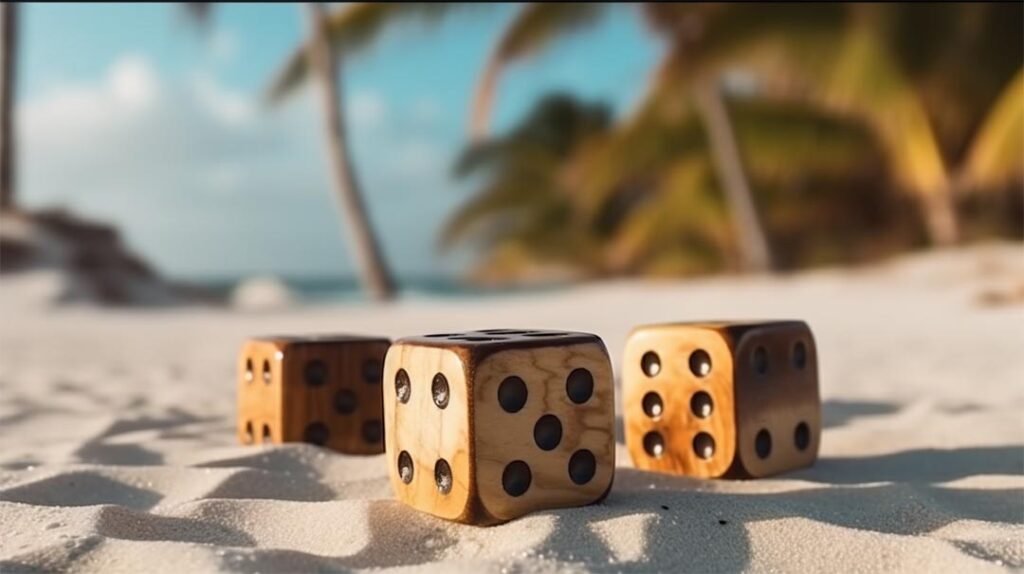
Six wooden dice, typically 7–10 cm across, thrown onto grass. Players build a score from poker-style combinations, and can re-roll the dice that did not score — at the risk of losing the round’s points entirely if the next throw scores nothing.
That push-your-luck mechanic is the whole game. Without it, yard dice is just a large dice set. With it, it produces the arguments and the last-round comebacks that make people play again.
The rules are the same family as the pub dice game Farkle, which is why the scoring will feel familiar to some players and completely new to others. Print the scoring on the lid of the box and you remove the only barrier to play.
What You Need
- Six oversized dice — 7–10 cm, with burned or engraved pips rather than painted ones. Painted pips wear off on grass within a season.
- A scorecard and pencil — or a scoring app, though paper is faster for a group.
- Flat ground — grass is ideal because the dice do not bounce far. A hard surface sends them under furniture.
- A carrying bag — six large dice are awkward to carry loose.
The Rules
Setting Up
Two or more players, individually or in teams. Agree a target score before the first throw — 5,000 points is a common finish for a game of 15–20 minutes, and 10,000 for a longer one. Then decide who goes first. The first player takes all six dice.
Playing a Turn
Throw all six dice. Set aside at least one scoring die, then choose: bank the points and end your turn, or re-roll the dice still in play.
If a throw produces no scoring dice at all, that is a bust. You lose everything accumulated in that turn, and play passes on. That single rule is what makes the game worth playing.
If all six dice score, you may pick them all up and continue the turn — a “hot dice” rule that most house versions include and that produces the big scores.
Scoring
- Single 1 — 100 points
- Single 5 — 50 points
- Three of a kind — 100 × the face value. Three 4s is 400, three 6s is 600.
- Three 1s — 1,000 points, as an exception to the rule above.
- Straight 1–2–3–4–5–6 — 1,500 points, and it can only be scored on a single throw of all six dice.
- Three pairs — 1,500 points in most house rules. Worth stating on the card, because players will ask.
Other combinations — four of a kind, five of a kind, two triplets — vary by region. Decide before the game and write it down. Half the arguments about dice games come from two players using two different scoring tables.
Ending the Game
The first player or team to reach the target wins. One common variant: a player must reach the target exactly, and overshooting drops them back. It slows the endgame and is worth including if the group is competitive.
For a tie, each tied player throws once and the highest scoring die wins.
House Rules Worth Adding
- Three busts in a row costs 500 points. Stops cautious players from grinding.
- Sudden death for the last round — everyone gets one final turn regardless of order.
- Left hand only for the player who is furthest ahead. A handicap that costs nothing to implement.
What to Check on a Set
Yard dice looks like a product anyone could make, and most of what is sold is made badly. Five things separate a good set:
- Pips. Burned or engraved, not painted. Painted pips chip within a season of grass play, and a die with an unreadable face is scrap.
- Cube accuracy. A die that is 1 mm out of square rolls unevenly, and players notice. Ask what tolerance the factory works to.
- Edges. Rounded rather than sharp. A sharp hardwood edge splits on impact with a stone.
- Species. Beech for weight and impact resistance, rubberwood for a lower price point. Pine dents and is not suitable.
- Finish. Water-based lacquer, and the coating should meet EN71-3 if the set is sold as a children’s product.
Why It Works Commercially
- One SKU, no assembly. Six dice and a bag. Nothing to break, nothing to lose, no returns for missing parts.
- Low freight per unit. Dice nest into a compact carton, unlike anything with long pegs or boards.
- Easy to customise. A logo on the bag or a burned mark on the six-face of each die is enough to make it a corporate gift.
- Reads as premium. Large solid hardwood dice photograph well and feel substantial, which supports a higher retail price than the material cost suggests.
What it does not do is carry a brand on its own. Yard dice is a good second or third product in a range, and a weak first one, because there is no story to tell beyond the material.
Conclusion
Six dice, one scoring card, one rule that makes people gamble their points. It is the least complicated product we make and one of the easiest to get wrong in production, because everything rests on the accuracy of the cube and the durability of the pips.
We build yard dice in beech and rubberwood from 500 sets, with burned pips, a branded bag and EN71 or ASTM F963 compliance. Send us the die size and the retail price you are aiming at and we will quote it.
FAQs
What size should yard dice be?
7–10 cm across is the practical range. Smaller is hard to read from a few metres away; larger becomes heavy enough to hurt when it lands on someone.
How many dice are in a set?
Six. Five works for a shorter game, but the straight and the three-pairs combination both need six.
Can the dice be painted in brand colours?
Yes, though the pips should still be burned rather than painted. Coloured dice with burned pips keep their legibility; fully painted dice do not.
What is the minimum order?
500 sets. Mixed die sizes or two colourways can be combined within that.
How long does production take?
Samples in 5–10 days after the specification is agreed, and production in 30–45 days after sample approval.
Sourcing Wooden Garden Games in Bulk?
Kangjie is the direct manufacturer behind these games — no trading company, no middleman margin. We supply Kubb, Croquet, Molkky, Ring Toss, Tumble Tower, Cornhole and more to importers, retailers and brand owners worldwide.
- Factory-direct pricing with transparent volume tiers (500 / 1,000 / 5,000 units)
- OEM & ODM: logo, packaging, size and finish built to your specification
- EN71 & ASTM F963 compliant; FSC-certified timber
- Bulk lead time 30–45 days, quotation within 24 hours









