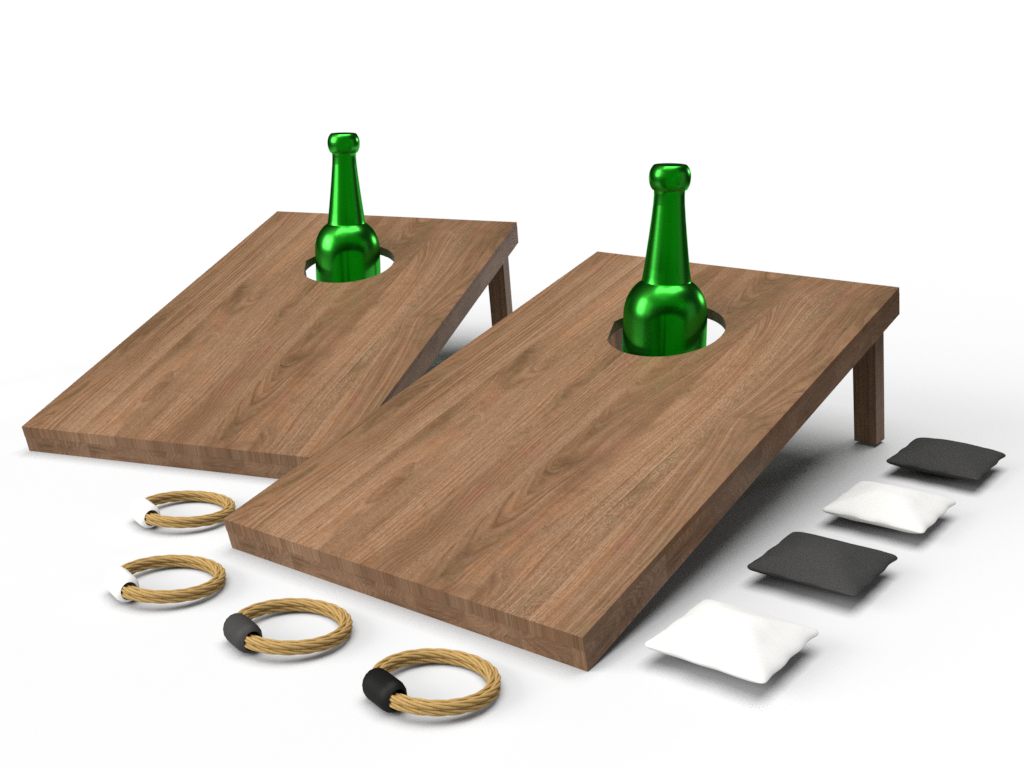
The honest answer is that cornhole boards are almost never made from solid hardwood. The playing surface is plywood, usually birch or maple faced, and the frame is softwood. Understanding why that is the case explains almost every quality decision on the product.
So when a supplier says their boards are “maple”, the accurate reading is “maple-faced plywood”. That is a good material. It is not a solid maple panel, and a solid maple panel would be a worse product, for reasons set out below.
Why the Playing Surface Is Plywood
Three reasons, all of them practical.
Dimensional stability. Plywood is made of crossed layers, so it resists the seasonal movement that solid timber goes through. A solid timber panel of board size will cup and twist over a season outdoors, and a cupped board changes how a bag behaves on impact.
Consistent bounce. The whole game depends on the board giving the same response every time. Plywood gives that; solid timber with grain running one way does not.
Weight. A solid hardwood panel at board dimensions would be heavy enough to make the product impractical to move. Plywood gets the stiffness without the mass.
The usual specification is 12 mm (1/2 inch) or 18 mm (3/4 inch) plywood. Thicker is better for play and worse for freight, and this is the trade-off most buyers are actually making when they compare two quotations.

The Face Veneer
What people mean by “maple boards” is the face veneer, and it matters for two reasons: appearance and how the surface takes a finish or a print.
| Face | Look | Behaviour | Best for |
|---|---|---|---|
| Maple | Fine, even grain, pale | Takes stain evenly, prints cleanly, resists denting better than pine | Premium boards, printed faces |
| Birch | Slightly more figure, warmer tone | Very similar performance, usually cheaper | The best value for a good board |
| Pine faced | Pronounced grain, knots possible | Softer, dents more, stain goes blotchy because of the hard-soft grain contrast | Entry price point only |
Two materials to avoid for a playing surface. MDF swells permanently once it takes on water and should never be used for anything that goes outdoors. Particleboard has the same problem and less stiffness.
The Frame and Legs
Nobody photographs the frame, and it is where boards fail.
- Softwood is fine. Pine or fir for the frame and legs is normal and appropriate. It does not need to be hardwood.
- Joint construction matters more than species. Screwed joints with pilot holes hold. Stapled joints work loose after a season of people leaning on the board.
- Leg attachment is the weak point. Ask how the leg hinges or fixes, and whether there is a metal insert. This is the part that breaks first.
- Stainless fixings cost a little more and remove an entire category of complaint about rust stains on decks and patios.
Finish, Which Is Where Quality Is Decided
The finish is not decoration. It is what protects the panel, and on a product sold for children it is also what carries the toy safety compliance, because heavy metal migration limits apply to the coating rather than to the timber.
Ask three things: the finish type, the number of coats, and whether the edges and the inside of the hole are coated. An uncoated hole edge is where water gets in and where a board starts to delaminate.
On printed faces, ask how the print is applied. A direct print with a sealed overcoat survives weather far better than a vinyl decal, and the price difference is smaller than the difference in how the product is judged after one summer.
What to Specify
- Panel thickness in millimetres. Not the finished weight, which tells you nothing useful.
- Face veneer species and grade.
- Frame species and joint method.
- Hole diameter and position. 6 inches, centred 9 inches from the top edge.
- Finish type, coat count, and whether edges and hole are coated.
- Fixings. Coated or stainless.
- Carton cube. Boards are bulky and freight is charged on volume.
Frequently Asked Questions
Do you offer solid maple boards?
We would rather not, and we will say so. A solid maple panel at board size is heavy, moves with humidity, and does not play better than a good plywood board. Maple-faced plywood is the better product and it is what “maple boards” usually means in this industry.
What thickness should I choose?
12 mm for a lighter board that ships cheaper, 18 mm for a board that plays better and lasts longer. Most buyers settle on 18 mm for retail and 12 mm for a compact or travel version.
Can I get samples before a bulk order?
Yes. Samples go out five to ten days after the specification is agreed. On this product a physical sample is the only way to judge bounce and finish.
Can the boards be customized?
Yes: printed faces, custom stains, engraved or printed logos, custom bag colours and custom cartons. A new board dimension or a new frame profile needs tooling and carries a setup cost.
What is the lead time for 500 sets?
Samples in five to ten days after the specification is agreed, bulk production in thirty to forty-five days after sample approval. Shipping time is quoted separately because it depends on destination and mode.
How do you handle shipping to Europe and the US?
We quote the freight terms explicitly rather than folding them into a single figure, so you can see what the goods cost and what the logistics cost. For US imports, note that the Children’s Product Certificate is issued by the importer on the basis of the test reports, not by the factory.
Sourcing Wooden Garden Games in Bulk?
Kangjie is the direct manufacturer behind these games — no trading company, no middleman margin. We supply Kubb, Croquet, Molkky, Ring Toss, Tumble Tower, Cornhole and more to importers, retailers and brand owners worldwide.
- Factory-direct pricing with transparent volume tiers (500 / 1,000 / 5,000 units)
- OEM & ODM: logo, packaging, size and finish built to your specification
- EN71 & ASTM F963 compliant; FSC-certified timber
- Bulk lead time 30–45 days, quotation within 24 hours