Hook & Ring Toss Game Instructions: 6 Steps

Main Menu
Cornhole is two boards, eight bags, one distance and one scoring rule that almost every casual player gets wrong.
The game is easy to start and it stays interesting for a specific reason: a near miss still scores. A bag on the board is a point, so a weaker player is never shut out, and the game stays close enough to be worth finishing.
What follows is the setup, the rules, the throwing technique that actually works, and the scoring rule that decides most close games.
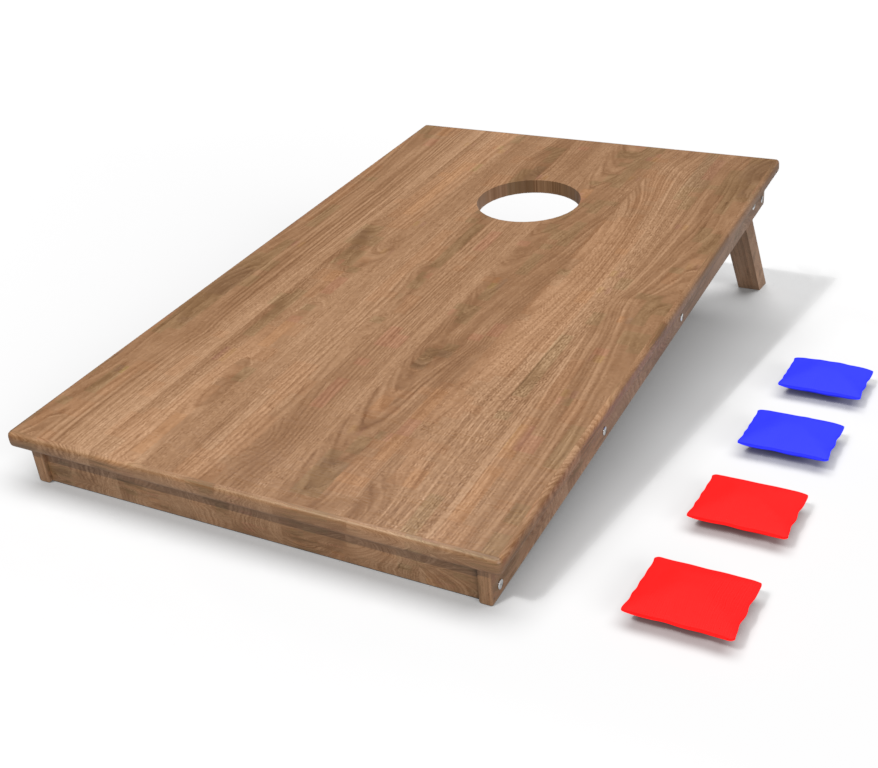
It also covers the board dimensions, because a board that is built wrong plays badly and the player will not be able to say why. That is the most common hidden fault in the category.
Cornhole, also called bean bag toss or baggo, is played on two inclined boards facing each other. The origin is usually given as Cincinnati, Ohio, though a German or Bavarian origin is also claimed and neither is well documented. What is documented is American play from the 1980s onward.
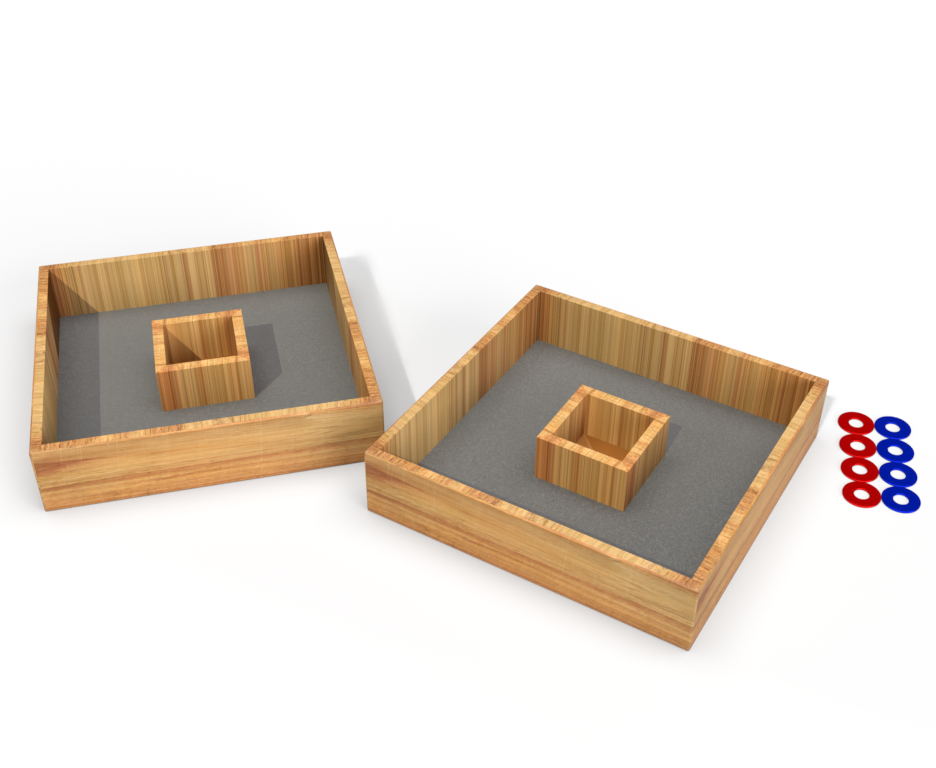
The board is the game. These are the dimensions that matter:
| Dimension | Specification | What happens if it is wrong |
|---|---|---|
| Board size | 1,220 x 610 mm | Smaller boards are harder and are usually sold as travel sets |
| Top thickness | 18 mm plywood | Thinner flexes under a landing bag and the bounce becomes inconsistent |
| Hole diameter | 152 mm (6 in) | Larger and the game is too easy; smaller and it is a lottery |
| Hole centre from top edge | 229 mm (9 in) | Moving the hole changes the whole difficulty curve |
| Back edge height | 305 mm (12 in) | Sets the pitch. Too low and bags do not slide |
| Front edge height | 76 to 102 mm (3 to 4 in) | The pitch is the difference between the two edges |
| Bag size and mass | 152 mm square, 425 to 454 g | Lighter bags blow off course; heavier ones bounce off the board |
The pitch — back edge 305 mm, front edge 76 to 102 mm — is the part that gets missed. A flat board is not a cornhole board. It is a target, and bags hit it and stop dead instead of sliding, which removes the whole slide-shot dimension of the game.
Two boards, eight bags in two colours, and a flat surface.
The court is about 3 m wide and 13.7 m long in total. That is the space you need, not the space between the boards.
Four things, and the fourth is the one that separates good players from consistent ones.
The throw is a pendulum, not a throw. The arm stays straight and the motion comes from the shoulder, which is why the release point is low and repeatable.
This is the rule that decides close games and the one most casual players get wrong.
Cornhole scores by cancellation. At the end of a round, you compare the two teams’ round scores and only the difference is awarded, to the team with the higher score. The other team scores nothing.
| Team | Bags on board | Bags in hole | Round score | Points awarded |
|---|---|---|---|---|
| A | 2 | 1 | 2 + 3 = 5 | 2 |
| B | 3 | 0 | 3 | 0 |
Team A scored 5 and Team B scored 3, so Team A is awarded 2 points and Team B gets nothing. The naive version — both teams add their scores — produces a game where nobody ever catches up, because both sides accumulate at the same rate.
Cancellation is what makes the last bag of a round matter. If your opponent has three bags on the board, your fourth bag is worth three points even if it only lands on the board, because it cancels one of theirs.
Recreational games often use a bust rule: going over 21 drops your score back to 13. It is a house rule, not part of the standard, and it exists because a game to exactly 21 with no bust rule can stall. Agree which version is being played before the first bag.
Four failures, in the order they come back.
What is not a variation: three-a-side. Cornhole is singles or doubles, and adding players means somebody stands and watches.
Yes, with a shorter distance and a low-bounce bag. The board still needs 8.23 m to be the real game, so indoor play is a different, shorter version. The bags are quiet; the board is the noise.
8.23 m (27 ft) from the front edge of one board to the front edge of the other. Measuring hole to hole or centre to centre gives a different, wrong distance.
For casual play, any bag of roughly 425 to 454 g works. For competitive play the bag must be 152 mm square and within the weight range, and the fill matters: a bag with the wrong fill slides differently and the whole game changes.
1,220 x 610 mm, 18 mm plywood, hole 152 mm across centred 229 mm from the top edge, back edge 305 mm high and front edge 76 to 102 mm.
Yes, the American Cornhole League runs tournaments at several skill levels. Its rules are the closest thing to a standard, including winning by two at 21.
Yes. Shorten the distance to about 5.5 m and use 300 g bags. The rules do not need to change, and the near-miss scoring means a child is never shut out.
Cornhole works because the scoring is forgiving and the equipment is simple. Two boards at the right distance, eight bags at the right weight, and one rule that most players get wrong: only the difference in a round is awarded.
If you are buying a set, check the pitch and the edge sealing before anything else. Those two decide whether the board plays properly and whether it lasts.
Trust our wooden game experts to deliver premium quality and unbeatable value, on-time and on-budget.
kangjiegardengame.com
Typically replies within minutes
How Can We Assist You Today?
WhatsApp Us
🟢 Online | Privacy policy
WhatsApp us
Get notified about new products
Custom garden games available—our expert design team brings innovative ideas to life.