
Main Menu
Ever wonder why there is a growing trend for wooden garden games? Why are the likes of cornhole, ladder toss, and ring toss making such a significant comeback?
The honest answer is that “sustainable” is the most over-used word in the garden category, and most of the claims attached to it do not survive a second question. Wood is a renewable material. That is a fact. Whether a particular wooden game is the greener choice depends on where the timber came from, what was put on the surface, how it was packed, and how long it lasts before it is thrown away.
This article takes those four questions one at a time, including the places where wood loses to plastic.

A wooden game is only as good as the forest behind it. Two identical sets, one from a managed forest and one from cleared land, carry the same retail price and a completely different environmental story.
The document that answers the question is a chain-of-custody certificate, FSC or PEFC. It traces the fibre from certified forest through the mill to the finished product, and it is auditable. Without one, “sustainable timber” is a marketing sentence.
What the certificate does not tell you, and this matters: it says nothing about the finish, the glue, the factory’s labour practices or the freight. It covers the wood and only the wood. Buyers routinely assume it covers more.
Species choice matters too, and not in the way most people think. Beech, birch, ash, eucalyptus and pine are all fast-growing or abundant, and all of them are appropriate for garden games. Tropical hardwoods are where the supply-chain risk sits, and several genera are now restricted in international trade, so a set built on temperate species avoids the question entirely.
You can build a game from certified timber and then coat it in something that undoes the point.
Solvent-borne lacquers and polyurethanes carry high volatile organic compound content, which is a workplace exposure issue in the factory and an indoor air issue in the customer’s home. Water-based acrylic clear coats have a fraction of the VOC load and have improved to the point where they are genuinely durable on a garden product.
There is a second decision that gets less attention: whether to seal the wood at all. A penetrating oil, linseed or tung, leaves the surface breathable and repairable, and can be renewed by the customer with a rag. A film finish looks better on the shelf and cannot be repaired once it fails. For a product meant to sit outdoors for a decade, repairable beats perfect.
One thing we will not claim: that a coated wooden game is non-toxic in any absolute sense. The coating is a cured polymer film. It is safe in normal use, it is tested for heavy-metal migration under EN 71-3, and it is not edible, compostable or something to be sanded without a mask.
The environmental argument for wood is almost never about the material. It is about the replacement cycle.
Roughly half the dry weight of wood is carbon that the tree pulled out of the atmosphere. A 10 kg hardwood set holds about 5 kg of carbon. If that set is used for ten years, the carbon cost per year of play is half a kilogram. If it is replaced every two years because the joints opened and the paint failed, the same product is five times worse, regardless of how the timber was certified.
That reframes the design brief. The greenest thing a manufacturer can do is make the joints survive, specify a moisture content that will not move after shipping, and use hardware that can be replaced rather than moulded in.
It also means the honest comparison is not wood against plastic. It is a well-made wooden set against a cheap wooden set, and the cheap one usually loses.
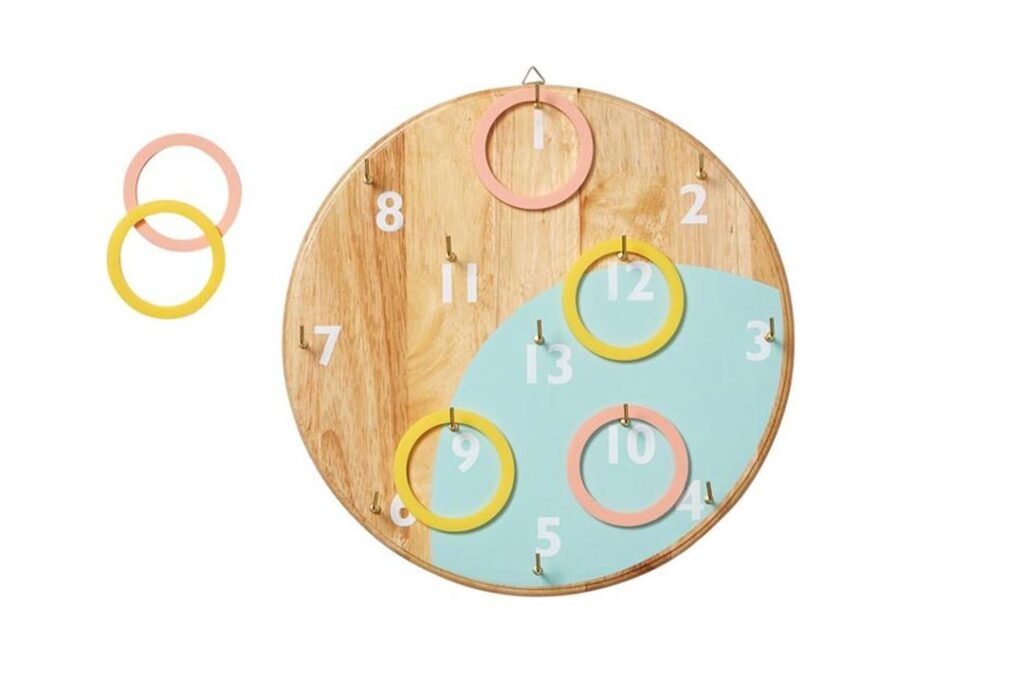
Three honest points, because a page that only lists advantages is not useful to a buyer.
Recycling. A finished, glued wooden game is not recyclable in a kerbside stream. A polyethylene board is. If end-of-life recyclability is the customer’s priority, moulded plastic wins and no amount of timber certification changes that.
Water. Wood moves. A board left in the rain will swell, and a joint that was tight in July can be loose in October. Plastic does not care. This is why every wooden game in the category ships with storage advice, and why a set that ignores that advice will not last.
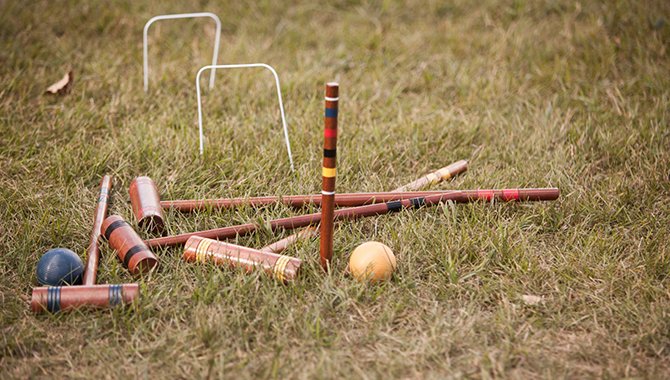
Weight and freight. Wood is dense. A six-player croquet set is 10 to 14 kg. Shipping that volume by air is indefensible on carbon grounds, so a wooden game is inherently a sea-freight product with a 30 to 45 day lead time and a container-sized minimum. That is a real constraint, not a detail.
For buyers who want the specification rather than the adjectives, this is what goes on our process sheets.
Species. Beech, birch, rubberwood, ash, eucalyptus or pine, named by species rather than described as “hardwood”.
Moisture content. 8 to 12 percent at machining, verified on a batch sample, because this single number decides whether the product survives its first winter in a customer’s shed.
Finish. Water-based clear coat at minimum film thickness, or a penetrating oil where the product is meant to be renewed.
Hardware. Stainless or galvanised where the part is exposed to soil, because a zinc-plated screw in wet ground is a two-season component.
Tolerances. Stated per part, not per batch, since a set where every piece is 0.3 mm thick plays perfectly and a set that ranges across 1 mm does not.
Certification is a set of documents with specific scopes, and the scope is the part buyers get wrong.
FSC or PEFC chain of custody covers the timber. Nothing else.
EN 71-1 covers physical and mechanical hazards, EN 71-2 flammability, EN 71-3 migration of elements from coatings and materials. All three apply only if the product is age-graded as a toy for the European market.
ASTM F963 and a Children’s Product Certificate are the US equivalent. The CPC is issued by the importer, not by the factory, and first-time importers are frequently surprised by that.
TSCA Title VI and CARB Phase 2 apply to engineered wood, plywood and MDF. Solid timber is out of scope, which is one of the few regulatory advantages of building in solid wood.
ISPM 15 applies to the pallet, not the product, and it is checked at the port rather than at the factory gate.
If a set is sold to adults as sporting equipment at 14+, the toy package does not apply. Deciding the age grade before testing is considerably cheaper than testing twice.
Can you match a competitor’s sample? Usually, and where we cannot we say so before quoting. The parts that are genuinely hard to match are turned profiles, tight-tolerance diameters and multi-colour print.
What is the smallest order that makes sense? 500 sets. Below that the setup cost dominates and the unit price stops being competitive for either side.
How long from enquiry to container? Sampling 5 to 10 days after the specification is fixed, bulk production 30 to 45 days, ocean freight about 30 days to the US west coast. Roughly three months end to end, which is why garden retail orders are placed in autumn for a spring shelf.
What if the first shipment is wrong? It happens, and the answer is a pre-shipment inspection against an agreed specification rather than a promise. Put the tolerances, the finish and the carton dimensions in writing, and inspect against them.

500 sets, with volume tiers at 500, 1,000 and 5,000 units. Samples ship in 5 to 10 days once the specification is agreed, and quotations come back within 24 hours of a clear brief.
Logo, packaging, size, colour and finish are all open to specification. What is not open: we will not print a claim we cannot document, and we will not describe a product as compostable or non-toxic when the material does not support it. If your artwork needs a sentence we cannot stand behind, we will flag it before the print run rather than after.
Bulk production runs 30 to 45 days. Ocean freight adds roughly 30 days to the US west coast and 35 to 40 to Europe, plus customs. We are a factory, not a freight forwarder, but we will give you the carton dimensions, gross weights and cube per set that your forwarder needs to quote accurately.
So is a wooden garden game the sustainable choice? For most buyers, yes, provided the timber is certified, the finish is water-based, the packaging is paper rather than plastic, and the product is built to last more than a few seasons.
If any of those four is missing, the claim does not hold, and the customer is buying a plastic-alternative aesthetic rather than a lower-impact product.
Four things, in order of impact: certified timber from a managed forest, a low-VOC water-based finish, paper-based packaging, and a service life long enough that the carbon stored in the wood is not released by constant replacement. Miss any one of them and the claim weakens considerably.
500 sets, with volume pricing at 500, 1,000 and 5,000 units. Samples take 5 to 10 days once the specification is agreed, and bulk production runs 30 to 45 days.
By specifying numbers rather than adjectives: species, moisture content at machining, finish type and film thickness, and per-part tolerances. Those go into the process sheet, and pre-shipment inspection is carried out against that sheet. Test reports for EN 71 and ASTM F963 are issued against the specific product, not offered as a general claim.
It can survive a season outdoors, but it will not survive a decade of it. UV greys the surface and water causes the swell-and-shrink cycle that opens joints. The practical answer is a covered store through winter, which is what we tell end customers and what we would rather you printed on the carton than a claim about all-weather durability.
Yes. We ship to the United States, the United Kingdom, the European Union, Australia and New Zealand, and we can supply the documentation each market requires, including FSC chain of custody and toy safety test reports where the product is age-graded as a toy.
This article is published by Kangjie, a manufacturer of wooden garden games for importers, retailers and brand owners. If you are specifying a product and want the material and finish options in writing, send us the brief and we will come back within 24 hours.
Get a free copy of our catalog
Trust our wooden game experts to deliver premium quality and unbeatable value, on-time and on-budget.
kangjiegardengame.com
Typically replies within minutes
How Can We Assist You Today?
WhatsApp Us
🟢 Online | Privacy policy
WhatsApp us
Get notified about new products
Custom garden games available—our expert design team brings innovative ideas to life.