
Main Menu
Wooden outdoor games are popular for reasons that are mostly aesthetic, and that is worth admitting before making any other argument. They look better than plastic, they feel better in the hand, and they photograph well enough to sell a garden party on their own.
The functional argument is narrower but real: wood is dense, so pieces stay put in wind and hold their position on uneven ground, and it is repairable in a way that moulded plastic is not.
What follows is a survey of the games that work, grouped by how they are played, with an honest note on the limits of the material.
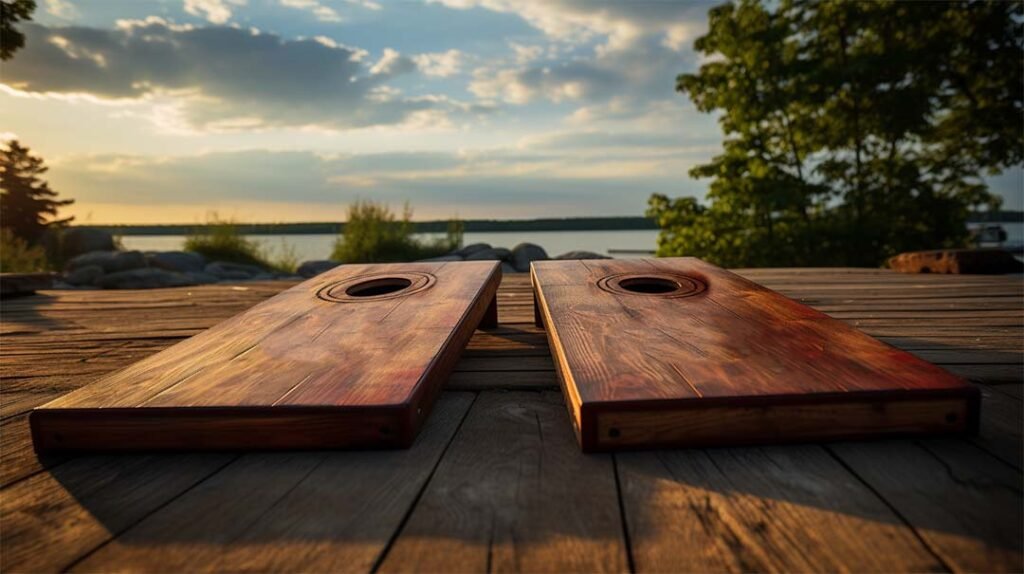
Two boards, eight bags, one distance. Cornhole is the most-played game in the category and it earns that position on its scoring structure: three points for a bag on the board, one for a bag in the hole, and cancellation between the two teams.
That structure is why beginners keep playing. A near miss still scores, so a weak player is never shut out, and the game stays close enough to be worth finishing.
Specification that matters: boards 1220 by 610 mm with the back edge 305 mm above ground and the front edge 76 to 102 mm, giving the regulation pitch. A board that is flat rather than pitched plays badly and the customer will not know why.
Fifty-four blocks, eighteen layers of three, and one rule. It is the only game on this list with no scoring at all, and it still works, because the tension is shared rather than comparative: everyone is watching the same tower.
Specification that matters: thickness tolerance of plus or minus 0.2 mm within a set. Eighteen layers multiply any variation, so a set with half a millimetre of inconsistency leans before anyone touches it. The other spec is the finish, which should be none: any film coating reduces the friction the game depends on.
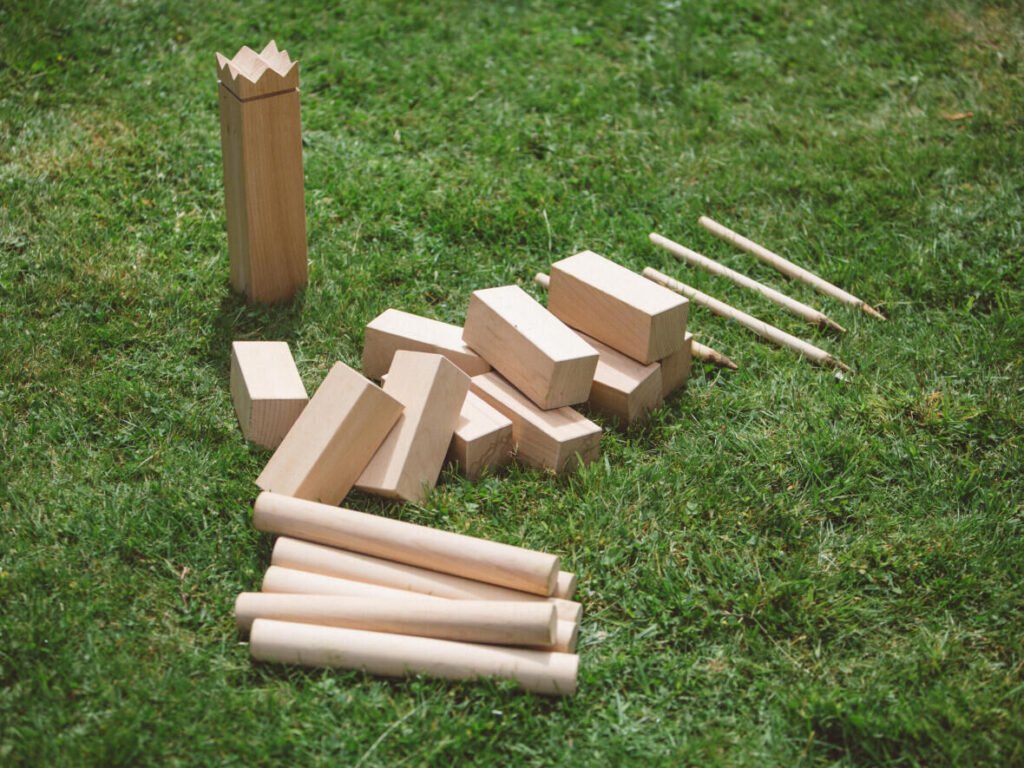
Kubb is Swedish, played on a five by eight metre field, and it handles teams better than anything else in the category because batons are shared rather than owned. Six batons per turn, and the team decides who throws which.
The Viking association that appears in almost every description of the game is not supported by any evidence. There is no Viking-era artefact and no contemporary account. What is documented is play on Gotland in the early twentieth century and an international spread from the 1980s. It is a good story and it is a story.
Specification that matters: straight grain on the batons. A baton turned from a piece with diagonal grain will snap at the first hard contact, and it is the part that takes the most punishment.
Twelve numbered pins and one unnumbered throwing pin, with a target of exactly fifty. The mechanic that makes it a game is that fallen pins are stood back up where they fell, so the field scatters as play goes on and every game has a different shape.
Specification that matters: pin diameter tolerance across the twelve. Pins that vary in diameter fall differently, and a set where one pin is noticeably heavier generates complaints that are hard to answer.
The name is a registered trademark, so if you are writing your own copy, describe it as a Finnish numbered-pin throwing game and use the name only where you are genuinely selling that product.
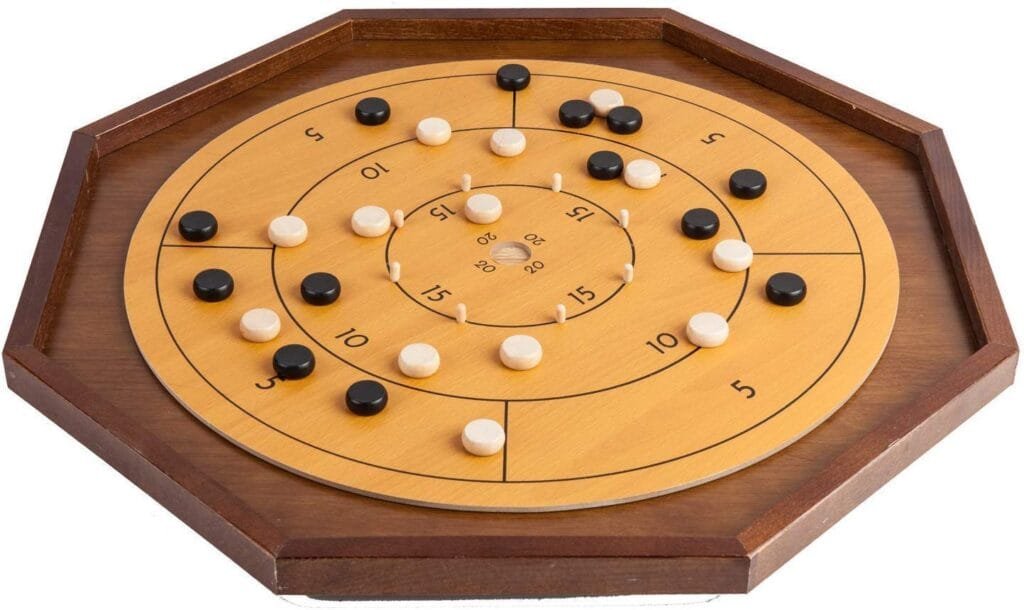
A Canadian dexterity game played on a round board with a raised rim and a centre hole. Players flick discs, and any disc that stops inside the outer ring is removed, so the game rewards precision rather than force.
Why it belongs in a garden range: it is one of the few games in this list that is genuinely a board game and still works outdoors, because the playing surface is a solid disc that sits flat on a table and the pieces are heavy enough not to blow away.
An ancient alignment and capture game for two players, played on a board of three concentric squares joined at the midpoints. Each player has nine pieces, and the game moves through three phases: placing, moving, then flying.
It is the right replacement for anyone tempted to recommend a sport as a board game. It has a genuine strategic depth, a short rule set, and it has been played for at least two thousand years, which is a stronger claim than most modern games can make.
Specification that matters: a routed board with a solid frame. A printed grid on a flat panel wears where fingers land and fades within two summers outdoors.
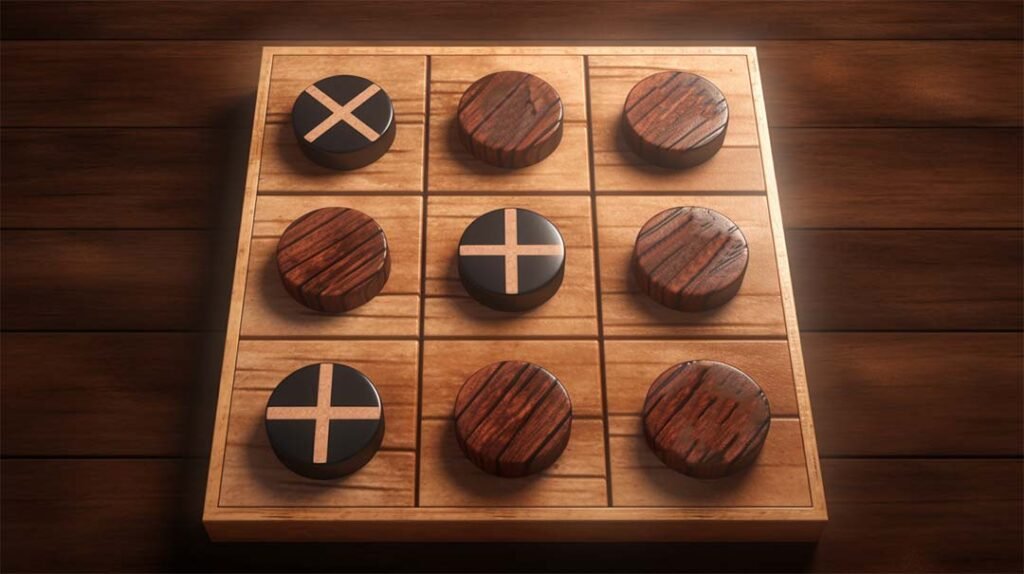
Nine cells, ten pieces, and a game that is completely solved: with perfect play it is always a draw. That does not make it a bad product, because most players do not play perfectly, and the skill it teaches is spotting a fork.
Specification that matters: piece diameter against cell size. A piece should be no more than three quarters of the cell, or placing one nudges its neighbours. And pieces below 31.7 mm fall inside the small-parts cylinder used in EN 71-1, which decides the age grade.
A dice game with hinged numbered tiles. Roll, then flip down any combination of tiles that adds up to the roll. The aim is to close every tile, and the game is short enough to play repeatedly, which is what makes it work as a pub or cafe product.
Specification that matters: the hinge. It is the only moving part and it takes every impact. A brass or stainless hinge outlasts a plated one by years, and it is the difference between a product that survives a bar table and one that does not.
Jump one peg over another into an empty hole and remove the jumped peg. The aim is to leave a single peg on the board. It is a puzzle rather than a game, which makes it a different product: it sells to a different customer and it sits on a different shelf.
Specification that matters: hole diameter and peg diameter, and the tolerance between them. A peg that is loose in its hole feels cheap and a peg that binds is unplayable.
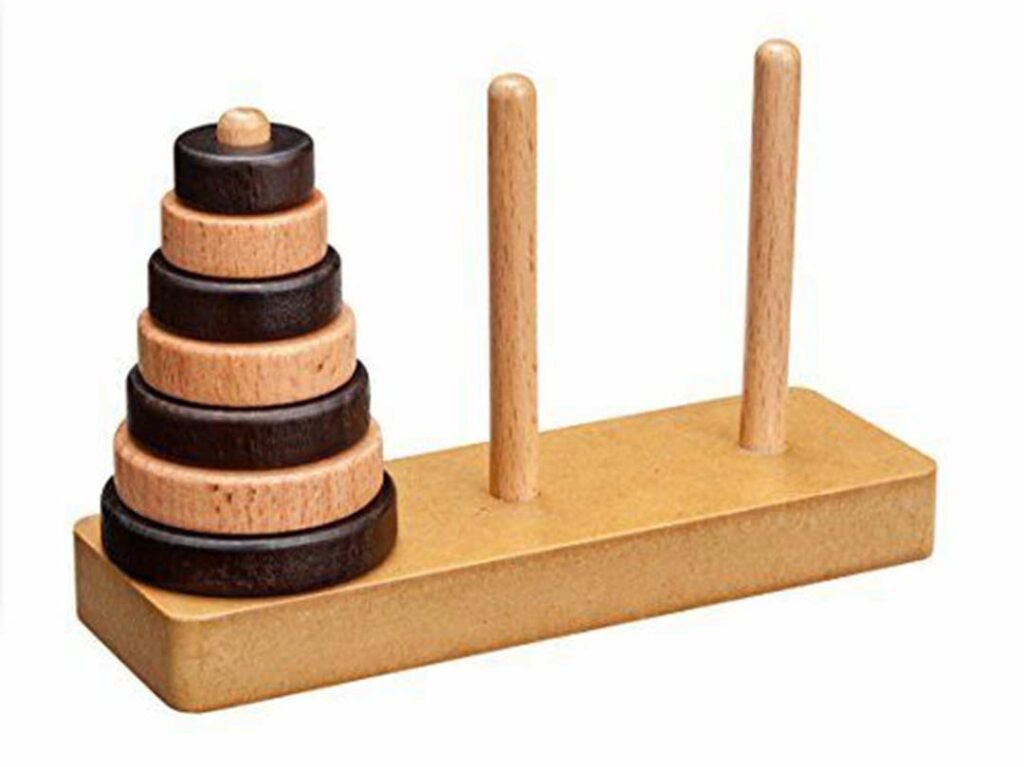
Three pegs, a stack of discs of decreasing size, and one rule: never place a larger disc on a smaller one. The minimum number of moves to solve a stack of n discs is 2 to the power of n minus 1, so seven discs takes 127 moves and eight takes 255.
Specification that matters: disc thickness and the fit on the peg. A disc that wobbles on its peg makes the puzzle feel imprecise, and the whole appeal of the product is precision.
Two claims worth correcting, because both appear in most articles on this subject.
Wood is not biodegradable in any useful sense once it is a finished product. A glued, oiled and coated game does not break down in a garden, and describing it as biodegradable is a claim that will not survive a determined customer. What is true is that the timber is renewable, that it stores carbon for as long as the product exists, and that it can go to energy recovery at end of life.
Wooden games are not all-weather. UV greys the surface and breaks down lignin, water causes the swell and shrink cycle that opens joints, and freeze-thaw does more damage in one winter than a summer of rain. A well-built set kept under cover lasts five to ten years. The same set left out lasts one or two.
The honest case for wood is narrower and stronger than the marketing version: it is dense enough to stay put in wind, it is warm to handle, it can be repaired rather than replaced, and it looks like something worth leaving out where guests can see it.
Partly. The timber is renewable and stores carbon for as long as the product lasts, and FSC or PEFC chain of custody is the document that evidences where it came from. What is not true is that a finished wooden game is biodegradable; a glued and coated product does not break down in a garden. The strongest environmental argument is longevity, not material label.
Keep them dry and out of direct sun between games. Store under cover through winter, bring mallets and bats indoors, and wipe the playing surfaces rather than washing them. If the finish is a water-based clear coat, it can be lightly sanded and recoated in year three, which is what gives the product a second life.
Yes. Engraving, staining, printed or engraved playing surfaces, branded bags and custom cartons are all straightforward and do not change the tooling. Minimum order is 500 sets, with samples in 5 to 10 days and production in 30 to 45 days.
Kubb, because batons are shared within a team rather than owned by a player, so it scales to twelve people without anyone waiting long. A tumble tower also works at any number, for a different reason: everyone is watching the same tower.
Because they are social in a way that does not need explaining. Everyone is in the same place, looking at the same object, and nobody is holding a screen. That is the entire argument, and it does not need a statistic attached to it.
If you are specifying a wooden game range and want the material and finish options in writing, send us the brief. We will come back within 24 hours with the species, moisture content, finish and tolerances we would use, plus the carton dimensions your forwarder will ask for.
Get a free copy of our catalog
Trust our wooden game experts to deliver premium quality and unbeatable value, on-time and on-budget.
kangjiegardengame.com
Typically replies within minutes
How Can We Assist You Today?
WhatsApp Us
🟢 Online | Privacy policy
WhatsApp us
Get notified about new products
Custom garden games available—our expert design team brings innovative ideas to life.