
Main Menu
A garden cricket set is not a cricket set. That distinction is the whole product, and most listings blur it.
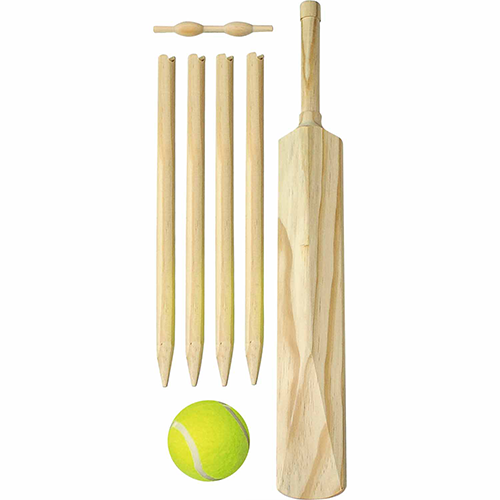
Real cricket is eleven a side, a 20.12 metre pitch, a hard leather ball weighing 156 to 163 grams, and protective equipment that costs more than the bat. Garden cricket is one bat, one soft ball, one stump, and as many people as fit on the lawn.
What follows is what the product actually is, what the wood does and does not do, and where these sets fail.
| Component | Garden set | Match cricket |
|---|---|---|
| Bat | 76 to 79 cm, roughly junior size 4 or 5 | 965 mm maximum, pressed willow, about 1.2 kg |
| Ball | Rubber or tennis ball, 60 to 80 g | Leather, 156 to 163 g, 22.4 to 22.9 cm circumference |
| Wicket | One stump, sometimes three | Three stumps, 22.86 cm wide, 71.1 cm tall, plus bails |
| Pitch | Whatever lawn exists | 20.12 m between popping creases |
| Protection | None | Pads, gloves, helmet, box |
| Players | 1 to 4 | 22 |
A hard leather ball at 156 grams, thrown at even sixty kilometres an hour, breaks fingers and teeth. No garden set should ship with one, and any set that does is being sold to adults who will use it in a garden where children are standing.
A tennis ball is the sensible default. It is light, it bounces, and it hurts without injuring. A soft rubber practice ball is the alternative and it behaves more like the real thing at low speed.
If a customer asks for a proper ball, that is a different product with a different liability profile, and it should be sold with the protection that goes with it.
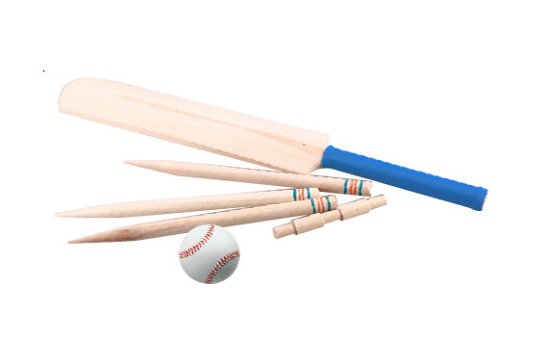
Three reasons hold up and one does not.
A wooden bat has enough mass to transfer energy into the ball. A hollow plastic bat flexes on impact and loses most of that energy, which is exactly why plastic bats feel dead in the hand.
Wood absorbs the vibration of a mis-hit. A plastic bat rings, and the ring goes straight into the hands and wrists. This is why a child will stop playing with a plastic bat after a stinger and keep playing with a wooden one.
A wooden bat can be sanded and re-oiled. A cracked plastic bat is scrap, and it cracks at the shoulder within a season.
“Eco-friendly” as a blanket claim. Wood is renewable and it is lower-impact than injection-moulded plastic, and both of those are true. It is also not the whole story once a finish, a glued handle and a printed carton are involved, and a buyer who repeats the claim without qualification will eventually be asked to defend it.
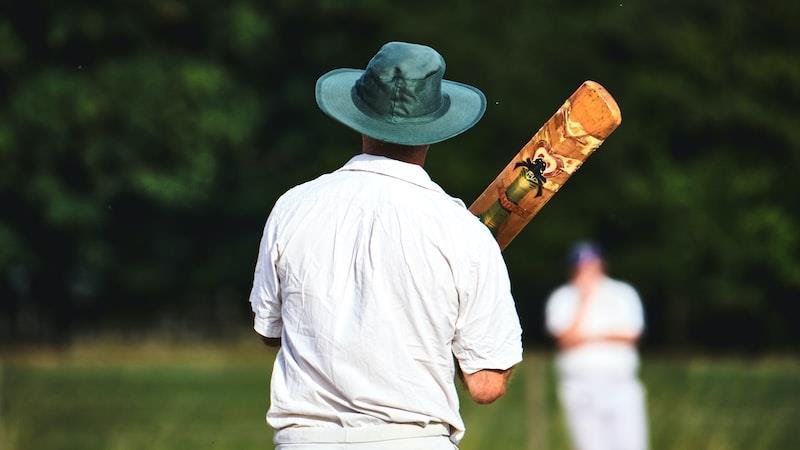
Cricket bats are made from cricket bat willow, Salix alba var. caerulea, a specific cultivar grown for the purpose, pressed and then shaped. A garden set is not made from it. A single cleft of bat willow costs more than a whole garden set retails for.
| Species | Density | Good for | Failure mode |
|---|---|---|---|
| Beech | About 720 kg/m3 | Bat blades, stumps | Hard and dense, takes impact well. Splits if the grain runs out at the shoulder |
| Rubberwood | About 600 kg/m3 | Bat blades, stumps | Consistent and cheap. Dents rather than splits, so it wears out slowly |
| Pine | About 500 kg/m3 | Stumps only | Too soft for a bat face. It compresses under repeated impact and the face goes concave |
| Bat willow | About 420 kg/m3 | Match bats only | Not used in garden sets. Requires pressing, and the material cost is prohibitive |
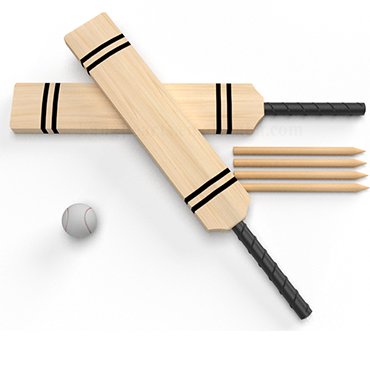
Four failure points, in the order they come back to us.
End grain plus wet grass. Once water gets in, the toe swells, the grain opens and the bat splits across the bottom. The fix costs almost nothing: seal the end grain, and tell the customer to stand the bat up rather than resting it on its face in the grass.
The bat is a blade plus a handle, spliced and glued, then bound with twine and a grip. That join takes the entire torque of a mis-hit. On cheap sets the splice is short and the glue is the weak link, and the bat fails by rotating in the hand rather than breaking in two.
A stump driven into the ground absorbs water at the bottom fifty millimetres and rots upward from there. A rubber foot solves it and costs a few cents, which is why its absence tells you something about the rest of the build.
Not a wood failure, but the thing that gets complained about. Rubber balls go hard and lose bounce after a season in the sun, and a set that plays badly is blamed on the bat.
Laser engraving on the striking face creates a stress riser at the edge of the engraved area. On a bat that gets hit, that is where it will eventually crack. Engrave the back of the blade, or the handle, or the box. If a customer insists on the face, tell them what it does rather than just doing it.
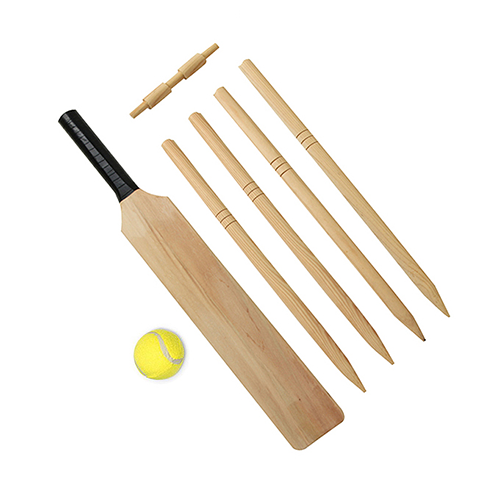
Bat willow, pressed blades, match-grade equipment. If a customer needs a real cricket bat, we are the wrong supplier and we will say so before quoting. The category is garden sets, and the honest version of that product is a good beech or rubberwood bat with a sealed toe and a tennis ball.
Minimum order 500 sets. Samples in 5 to 10 days, bulk production 30 to 45 days after sample approval. Quotes within 24 hours of a specification.
Customisation that works: engraving on the back of the blade, stained handles, team colours on the stump, printed carton, and a logo burned into the box. Engraving on the striking face is the one thing we will push back on.
Cartons run 10 to 20 sets depending on bat length. We will send the carton dimensions and the cube with the quote, because your forwarder will ask for them and it is faster if nobody has to email twice.
Garden cricket works because it is the cheapest way to get a bat and a ball into a garden and start a game whose rules everyone already half-knows. Nobody has to be taught the objective, only the house rules.
It is also the category where the honest specification matters most, because the difference between a set that lasts three summers and one that lasts one is about two dollars of material, a sealed toe, and a ball that is not too hard.
We sign NDAs. If you are developing a private-label set with a specific bat length, handle wrap or carton design, send the brief and we will work under one.
Mass and damping. A wooden bat transfers energy into the ball, so the ball actually goes somewhere. A hollow plastic bat flexes and loses most of that energy, and it rings in the hands on a mis-hit, which is why children stop using it. A wooden bat can also be sanded and re-oiled; a cracked plastic one is scrap.
A soft ball, either a rubber practice ball or a tennis ball, depending on the set. We do not supply a hard leather ball with any garden set. A 156 gram leather ball at sixty kilometres an hour breaks fingers, and garden sets get used where children are standing.
Seal the end grain on the toe, not just the faces, and machine at 8 to 12 percent moisture content. The failure is water entering the end grain and swelling the toe until the grain opens. Sealing costs very little and it is the difference between one season and several.
500 sets. Samples in 5 to 10 days, bulk production 30 to 45 days after sample approval. Quotes come back within 24 hours of a specification, including carton dimensions and cube.
Yes. Engraving on the back of the blade, stained handles, team colours on the stump, and a printed carton. We do not engrave the striking face, because the edge of the engraved area becomes a stress riser and that is where the bat will eventually crack.
Get a free copy of our catalog
Trust our wooden game experts to deliver premium quality and unbeatable value, on-time and on-budget.
kangjiegardengame.com
Typically replies within minutes
How Can We Assist You Today?
WhatsApp Us
🟢 Online | Privacy policy
WhatsApp us
Get notified about new products
Custom garden games available—our expert design team brings innovative ideas to life.