
Main Menu
The Tower of Hanoi is one of the very few wooden puzzles that is also a piece of mathematics you can hold. That makes it a good product and a difficult one to buy well, because most sets on the market are built to look correct rather than to play correctly, and the difference only appears once someone sits down with one.
This article covers what the puzzle actually is, the four physical details that decide whether a set works, how many disks to specify, and what to put in an order specification so that the set you receive matches the sample.

Three pegs on a base, and a stack of disks of decreasing size on the first peg. The task is to move the entire stack to another peg, under three rules that never change:
Only one disk may be moved at a time.
Only the top disk of a stack may be moved.
A larger disk may never be placed on a smaller one.
Those three rules produce a puzzle with a known and exact solution. The minimum number of moves for n disks is 2n minus 1.
| Disks | Minimum moves | Who it suits |
|---|---|---|
| 3 | 7 | Young children, first contact |
| 5 | 31 | Casual adult play |
| 8 | 255 | The standard retail version |
| 10 | 1023 | Display piece, very few finish it |
That table is the most useful thing on this page for a buyer. A ten-disk set looks impressive and is effectively unsolvable for a casual player, because a thousand moves at one move every two seconds is over half an hour of unbroken concentration with no mistakes allowed. An eight-disk set is the version most people can actually complete, which is why it is the standard.
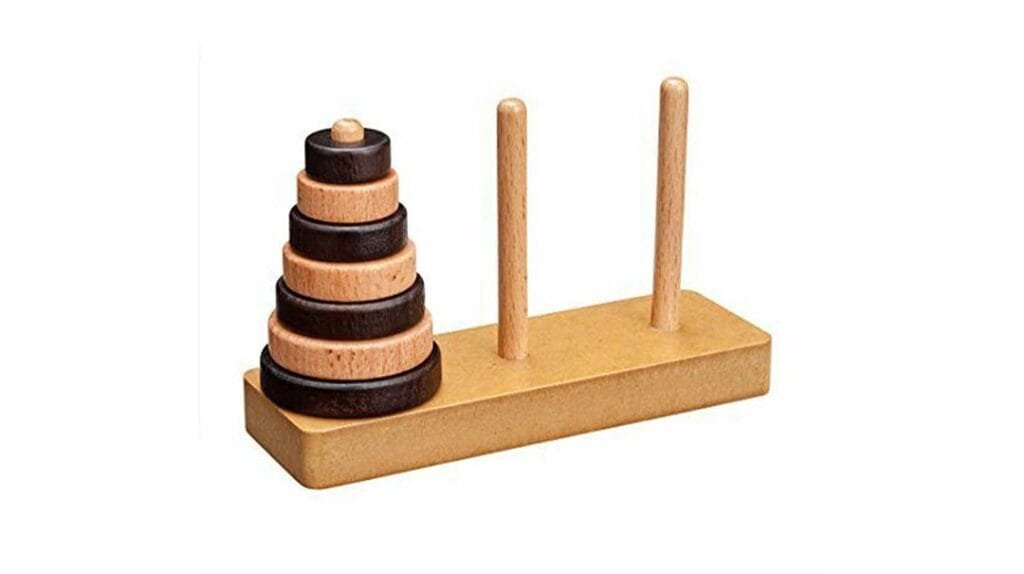
This is the single most important specification and the one most often left out of a quotation.
A disk that is too thin feels like a token and slides rather than lifts. A disk that is too thick makes the tower unstable at the top and the puzzle physically awkward. The right thickness scales with the disk diameter: a set with 60 mm disks needs roughly 12 to 15 mm of thickness to feel like a solid object in the hand.
Ask for the disk thickness in millimetres for the smallest and the largest disk, not an average. On a well-made set the thickness is constant across all disks, because a set where the small disks are thinner than the large ones feels wrong immediately even if nobody can say why.
The disks have to drop onto the peg without binding and without rattling. That is a tolerance question, and it is where cheap sets fail.
If the hole is too tight, the disks stick, and a puzzle that sticks is not a puzzle. If the hole is too loose, the tower leans and the player can see the wobble. A clearance of roughly 1 to 1.5 mm on the peg diameter is the range that feels right.
The base matters as much. Three pegs on a thin base will tip when someone leans on the tallest stack, and a puzzle that falls over mid-solve is the most common complaint on entry-level sets. A base thickness that is at least equal to the largest disk thickness, with the pegs set well inside the edges, solves it.
Every disk edge gets handled constantly, and an edge that has not been properly rounded will feel sharp within a few minutes of play. This is not a cosmetic issue: a burr on a disk edge is a splinter risk, and on a children’s product it is a compliance issue as well.
Ask how the edges are finished. A radius on both faces of every disk, sanded to at least 180 grit before finishing, is the baseline. A set where only the outer rim has been rounded and the hole edge has not is a set that was made quickly.
On finish: a hardwax oil or a water-based lacquer both work. What matters is that the finish is applied to the hole as well as the faces, because an unfinished hole will swell and bind in a humid room.

Disk count is the specification that decides who the product is for, and it is worth choosing deliberately rather than defaulting.
Five disks is a children’s product. Thirty-one moves is completable by a seven-year-old in a few minutes, which is the right length of attention for that age.
Eight disks is the adult retail standard. Two hundred and fifty-five moves takes most people fifteen to twenty-five minutes on a first attempt and considerably less once they understand the pattern. This is the version that sells.
Ten disks is a display and gift product. It photographs beautifully and it is a genuine challenge, but be honest in the copy about what it takes, because a customer who buys it expecting a coffee-table puzzle and finds a thousand-move commitment will return it.
A useful pattern for a range is to offer the same design in two disk counts at two price points, because the tooling is shared and the difference in material cost is small.
The Tower of Hanoi is not a garden game and it should not be positioned as one. It is a tabletop puzzle, which makes it useful for a different reason: it has no seasonality.
Garden games peak in spring and early summer. A puzzle sells steadily all year, peaks before Christmas as a gift, and does well in museum shops, bookshops, education suppliers and corporate gifting. For a buyer with a seasonal order book, that makes it a useful product to smooth out the year.
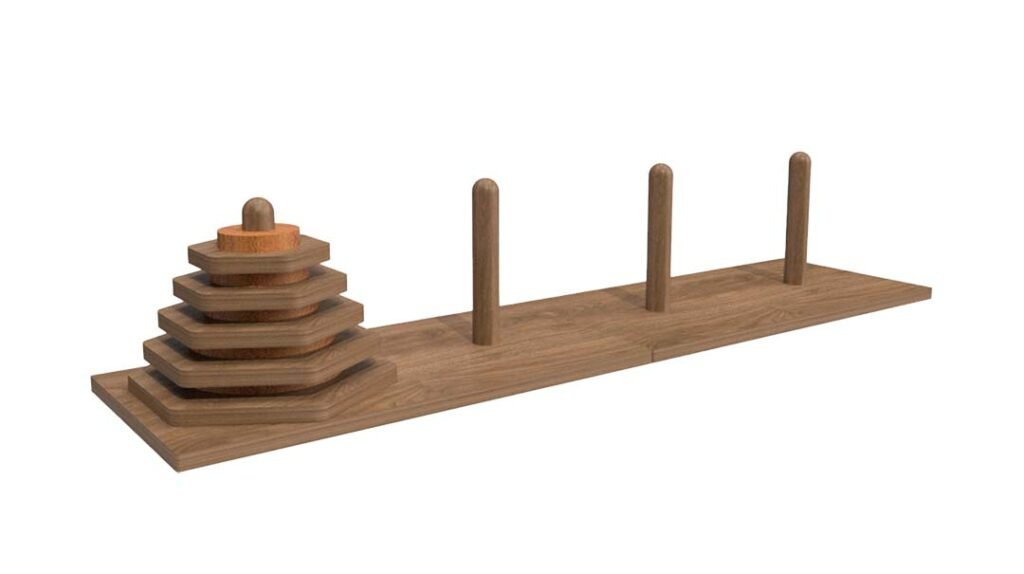
It is also one of the cheapest products in the category to customize, because every disk face is a flat circular surface and the base is a large flat panel. Laser engraving a logo on the base or on the largest disk costs very little and turns the product into a gift.
Minimum order. Around 500 sets per design for a custom run. Below that, a stock design with your branding applied is usually the better route, because the setup cost is spread over too few units to make sense.
Samples. Five to ten days after the specification is agreed. On a puzzle this is not optional: the whole product is judged by how it feels in the hand, and no photograph answers that.
Production. Thirty to forty-five days after sample approval. The window assumes the specification stops changing at approval, which is the single biggest cause of delay in this category.
Compliance. If the product is marketed to children, it needs testing to EN 71 for Europe or ASTM F963 for the United States. For US imports the importer issues the Children’s Product Certificate on the basis of those reports, and a tracking label has to be applied to the product and the packaging.
Six lines in a specification prevent almost every dispute on this product.
Disk count, and the diameter of the largest and smallest disk.
Disk thickness in millimetres, constant across the set.
Peg diameter and the resulting hole clearance.
Base dimensions and thickness, and whether the pegs are through-fixed or dowelled into the base.
Timber species and finish type, with the number of coats.
Edge treatment: radius on both faces of every disk and inside every hole.
A supplier who can answer all six without going away to check is a supplier who makes the product. A supplier who answers three and improvises the rest is a supplier who will buy it in and put your logo on the box.
Two clarifications that come up on almost every order.
FSC covers the timber, not the product. It is a chain-of-custody certification for the wood supply and it says nothing about whether the finished puzzle is safe. Both matter, but they answer different questions and should not be presented as one thing.
Age labelling should follow the tested configuration. A set with small disks has small parts, and small parts carry a choking risk for children under three. The age statement on the box has to match what was actually tested, not what marketing would prefer.
None of this is complicated, but it has to be decided before the packaging is printed, because the tracking label and the age marking are physical requirements rather than stickers added later.
The Tower of Hanoi is a good product because it has real content behind it: a defined puzzle, a known solution, and a difficulty that can be tuned by changing one number. That makes it easy to explain and easy to sell to a customer who wants something with substance rather than another lawn ornament.
It is also easy to make badly, and the failures are all in the details that a photograph cannot show: disk thickness, hole clearance, base stability and edge sanding. Those four things are the product. Everything else is packaging.
2 to the power of the number of disks, minus 1. So 3 disks takes 7 moves, 5 disks takes 31, 8 disks takes 255, and 10 disks takes 1,023. The formula is exact, not an estimate.
Eight for a general retail product, five for a children's version, ten only if you are selling it as a display or gift piece and are prepared to say in the copy that it is genuinely hard.
Hardwood for the disks, because softwood bruises at the edges and the edges are handled constantly. Finish is a hardwax oil or a water-based lacquer, applied to the hole as well as the faces so the disks do not swell and bind in humid conditions.
Yes for the larger-disk versions, with an age statement that matches what has been tested. Any set with small parts carries a choking risk for children under three, so the tested configuration decides the label rather than the other way round.
Yes, and it is one of the cheapest customization options in the whole wooden game category, because the base is a large flat panel and the disk faces are flat circles. Engraving the base is the usual choice for corporate orders.
Sourcing custom wooden garden games?
We manufacture direct in Guangzhou: 500-set minimum, quotes within 24 hours, samples in 5–10 days, production in 30–45 days, EN71 and ASTM F963 compliance, FSC-certified timber. Send your specification: contact us
Get a free copy of our catalog
Trust our wooden game experts to deliver premium quality and unbeatable value, on-time and on-budget.
kangjiegardengame.com
Typically replies within minutes
How Can We Assist You Today?
WhatsApp Us
🟢 Online | Privacy policy
WhatsApp us
Get notified about new products
Custom garden games available—our expert design team brings innovative ideas to life.