
Main Menu
The question contains a mix-up worth clearing up first, because it changes the answer completely.
Bowling is not a garden game. A bowling lane is a building: 18 metres of hard maple and pine, installed by a specialist contractor, and nobody makes one out of a garden set. What the question is probably reaching for is either garden bowling — skittles, in its many forms — or the timber trade that supplies lanes.
So this covers three genuinely different problems: a building material, a set of striking tools, and a flat panel that has to stay flat. The species are different because the problems are different.
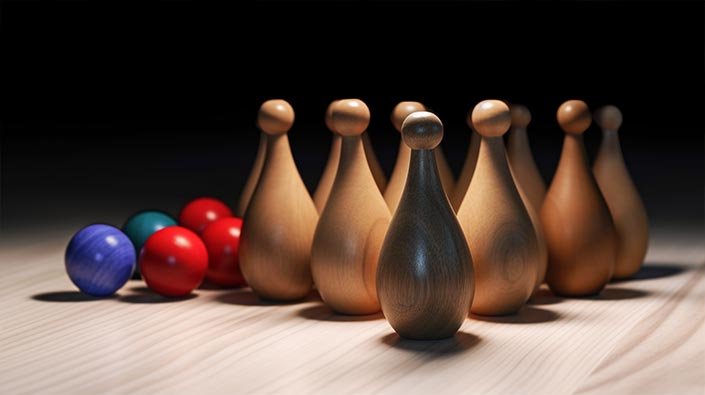
A regulation lane is hard maple for the first 4.6 metres of the approach and the pin deck, with pine for the main run. The maple takes the impact of a 7 kg ball landing; the pine is there because it is cheaper and the ball has stopped bouncing by then.
Almost no new lane is solid timber. Synthetic lanes — a melamine or phenolic surface on a particleboard core — have been the default for decades, because they are consistent, they do not need resurfacing, and they cost less to install.
What this means for a garden game supplier: nothing. The species used in lanes are irrelevant to what you sell. The useful takeaway is the design principle, which does transfer: put the hard, dense material where the impact is and the cheap material where it is not.

Traditional croquet equipment used two species that are now effectively unavailable, and this matters commercially because customers ask for “traditional” without knowing what it means.
Modern sets use beech, ash, hickory or rubberwood for heads, and a composite or hardwood ball. That is not a downgrade in playability, but it is a different product, and calling it traditional invites a comparison it will lose.
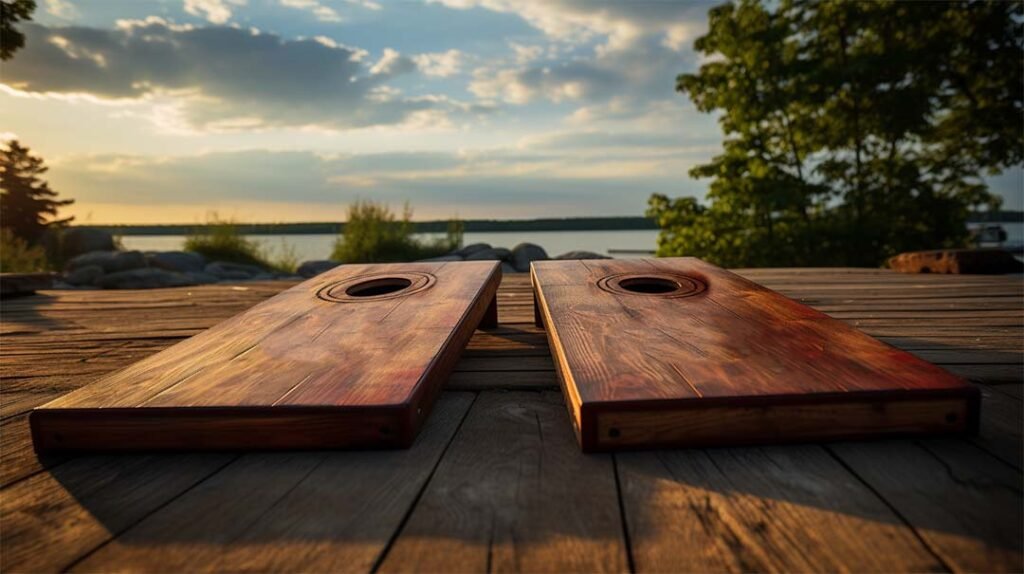
Cornhole boards are plywood, and the reason is dimensional stability rather than cost.
A solid wood panel 1,220 by 610 mm will cup, bow and twist as it takes on and loses moisture across the seasons. A plywood panel will not, because the crossed plies restrain each other. That is the entire argument, and it is decisive for a product that lives outdoors.
What to specify:
Not hardness, which is what most buyers ask about first.
Hardness comes fifth, and it only matters where the surface is a playing surface — a croquet ball, a skittle, a puck.
There is no such thing as a weatherproof wooden garden game. There are species that resist rot, and there is a finish that slows water uptake, and neither is the same as surviving a winter outside.
| Species | Density | Rot resistance | Where it belongs |
|---|---|---|---|
| Teak | About 630 kg/m3 | High, from natural oils | Premium sets. Expensive and increasingly hard to source |
| Cedar | About 380 kg/m3 | High | Boards and posts that stay outdoors. Soft, so it dents |
| Thermowood | About 450 kg/m3 | High, without chemicals | Outdoor boards. Brittle at thin sections |
| Robinia / acacia | About 750 kg/m3 | High | Pieces that take impact and stay out |
| Beech | About 720 kg/m3 | Low | Mallets, pins, pieces. Indoors or stored |
| Rubberwood | About 600 kg/m3 | Low | High-volume sets. Always needs a finish |
| Pine | About 500 kg/m3 | Low | Cheap framing and stumps. Compresses under impact |
UV is the part people forget. Sunlight breaks down lignin at the surface and the wood greys, which is cosmetic. Freeze-thaw is the part that does damage: water enters a joint or a glue line, freezes, expands, and the joint opens. A set left out through a northern winter will not fail because of the species. It will fail at the joints.
There is no such thing as a weatherproof wooden garden game. There are species that resist rot, and there is a finish that slows water uptake, and neither is the same as surviving a winter outside.
| Species | Density | Rot resistance | Where it belongs |
|---|---|---|---|
| Teak | About 630 kg/m3 | High, from natural oils | Premium sets. Expensive and increasingly hard to source |
| Cedar | About 380 kg/m3 | High | Boards and posts that stay outdoors. Soft, so it dents |
| Thermowood | About 450 kg/m3 | High, without chemicals | Outdoor boards. Brittle at thin sections |
| Robinia / acacia | About 750 kg/m3 | High | Pieces that take impact and stay out |
| Beech | About 720 kg/m3 | Low | Mallets, pins, pieces. Indoors or stored |
| Rubberwood | About 600 kg/m3 | Low | High-volume sets. Always needs a finish |
| Pine | About 500 kg/m3 | Low | Cheap framing and stumps. Compresses under impact |
UV is the part people forget. Sunlight breaks down lignin at the surface and the wood greys, which is cosmetic and harmless. Freeze-thaw is the part that does damage: water enters a joint or a glue line, freezes, expands, and the joint opens. A set left out through a northern winter will not fail because of the species. It will fail at the joints.
Four things to put in a specification, in the order that decides whether the shipment is usable.
Three games, three different timber problems. A bowling lane is a building and its species are irrelevant to a garden catalogue. Croquet’s traditional species are CITES-restricted and effectively gone. Cornhole is plywood because plywood stays flat.
The general rule that comes out of all three: choose for stability and grain before hardness, and finish the end grain before the face.
For struck parts, wood absorbs impact where plastic cracks and metal dents permanently. For flat panels, plywood is more stable than any moulded plastic at the same stiffness. Metal is used where it belongs: hooks, fasteners, and the wire parts of a ring game.
Keep it dry and out of the sun. Oil the end grain twice a year with a penetrating oil, not a film finish. Do not store it in a car boot in summer, and do not leave it out overnight where dew will reach it.
Because the demand changes. A cornhole top needs to stay flat, a mallet head needs to absorb impact without splitting, and a handle needs to flex. Those are three different material properties and no single species is best at all three.
Yes, and they are usually pine or a lower grade of rubberwood. That is a legitimate choice for a high-volume set, as long as the specification says so. What is not legitimate is calling pine a hardwood.
Yes. Species substitution, board size, finish colour, engraving and carton design are all quotable. The one thing we will push back on is a species that cannot be legally exported or imported.
If you are specifying a wooden game range and need the species options in writing, send us the game, the target market and the volume. We will come back with the species we would use, the moisture content, the grain requirement and the carton dimensions.
Get a free copy of our catalog
Trust our wooden game experts to deliver premium quality and unbeatable value, on-time and on-budget.
kangjiegardengame.com
Typically replies within minutes
How Can We Assist You Today?
WhatsApp Us
🟢 Online | Privacy policy
WhatsApp us
Get notified about new products
Custom garden games available—our expert design team brings innovative ideas to life.