
Main Menu
There is no single size, because “four in a row” describes a rule rather than a product. What exists is a range from a 250 mm tabletop set to a 1.6 m garden board, and the size you want is determined by one number: the disc diameter.
Everything else follows from it. The frame height, the overall width, the weight and the price are all functions of how big the discs are.
Here is the range, the ratios that keep a set playable, and the size that suits each use.
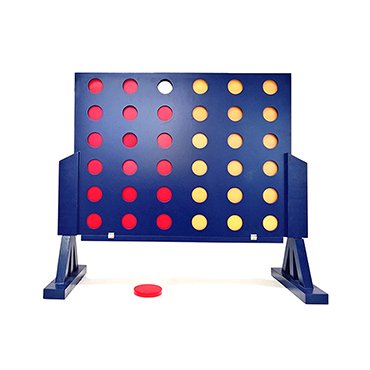
Two players drop discs into a grid of seven columns and six rows, and the first to line up four of their own colour horizontally, vertically or diagonally wins.
Two consequences follow from the grid. Forty-two cells means twenty-one discs each, so a full board uses every disc exactly once. And because the game is small and finite, it has been solved: with perfect play the first player wins.
Milton Bradley first sold it in February 1974, designed by Howard Wexler and Ned Strongin. It had appeared earlier under other names, including The Captain’s Mistress, and the underlying game is much older than any of the commercial versions.
The specific trade name is a Hasbro mark. In your own catalogue, describe the game rather than the brand: four in a row, four in a line, or drop four.
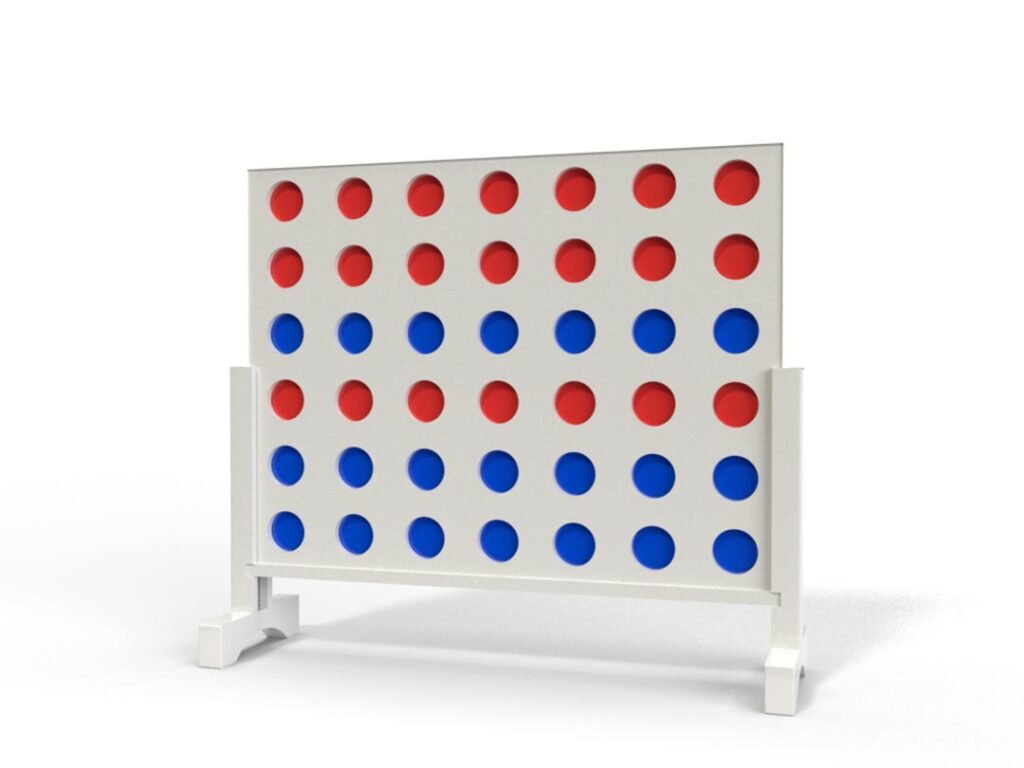
Sort by disc diameter rather than by overall size, because the disc is what the player touches and what the price scales with.
| Category | Disc diameter | Overall size | Weight | Use |
|---|---|---|---|---|
| Travel | 15 to 20 mm | About 150 x 130 mm | Under 0.3 kg | A bag, a car, a restaurant table |
| Standard tabletop | 25 mm | About 250 x 300 mm | 0.6 to 1 kg | The classic. A coffee table |
| Family wooden | 35 to 50 mm | 350 to 450 mm | 1.5 to 3 kg | A dining table or a picnic |
| Giant floor | 65 to 90 mm | 600 to 800 mm | 4 to 7 kg | A floor, a patio, a function room |
| Giant garden | 150 to 200 mm | 1,200 to 1,600 mm | 12 to 18 kg | A lawn or an event space |
The awkward gap is between 90 and 150 mm. A set with 110 mm discs is too big for a table and too small to read as a garden game, and it sells badly for exactly that reason.
Forty-two discs, twenty-one of each colour. That is not a packing decision: seven columns by six rows is forty-two cells, so the disc count is exactly the board’s capacity and each player gets half.
Three ratios decide whether the set plays properly:
At the standard 25 mm disc that gives a cell of about 33 mm and a board around 250 mm wide. At 150 mm it gives a cell of about 200 mm and a board of 1.4 m.
Carton size is driven by the frame rather than the discs, and it is the number a forwarder will ask for first.
| Category | Carton, typical | Units per carton | Cube per unit |
|---|---|---|---|
| Standard tabletop | 320 x 270 x 60 mm | 6 to 12 | 0.005 m3 |
| Family wooden | 480 x 420 x 90 mm | 4 to 6 | 0.018 m3 |
| Giant floor | 850 x 700 x 160 mm | 1 to 2 | 0.095 m3 |
| Giant garden | 1,650 x 450 x 250 mm | 1 | 0.19 m3 |
The giant garden set is the one that changes the economics. At 0.19 m3 per unit, a 40-foot container holds roughly 350 sets before palletisation, which is why freight becomes a larger share of landed cost than the wood does.
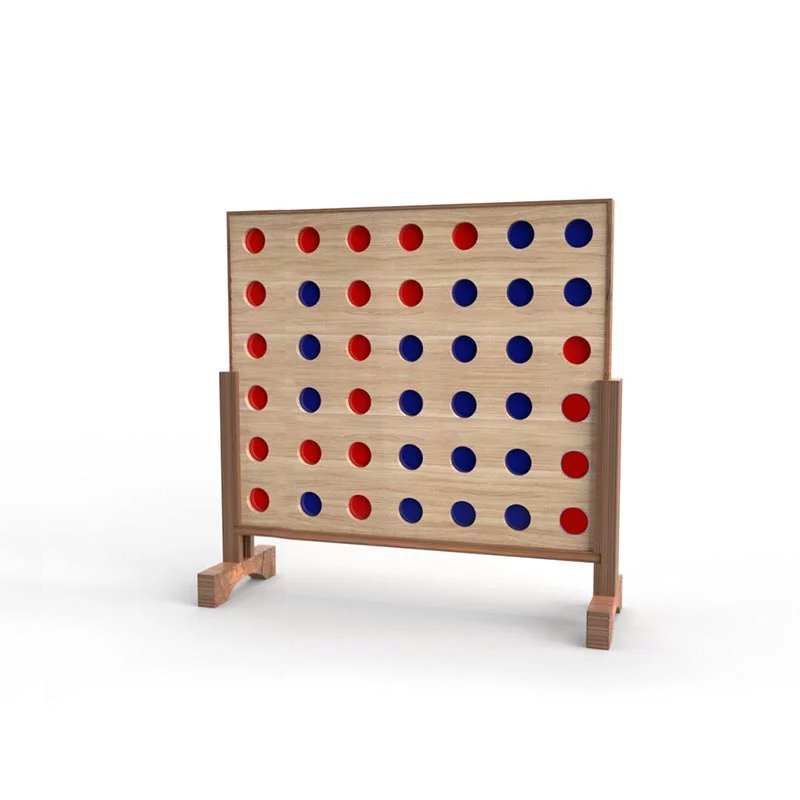
A bigger board is not just a bigger version of the same game, for three reasons.
Above 800 mm the set stops being portable in any normal sense. A 1.2 m board is 12 to 18 kg with the discs, it does not fit in a car boot with the seats up, and it takes two people to move safely.
If portability matters, the answer is a giant floor set at 600 to 800 mm rather than a garden set. If it does not, the garden set is the one that gets used at events.
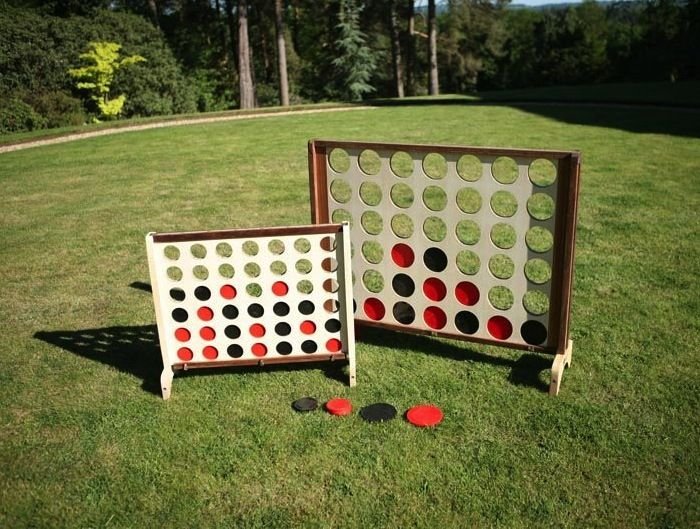
Beyond the size range, the meaningful variants are structural rather than dimensional.
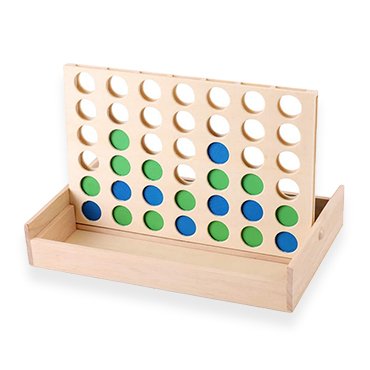
There is no single size. There is a range from a 150 mm travel set to a 1.6 m garden board, and the disc diameter determines everything else.
Pick the disc diameter by where the game will be played, then check the three ratios: disc to cell, thickness to diameter, and slot clearance. Those decide whether the set plays properly at any size.
About four, on a tabletop set. The rules take a minute and there is nothing to read. Watch the small-parts rule on travel sets, where the discs are under 31.7 mm.
Yes, with discs of 15 to 20 mm. They work, and the discs are small enough to be a hazard for children under three.
No. Disc diameter ranges from 15 mm to 200 mm across the category, and every other dimension scales from it.
Yes. Disc diameter, frame height, finish colour and engraving are all quotable. What should not change is the ratio of disc to cell, because that is what makes it playable.
About 25 mm on the classic tabletop version, which gives a board around 250 mm wide.
If you are specifying a set, send us the disc diameter and the frame style. We will come back with the overall dimensions, the weight, the carton size and the cube.
Get a free copy of our catalog
Trust our wooden game experts to deliver premium quality and unbeatable value, on-time and on-budget.
kangjiegardengame.com
Typically replies within minutes
How Can We Assist You Today?
WhatsApp Us
🟢 Online | Privacy policy
WhatsApp us
Get notified about new products
Custom garden games available—our expert design team brings innovative ideas to life.