
Main Menu
A Tower of Hanoi set has one hazard that almost nobody mentions in a product listing, and it is not the paint or the small parts. It is the peg.
Three vertical hardwood rods, 150 to 250 mm long, standing up out of a base. That is a fall-on hazard, and it is the reason the age grading on these sets matters more than on most wooden toys.
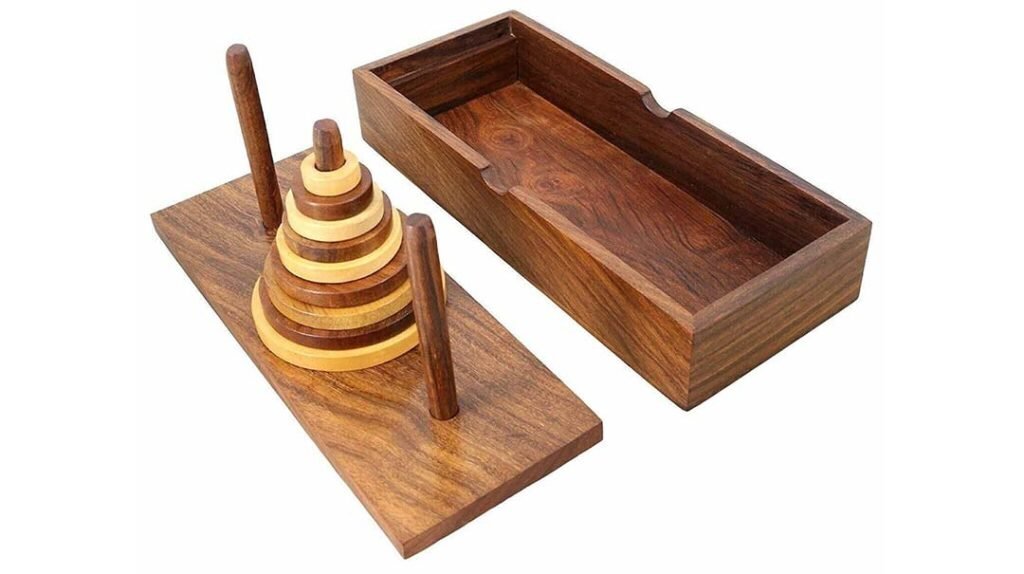
Three pegs, a stack of discs of decreasing size, and one rule: you may only move one disc at a time, and a larger disc may never sit on a smaller one. The puzzle is to move the whole stack from one peg to another.
The minimum number of moves is 2 to the power of n, minus 1, where n is the number of discs. Five discs is 31 moves. Eight discs is 255. That is why the game works as a puzzle at any age: the rules are one sentence and the difficulty is arithmetic.
A 200 mm rigid rod standing vertically out of a base is the hazard. A child falling onto it takes the load in the chest or the throat. The mitigations are all geometric: keep the pegs as short as the disc count allows, round the tops to a full radius, and make the base wide enough that the set tips rather than resists.

The small parts test uses a cylinder 31.7 mm in diameter and 57.1 mm deep. On an eight-disc set the smallest disc is usually well under that, which means the set is not for children under three and the labelling has to say so. On a five-disc set with 60 mm discs the whole set passes, and that is a different product with a different age grading.
EN 71-3 covers migration of nineteen elements from any painted or stained surface. For a set aimed at children this means a test report on the finish, not on the wood. Water-based stains and clear coats are the straightforward route; a solvent lacquer is not automatically a problem but it needs the same testing and it is harder to pass.
Discs should have a 2 to 3 mm edge radius and the base should have no sharp arris. The base also needs enough mass that the set does not slide when a disc is dropped onto a peg, because a set that skitters across a table is a set that ends up on the floor.

Two versions of the same puzzle sit in different regulatory categories.
| Version | Disc diameter | Smallest part | Age grading | Regime |
|---|---|---|---|---|
| Toddler set, 5 discs | 60 to 80 mm | Above 31.7 mm | 3+ | Toy directive, but passes small parts |
| Standard set, 8 discs | 30 to 90 mm | Below 31.7 mm | 3+ with warning, or 6+ | Toy directive, small parts warning required |
| Desk puzzle, 8 discs | 15 to 50 mm | Well below 31.7 mm | 14+ or not a toy | Outside the toy directive if marketed to adults |
The third row is the one that gets missed. A small desk version marketed as an adult executive puzzle is legitimately outside the toy directive, and the same object sold as a children’s game is inside it. The product did not change; the marketing did.

The Tower of Hanoi is a safe product made badly more often than it is an unsafe product. The failures are geometric: pegs too long, bases too light, edges too sharp, and a disc count that puts the smallest piece under the small-parts threshold without the labelling to match.
Get the geometry right and the only remaining question is which age the set is for, and that is a decision about marketing rather than about manufacturing.