
Main Menu
Cornhole and washer toss are usually presented as direct competitors, and they are not quite that. They occupy different footprints, they appeal to different customers, and they fail in different ways. For a buyer the useful question is not which one is better, but which one fits the space and the customer you already have.
Cornhole is the established, high-recognition game with a large playing area and a forgiving throw. Washer toss is the compact, heavier, more precise game that stores flat and travels well. Most retailers are better off carrying both than choosing.
What follows is a practical comparison: how each game plays, where each one wins, and what to inspect before you commit to a production run.
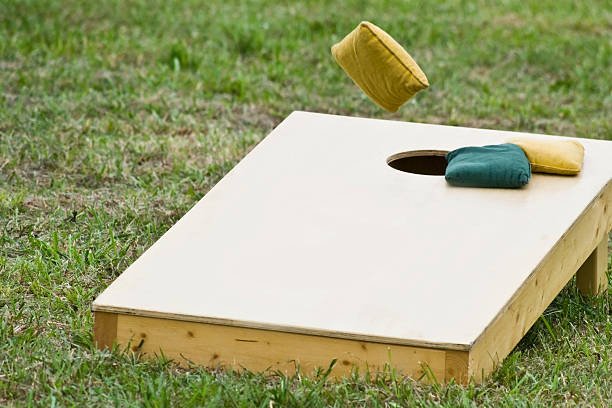
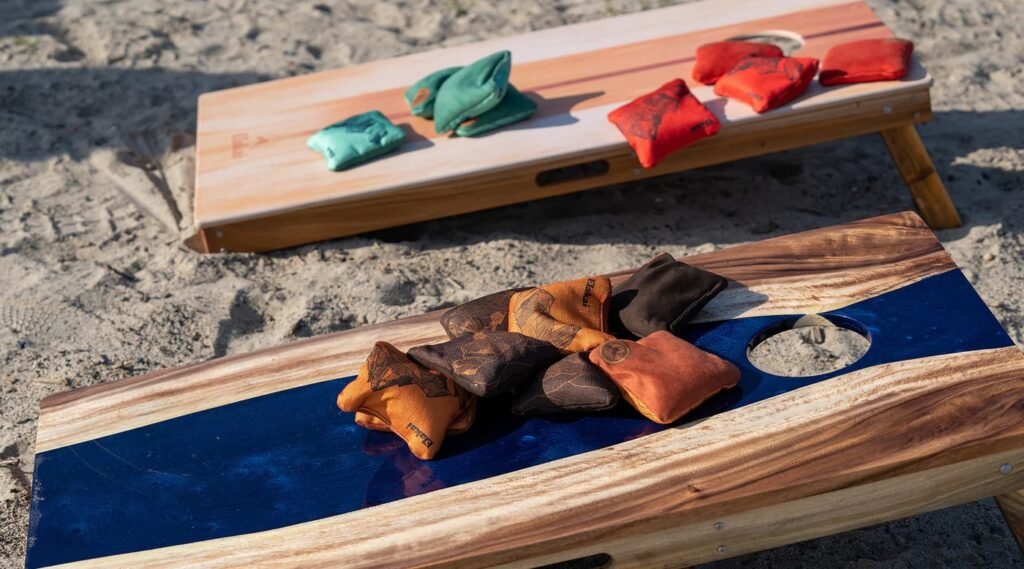
Two angled boards, eight bags, first to twenty-one. Almost every customer in North America already knows how to play, which removes the single biggest barrier to a lawn game sale: teaching.
Players stand level with one board and throw at the other. A bag in the hole scores three, a bag left on the board scores one, and bags on the board can be knocked off by the opponent. That knock-off rule is what gives the game its tactical layer, and it is why the last throws of a round matter more than the first.
The barrier to entry is genuinely low. A child and a grandparent can play the same game from the same distance. It is social without being athletic, which is exactly the combination that works for parties, tailgates and corporate events. The category is mature, so demand is predictable — but the generic end of it is crowded.
Boards are bulky. A standard set is two boards of roughly 60 by 120 cm, and that is a lot of carton for a product with a modest unit price. Storage is the constraint that decides whether a retailer can carry the line at all.
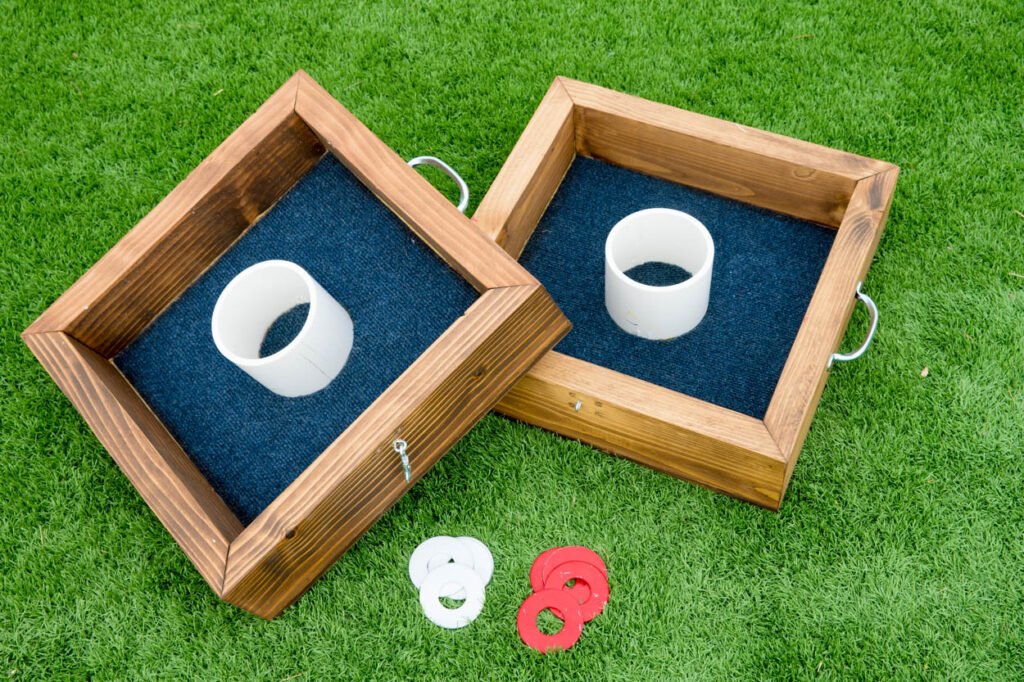
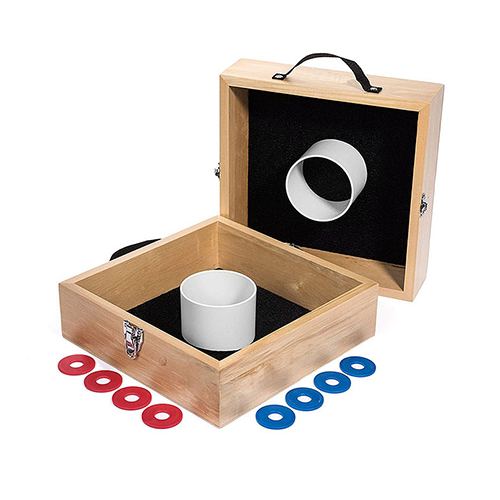
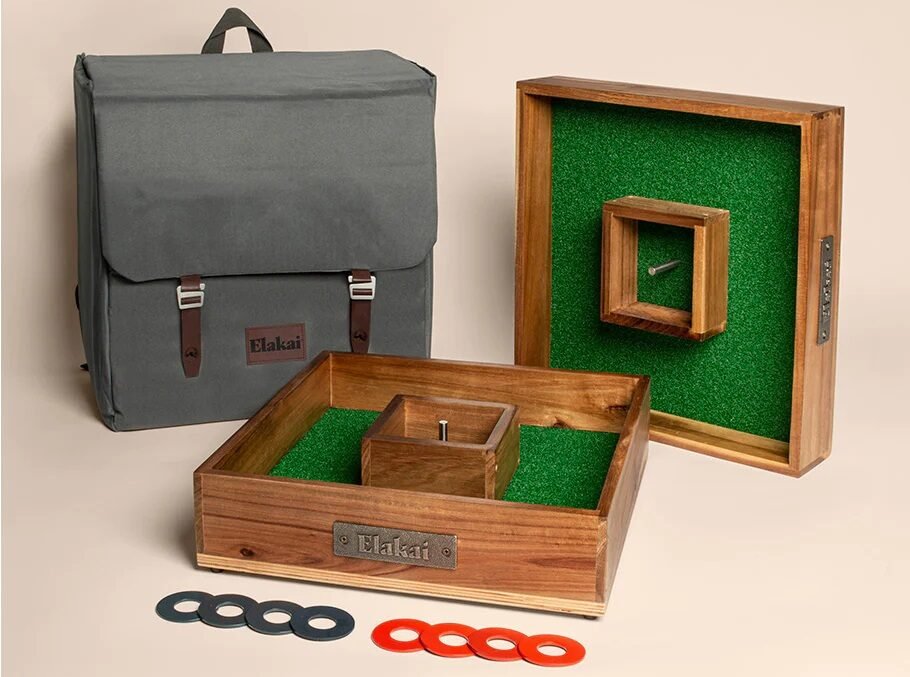
Two boxes on the ground, each with a cup in the centre, and a set of washers. Older than most people assume, and much smaller than cornhole.
Players throw washers at the opposite box. A washer in the cup is usually worth five points, a washer in the box one or three depending on the local rule set, and washers can be knocked out of scoring position. The metal-on-wood sound is why people remember the game.
Footprint. Two small boxes and a handful of washers pack into a fraction of the space a cornhole set needs.
Wind. Washers are heavy and barely affected by wind, which matters on a beach or an exposed lawn.
Playing pieces. There is nothing to absorb moisture, so the parts that wear are the boxes, not the projectiles.
Price point. Less material means a lower unit cost and a lower retail price, which opens an impulse-buy position cornhole cannot occupy.
Recognition. Most customers have not played it, so the packaging and the listing have to do the teaching. And the washers are hard metal, which makes the game unsuitable for very young children and requires a clear age statement on the box.
Cornhole is easier to start. The underhand toss is intuitive and the bag absorbs its own landing, so a poor throw often still stays on the board. Washer toss punishes a poor throw immediately: the washer bounces off or slides past. That makes it less forgiving for beginners and more rewarding for players who practise.
Washer toss, clearly. A cornhole set is two large boards; a washer toss set is two boxes that often nest or stack. For camping, boating, apartments and small patios, the compact game is the only one that realistically leaves the house.
Both are wooden products and neither should be left out in the rain, whatever the finish. The practical difference is that a wet cornhole bag is a real problem, because a damp bag changes weight and flight, while a wet washer just needs drying. Boards and boxes both need to be stored dry and flat.
Cornhole needs roughly 8 to 10 metres of clear ground between boards. Washer toss needs about half of that. On a small urban patio, that difference decides whether the game is playable at all.
Cornhole, on volume and recognition, and it will stay that way because the game is already part of the culture in North America. Washer toss sells in smaller numbers but at a better return per unit of shelf space, precisely because it takes up so little of it.
The decision comes down to your customer. A general outdoor retailer with floor space should carry cornhole as the anchor and washer toss as the compact add-on. A camping, hardware or gift retailer with limited space is often better served by washer toss alone, because a product that fits in a car boot sells in a shop where a product that does not, will not.
The two games do not cannibalise each other because they answer different constraints. A customer with a large garden buys cornhole. A customer with a balcony buys washer toss. A customer buying a gift buys whichever fits the budget. Stocking both widens the range of customers you can serve without doubling your storage burden, because the compact line takes very little space.
Both products are simple enough that quality lives entirely in a few details.
Panel thickness. Thin panels flex on impact and the playing surface loses consistency. Ask for panel thickness in millimetres, not the finished weight.
Joint construction. Legs and frames take the load when someone leans on the board. Screwed joints with pilot holes hold; stapled joints do not.
Finish. Ask for the finish type and the number of coats. Two coats of an exterior-grade finish behave very differently from one coat of oil, and the difference appears in season two.
Bags. Cornhole bags wear out long before the boards do. Confirm you can reorder them separately.
Washers. Diameter, weight and edge finish all affect how the game feels. A sharp edge chews up the box.
Carton cube. Cornhole freight is a volume calculation. Packed dimensions matter more than unit cost.
We manufacture wooden garden games in Guangzhou, including cornhole boards and washer toss boxes, and we work directly with importers, retailers and brand owners rather than through a trading layer.
The things buyers ask about most often:
Price. Direct manufacture removes the trading margin. What it does not do is make a heavy product cheap to ship, so freight is part of the conversation from the first quote.
Timing. Samples in five to ten days after the specification is agreed, bulk production in thirty to forty-five days after sample approval. Both windows assume the specification stops changing at approval.
Sampling. A physical sample goes out before any production run, because both of these products are judged by feel and a photo cannot answer that.
Minimum order. Around 500 sets per design for a custom run. Below that, stock designs with your branding applied are usually the better route.
Customization. Logo engraving, printed board faces, custom colours, branded carry bags and custom cartons. We sign a non-disclosure agreement before drawings are shared, and we do not produce a customer’s custom design for anyone else.
The honest answer to which one is that they are not substitutes. Cornhole is the anchor product: high recognition, large footprint, predictable demand. Washer toss is the compact line: lower recognition, small footprint, better return per unit of shelf space. A retailer who carries only one is choosing which customer to turn away.
What matters more than the choice is where the product comes from, because both games fail in the same place: thin panels, weak joints, and soft parts that wear out in a season.
1. Which game is easier for beginners?
Cornhole. The underhand toss is intuitive and a poorly thrown bag often still stays on the board. Washer toss is less forgiving, but it is easy to grasp after a few throws.
2. Are these suitable for children?
Cornhole is fine for children with the distance shortened. Washer toss uses hard metal washers, so it is better suited to older children and adults, and the packaging should carry an age statement.
3. What is the lead time on a custom order?
Samples in five to ten days after the specification is agreed, bulk production in thirty to forty-five days after sample approval. Shipping time is quoted separately, because it depends on destination and mode rather than on production.
4. Can you handle custom branding?
Yes: logo engraving, printed board faces, custom colours, branded bags and custom cartons. Design changes that need new tooling are quoted separately, because they carry a setup cost.
5. Which woods do you use?
Chinese fir and poplar are the usual choices for these products, because they balance strength and weight well. All sets are sealed with an exterior-grade finish, but a wooden game should still be stored dry — no finish makes wood suitable for permanent outdoor exposure.
6. Can you supply replacement bags?
Yes, and it is worth building into the first order. Bags wear out well before the boards do, and a customer who cannot buy replacements buys a new set from someone else.
Sourcing custom wooden garden games?
We manufacture direct in Guangzhou: 500-set minimum, quotes within 24 hours, samples in 5–10 days, production in 30–45 days, EN71 and ASTM F963 compliance, FSC-certified timber. Send your specification: contact us
Get a free copy of our catalog
Trust our outdoor game experts to deliver premium quality and unbeatable value, on-time and on-budget.
kangjiegardengame.com
Typically replies within minutes
How Can We Assist You Today?
WhatsApp Us
🟢 Online | Privacy policy
WhatsApp us
Custom garden games available—our expert design team brings innovative ideas to life.
Get notified about new products