
Main Menu
Mölkky looks like a game nobody has explained to you, and then it turns out to be one of the simplest things in the garden category. Twelve numbered pins, one unnumbered throwing pin, a line on the ground, and a target score of exactly fifty.
The name is Finnish and it is closer to MUL-ku than to the “mole-kay” most English speakers say. Both are understood.
What this guide covers is the rules as they are actually played, including the one mechanic that most explanations leave out and that decides every game.
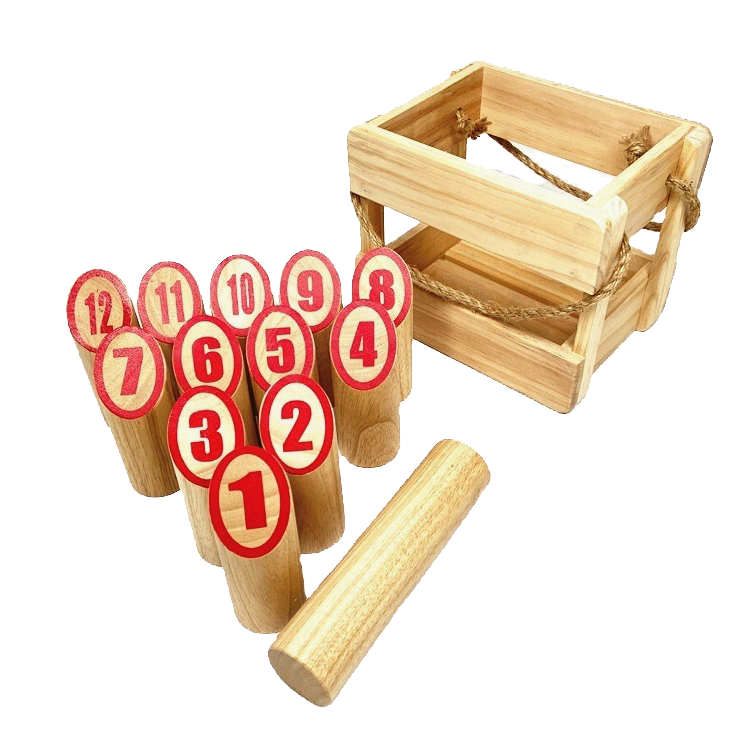
A throwing game from Finland. You stand behind a line and throw an unnumbered wooden pin underhand at a group of twelve numbered pins. What you knock down determines your score, and the score is the whole game.
It is often described as Finnish skittles or Finnish horseshoes. Both comparisons are reasonable and both miss the point: the interesting part is not the throwing, it is the arithmetic and the way the field changes shape as the game goes on.
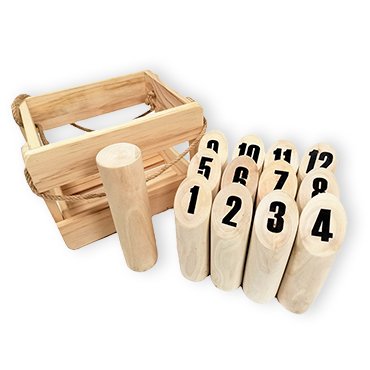
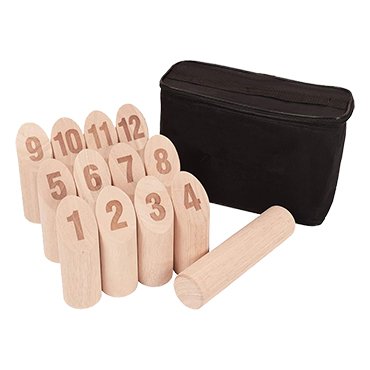
The set is twelve numbered pins and one unnumbered throwing pin. In official sets the throwing pin is the same size as the numbered pins; some retail sets ship a slightly larger one, which makes the game easier and is worth knowing if you are comparing products.
The pins start in a formation: pin 1 at the front, then a row of two, then three, then four, then pin 12 at the back. That is the standard layout and it matters, because pin 12 is the hardest to reach and therefore the most valuable.
Mark a throwing line 3.5 m from the front pin for adults. For children, use 2.5 m. Any short grass, sand or firm flat surface works; a manicured lawn is not required and a very soft surface makes the pins fall too easily.
A game between two players takes 15 to 25 minutes. Four players takes longer, and the wait between turns is the main reason groups play in pairs.

Here is the mechanic most explanations skip, and it is the one that turns Mölkky from a throwing game into a strategic one.
Fallen pins are stood back up where they fell. They are not returned to the starting formation. So the field scatters as the game goes on: pins end up spread across the playing area, some close to the throwing line, some far away, and the shape of the field is different in every game.
That single rule is why position matters. A pin that lands two metres to the side is easy to hit but worth only its own number. A pin that ends up at the back of a spread-out field is hard to reach and therefore a problem for whoever has to score next.
Two methods, and which one applies depends entirely on how many pins you knock down.
Knock down exactly one pin and you score the number printed on it. Take down the 12 on its own and you score 12. This is the high-value shot and it gets harder as the field spreads out.
Knock down two pins and you score 2, regardless of which pins they were. Knock down five and you score 5. The numbers on the fallen pins are irrelevant.
That is why the 12 pin is not automatically the best target. Late in a game, when the 12 is standing alone at the back, going for it is a 12 point shot. Early in a game, when it is surrounded, hitting it means hitting several pins and scoring 3.
A pin is down only if it is entirely on the ground. A pin leaning against another standing pin has not fallen and stays in play. This causes more arguments than any other rule, so agree it before the first throw.
The target is exactly 50 points. Not 50 or more: exactly 50.
If your score would pass 50, it does not stop at 50. It drops to 25, and you start again from there. This is the rule that makes the endgame interesting, because a player on 48 cannot simply aim at the biggest pin available. They need a 2, or two pins, and nothing else will do.
A throw that knocks down no pins is a miss. Three consecutive misses and that player is eliminated from the game. It is a harsh rule and it is the reason Mölkky rewards consistency over ambition: a player who scores 3 every turn will beat a player who scores 12 twice and then misses three times.
Players throw in a fixed order, one throw each per round, from behind the line. The pin must be thrown underarm. There is no run-up and no overarm throw.
The game rewards arithmetic more than it rewards accuracy, which is why good players beat strong throwers.
At the start the pins are tightly grouped, so a hit will usually take several down. That is fine. Scoring 4 or 5 per turn builds a base, and more importantly it scatters the field into a shape you will have to deal with later anyway.
Once the field has spread, look for high-numbered pins standing alone. A single 10, 11 or 12 with clear space around it is the best target on the field, because it scores its full value instead of the count.
On 47 points you need 3. On 48 you need 2. On 45 you need 5, which is either a single 5 or five pins, and the single 5 is far easier. Work out the number before you pick up the pin, not after you have knocked something down.
You are not only scoring, you are shaping the field for the next player. A high-numbered pin you leave standing, isolated and reachable, is a gift. Sometimes the correct move is to knock down a low pin even though a higher one is available, because the low pin is the one that would have given your opponent an easy 11.
For buyers, four numbers decide whether a set plays properly.
Minimum order 500 sets, samples 5 to 10 days, bulk production 30 to 45 days.
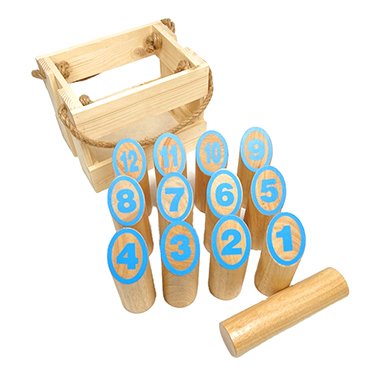
Mölkky is worth stocking because it is one of the few garden games with a genuine skill ceiling. The rules fit on a card, the equipment is twelve pins and a stick, and the game still produces arguments about whether to take the 12 or protect the field.
It is also one of the few games in the category that plays properly in a small space: 4 by 5 metres is enough, which is less than half what nine-wicket croquet needs.
1. How much space do I need?
About 4 by 5 metres, with a clear throwing lane of 3.5 m for adults. Children can play from 2.5 m.
2. What is the target score?
Exactly 50. Going over 50 drops your score to 25.
3. What happens after three misses?
Three consecutive throws that knock down no pins and that player is out of the game.
4. Is the wood sealed for outdoor use?
We finish pins with a water-based clear coat on all faces including the end grain, which slows moisture cycling. That is not the same as weatherproof: a set left out through a winter will crack at the base. Store it under cover.
5. Can the pins be customised?
Yes. Laser engraving, stained sets, and a logo on the throwing pin or the box are all straightforward. Engraving outlasts printing on a surface that gets hit repeatedly.
6. What is the lead time for 500 sets?
30 to 45 days after sample approval, with samples in 5 to 10 days.
Get a free copy of our catalog
Trust our dominoes game experts to deliver premium quality and unbeatable value, on-time and on-budget.
kangjiegardengame.com
Typically replies within minutes
How Can We Assist You Today?
WhatsApp Us
🟢 Online | Privacy policy
WhatsApp us
Custom garden games available—our expert design team brings innovative ideas to life.
Get notified about new products