
Main Menu
Mechanically, a tumbling tower and a Jenga set are the same game. Both are fifty-four blocks, eighteen levels of three, one hand, one block per turn, removed from below the top level and placed on top, and the game ends when the tower falls. The difference between the names is a trade name, and that difference is what matters if you are buying or selling one rather than playing one.
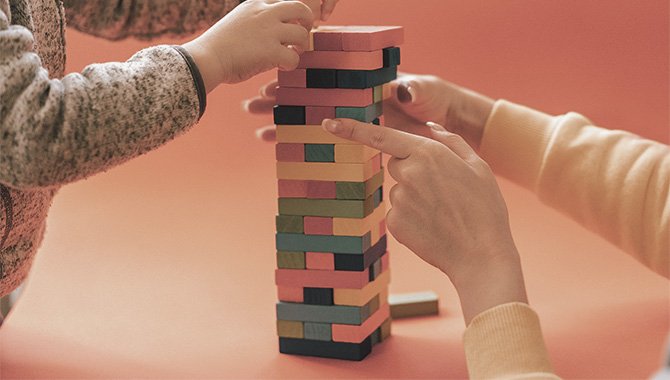
Jenga comes from East Africa. Leslie Scott, born in Tanzania, developed it in the 1970s from a block game her family played, and published it in the UK in the 1980s before Hasbro took it on. The name is the Swahili imperative “to build”, which is the one part of the story that is exactly as advertised.
After Jenga’s success, other manufacturers made the same game and called it something else, because Jenga is a registered trademark rather than a description. Tumbling tower is the generic English name. The game is the same; the word on the box is not.

Jenga is a registered trademark of Pokonobe Associates, licensed to Hasbro. It is not a generic word, and a product sold as Jenga without the licence is a trademark problem, not a style choice. A manufacturer or retailer can make and sell the game; it has to be called a tumbling tower, a stacking tower, or a hardwood block tower on the listing.
The branded set is made to a tight tolerance, and that tolerance is the product. A standard retail block is 75 mm long, 25 mm wide and 15 mm thick, and length must equal three times the width or the tower leans. A generic set varies more between batches, and the variation shows up as a tower that jams or leans. This is the real, measurable difference, and it is worth more than the badge.
The branded set carries a licensing and quality premium. Generic sets are cheaper, and some add house rules – a forfeit for toppling, a time limit, a reverse tower – which are fine as long as they are labelled as variants and not the core game.

For an individual buyer, either name works, and the thing to check is the block tolerance and the finish, not the badge. For a business, the line is the trademark: you can make and sell the game, but you cannot call it Jenga, and a listing that uses the word in the title or the bullet points is the one that gets pulled, not the one that sells better.
A tumbling tower and a Jenga set are the same game in play and a different product on paper. The mechanics are identical; the difference is the trade name and, in a good set, the block tolerance. Buy or sell the game under its generic name, check the fit rather than the badge, and keep the trademark word off the box.