
Main Menu
Hook and ring toss looks like nothing: a hook on a post, a ring on a string, and a swing. Then you try it, miss eleven times in a row, and realise the game is entirely in the release. It is one of the few lawn games where the equipment is almost free and the skill ceiling is genuinely high, which is exactly why it holds people’s attention.
This guide covers how the game is actually played, the technique that makes it work, the variations worth knowing, and what a buyer should check before ordering a container of them.
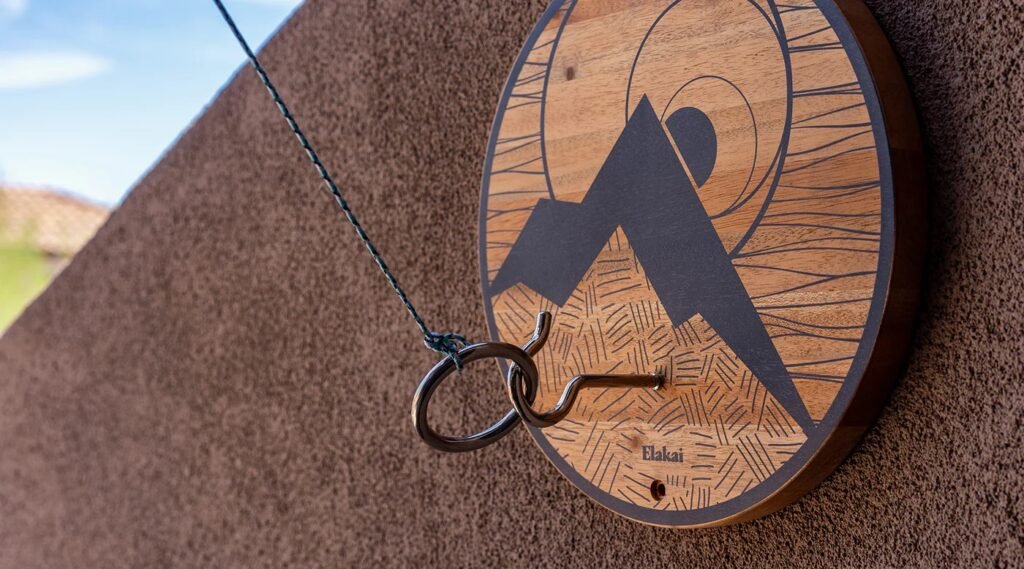
A vertical post or wall plate, a metal hook projecting horizontally, and a ring tied to a cord that hangs from above the hook. The player stands back and swings the ring so that it catches on the hook.
It goes by several names — hook and ring toss, ring on a string, hookey, and in the Bahamas, the ring game. The equipment is the same and the rules barely differ.
The base. A post, a wall plate or a free-standing frame. The base decides whether the game is portable or fixed, and that is the main product decision.
The hook. A metal hook, usually screwed or through-bolted into the base. This is the part that takes load, and it is where cheap sets fail.
The tether. A cord with a ring at one end, fixed to a point above the hook. Cord length is the single biggest factor in how the game feels.
It has no loose parts, so nothing gets lost. It can be played alone, which most lawn games cannot. It takes up almost no floor space. And it works indoors as well as outdoors, which is unusual in this category and matters for anyone selling into bars, games rooms or gift retail.
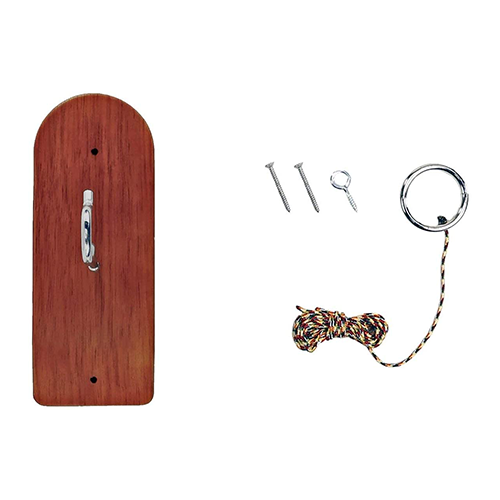
Fix the base at roughly chest height, with the hook projecting horizontally. Tie the cord to a point above and slightly forward of the hook, so the ring hangs clear of the base and swings freely. The standard playing distance is about six to nine feet; pick one and keep it for the whole match, because the distance is the difficulty setting.
This is where the game is won or lost. Do not throw the ring. Hold it lightly, let it hang, and swing your arm in a smooth pendulum from the shoulder. The ring should travel out and come back on a shallow arc, catching the hook on the return rather than on the way out.
Three things fix most beginners’ problems:
Reduce the power. A hard swing makes the ring overshoot. The correct swing feels almost lazy.
Keep the wrist still. A flicked wrist puts spin on the ring and it will not settle onto the hook.
Watch the hook, not the ring. Players who track the ring swing past it. Fix your eyes on the hook and let the ring arrive.
One point for each ringer. Play to an agreed total, usually 21. Many groups require a two point margin to win, which prevents a lucky last swing from deciding a match.
Turn order alternates, and a common house rule is that a miss passes the turn immediately, which keeps the game moving with more than two players.
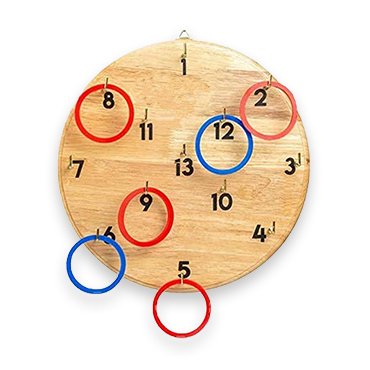
Players alternate. The first to score forces the opponent to match on their next swing or lose. Short, tense, and the best format for a group watching.
Mark three positions at increasing distance. Each player must score from each in order before moving back. A miss holds you at that mark for another turn. This is the format that separates players most clearly.
Two teams, alternating swings. The tactical question is whether to put your most consistent player first to build a lead or last to close one, and it is a real decision once the scores are close.
A house rule in a lot of bars: after scoring, you must switch hands. It is harder than it sounds and it is the fastest way to level a game between experienced and new players.
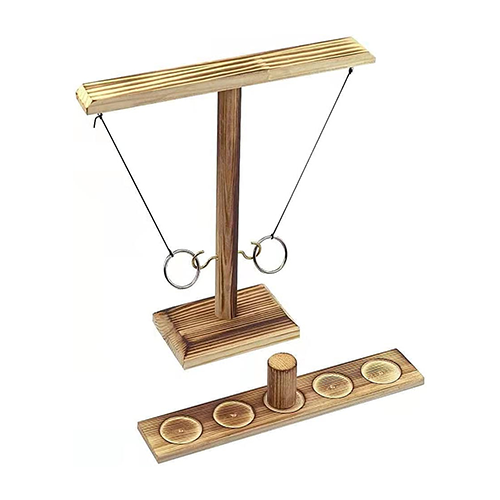
Hook and ring toss has a combination that is rare in the garden game category: a very low unit cost, a small carton, and a game that is genuinely difficult. That makes it useful at several price points and in several retail settings.
Small carton. The product is compact and light, which makes freight and storage cheap in a category where bulky items are the norm.
No loose parts. Nothing gets lost, so there are no missing-piece complaints and no need to stock spares.
Works indoors. This is the product’s real advantage. It sells into bars, games rooms, offices and gift retail as well as into garden ranges, which means it does not depend on the spring and summer peak.
Easy to brand. The base is a flat panel. Engraving a logo on it costs very little and turns the product into a corporate gift.
Demonstrable. A customer can try it in ten seconds, which is more than can be said for most of the category.
The hook fixing. This is the load-bearing part and the most common failure. Ask whether it is screwed, through-bolted or threaded into an insert, and how it is locked against rotation.
The cord. Material and length. A cord that stretches changes the swing arc over a season.
The ring. Metal or wood. Metal rings feel better and last; wooden rings look better and can split if dropped on a hard floor.
Base stability. A free-standing base that tips when the ring is pulled hard is a design flaw, not a user error.
1. What is the standard playing distance?
There is no single official distance. Six to nine feet from the hook is the usual range. Agree a distance at the start and keep it, because the distance is what makes the game hard or easy.
2. Which wood is best for an outdoor set?
A dense hardwood that holds a screw thread well, because the hook fixing is the part that fails. Mahogany and walnut are both used for that reason. Whatever the species, the finish is what protects it outdoors, and no finish makes a wooden set suitable for permanent exposure to weather.
3. Can the game carry our branding?
Yes. The base is a flat panel, so laser engraving or printing a logo is straightforward and inexpensive. Custom stains and custom packaging are also standard options.
4. How long does a game take?
A round to 21 points runs five to ten minutes with two players. A distance ladder match or a tournament format can fill an hour, which makes it a good format for a venue.
5. Is assembly difficult?
No. Most sets go from box to playable in a few minutes, usually with the hook already fitted and only the cord to attach. Worth confirming whether the hook is pre-fitted or requires tools, because that decides whether it is a gift or a project.
Hook and ring toss is a small product with an unusually wide market: garden retail, gift retail, bars, games rooms and corporate gifting. It costs little to make, ships small, has no loose parts and is genuinely difficult to master, which is the combination that keeps a game in use.
The failure mode is the hook fixing. Everything else on the product can be ordinary and it will still work; a hook that works loose ends the game. That is the one thing worth inspecting on a sample before you commit to a run.
Sourcing custom wooden garden games?
We manufacture direct in Guangzhou: 500-set minimum, quotes within 24 hours, samples in 5–10 days, production in 30–45 days, EN71 and ASTM F963 compliance, FSC-certified timber. Send your specification: contact us
Get a free copy of our catalog
Trust our dominoes game experts to deliver premium quality and unbeatable value, on-time and on-budget.
kangjiegardengame.com
Typically replies within minutes
How Can We Assist You Today?
WhatsApp Us
🟢 Online | Privacy policy
WhatsApp us
Custom garden games available—our expert design team brings innovative ideas to life.
Get notified about new products