
Main Menu
Wooden lawn dice are ordinary dice at eight to twelve times the size, rolled on grass instead of a table. The game does not change. What changes is that everyone can see the result from standing height, nobody can nudge a die, and the whole thing takes up the middle of a lawn instead of a corner of a table.
That is the entire product proposition, and it is a good one: the social dynamics of a dice game without everyone leaning over a table.
Here is how to play, which sets work for which games, and the one number that decides whether a set is fair.
One thing worth knowing before choosing a set: the number of dice decides which games you can play, and most sets are sold without saying so.
Three things, and only one of them is about the wood.
A die that is 0.5 mm out of square lands on one face more often than the others, and over a hundred rolls that is visible. The specification is a tolerance of plus or minus 0.5 mm on all three dimensions, and opposite faces summing to seven.
This is the number that decides whether a set is fair, and it is the number most sets do not publish.
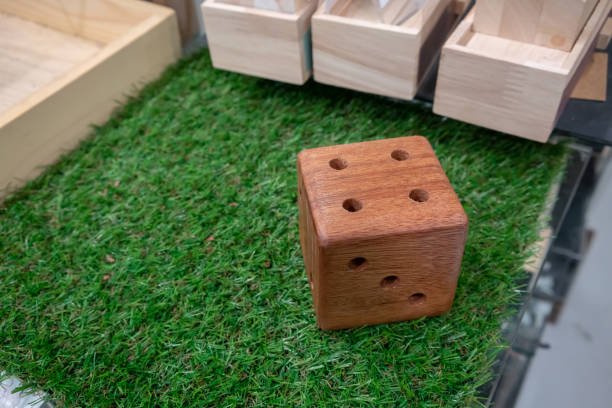
Painted dots wear off within a season, and a die with a missing dot is a die nobody trusts. Drilled and filled dots last, and the fill has to be a contrasting colour that does not shrink.
A 2 to 3 mm chamfer on every edge. A sharp-cornered die dents on impact, and a dented die rolls badly for the rest of its life. The chamfer also stops the die from splitting when it lands on a stone.
The species, within reason. Beech and rubberwood are both fine. The dice are not struck, they are dropped, so hardness is not the deciding property.
Six dice, a scoresheet, and one rule that makes it a game: you must bank points or risk losing them.
| Combination | Score |
|---|---|
| Single 1 | 100 |
| Single 5 | 50 |
| Three 1s | 1,000 |
| Three of 2, 3, 4, 5 or 6 | Face value x 100 (three 4s = 400) |
| Four of a kind | 1,000 |
| Five of a kind | 2,000 |
| Six of a kind | 3,000 |
| Straight, 1 to 6 | 1,500 |
| Three pairs | 1,500 |
| Two triplets | 2,500 |
The whole game is one decision, repeated: bank now or roll again. That is why it works with a group of any size and any age — the decision is identical for everyone and the risk is legible.
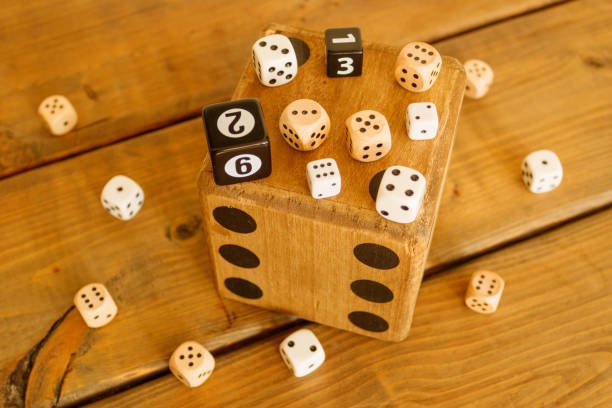
With five dice you play a category game: thirteen scoring boxes, each used once, and the player chooses which box to fill after each roll.
The categories are the poker hands — three of a kind, four of a kind, full house, small straight, large straight, five of a kind — plus an upper section of ones through sixes. Three rolls per turn, keeping any dice between rolls.
The published scorecards for this format vary between editions, so the honest advice is to print the scoring on the lid rather than assume a player knows it. A five-dice set with the categories printed inside the box is a better product than one without, and it costs nothing.
Farkle is a game of one repeated decision, and the decision has a shape.
There is a technique, and it is the opposite of throwing.
Roll the dice low and along the ground rather than tossing them in the air. A low roll with a bit of backspin produces a true result; a high toss produces a die that lands on an edge and topples, which is where arguments start.
On a hard surface, roll toward a backstop. On grass, roll from a crouch so the dice do not bounce.
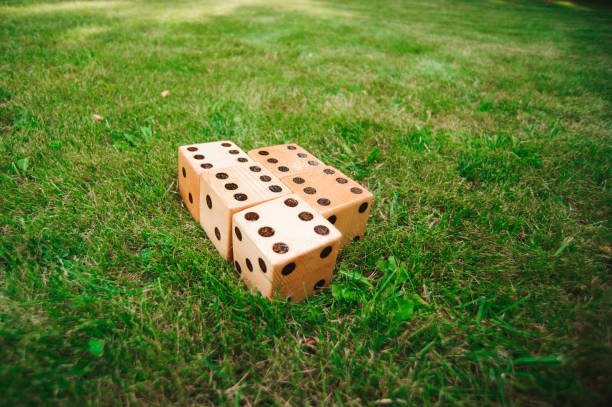
Lawn dice are a table game moved outdoors, and the move is worth making: everyone can see the roll, nobody can touch it, and the game fills a lawn instead of a corner.
Choose six dice over five if you want Farkle, check that opposite faces sum to seven, and roll low rather than tossing. Those three things cover most of what goes wrong.
Farkle works with two to eight. Above four, play in teams, because otherwise the wait between turns is longer than the turn.
Yes, from about six with the scoring simplified to ones and fives. The dice are large enough that small hands can manage them, and there is nothing to knock over.
Garden centres, game shops and online. Check the die size and whether the dots are drilled or printed — printed dots wear off within a season.
Yes, and it is a reasonable project: 50 mm hardwood cubes, drilled dots filled with a contrasting material, and a 2 to 3 mm chamfer on every edge. The tolerance is what is hard, not the shape.
They roll, but sand gets into the drilled dots and the dice stop sitting flat. A patio, a deck or short grass is better.
If you are sourcing lawn dice, send us the die size, the number of dice and whether you want drilled or printed dots. We will come back with the tolerance, the species and the carton dimensions.
Get a free copy of our catalog
Trust our wooden game experts to deliver premium quality and unbeatable value, on-time and on-budget.
kangjiegardengame.com
Typically replies within minutes
How Can We Assist You Today?
WhatsApp Us
🟢 Online | Privacy policy
WhatsApp us
Get notified about new products
Custom garden games available—our expert design team brings innovative ideas to life.