
Main Menu
The Tower of Hanoi is usually treated as a puzzle to stock rather than a product to specify, which is why so many sets on the market look right and play badly. It is one of the few games where a single dimensional error – a peg a fraction too thick, a disk that binds – makes the product unusable rather than merely imperfect.
That makes it a straightforward product to source well and an easy one to source badly. The specification is short, and every point on it is measurable.
Below: the history that makes it sell, the rules that set its difficulty tiers, the wholesale channels compared, and the four measurements that decide whether a set works.

The puzzle was invented by the French mathematician Édouard Lucas in 1883, and the story he attached to it was deliberately exotic: a temple in Benares with sixty-four golden disks, and priests moving them one at a time, the world ending when the last move is made.
That story is a large part of why the product sells. It gives a wooden puzzle a narrative that a plastic one does not have, and it is why the game appears in museum shops, science centres and gift retail rather than only in toy aisles.
The mathematics is genuine even though the legend is not. The minimum number of moves is 2n − 1, where n is the number of disks. Seven disks need 127 moves; ten need 1,023; the legendary sixty-four would need more moves than there are seconds in the age of the universe.
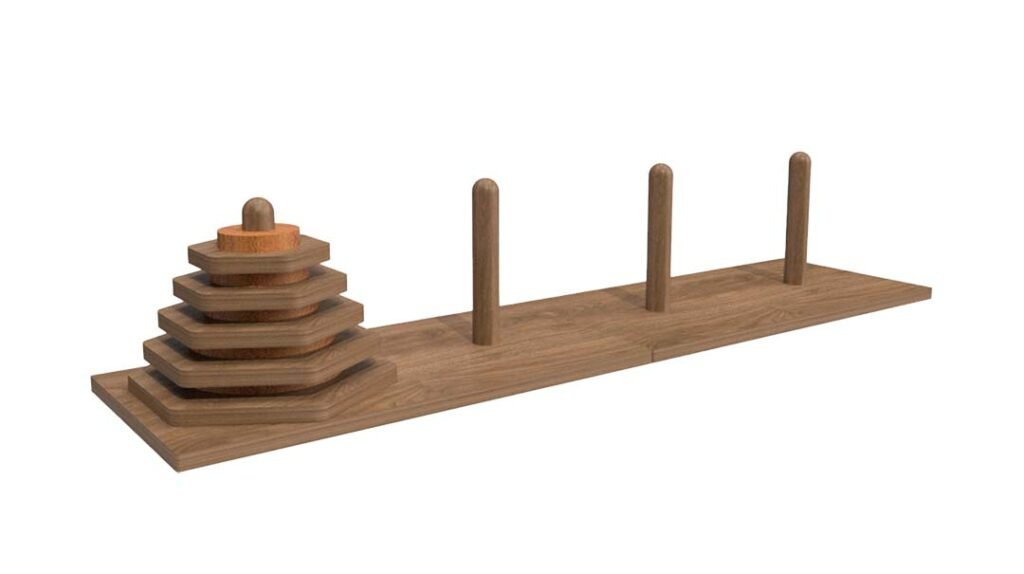
Three pegs, a stack of disks of decreasing size, and two rules: move one disk at a time, and never place a larger disk on a smaller one. The objective is to rebuild the stack on another peg.
That simplicity is the commercial asset. There is no rules card to read, nothing to translate, and no age barrier beyond the point where a child can hold two constraints at once – roughly six or seven.
The disk count sets the difficulty tier, and it is worth treating as a product decision rather than a detail. Five disks is a children’s puzzle solved in 31 moves. Seven is the traditional set and takes 127. Ten is a desk object for adults and takes over a thousand. Each count is a separate SKU with its own price point and its own box.
Buying wholesale is not simply a discount. Three things change at volume, and only one of them is price.
The saving is real but it is not linear, and understanding why matters more than the percentage.
A Tower of Hanoi set carries a setup cost – programming, turning or drilling, a first-article check, and packaging artwork. Spread across 500 sets, that setup is visible in the unit price; spread across 5,000 it is close to invisible. On a small wooden puzzle retailing at 15 to 25 euros, that difference is the difference between a workable margin and a thin one.
What does not fall with volume is material. A denser species, a thicker base or a better finish costs the same per unit at 500 as at 5,000. That is why the productive negotiation is on setup and packaging rather than on the timber.
For a seasonal or event-driven buyer, availability matters more than the last few percent of price. A puzzle that arrives after the school term has started, or after the gift fair, is worth less than the same stock in the right month.
Production runs 30–45 days from deposit and sample approval, and ocean transit adds roughly 30–40 days to Europe or 14–25 days to the US west coast. A buyer planning a fourth-quarter gift season is therefore placing the order in the summer, not in October.
Buying from a retail store is the only channel where you can handle the product before paying for it, which is genuinely useful once – as a reference. It is not a sourcing channel. Retail margin sits on top of wholesale margin, and the quantity available is whatever happens to be on the shelf.
The productive use of a retail purchase is as a benchmark: buy one set, measure the disk thickness, the peg diameter and the finish, and put those numbers into your own specification.
Marketplaces are useful for price discovery and poor for supplier verification. Listings are advertising, review counts are purchasable, and the same product appears under a dozen sellers who are all reselling one factory’s output.
The specific risk with a puzzle like this is that the photographs are almost always of a good set. A Tower of Hanoi looks identical in a listing whether the pegs are 12 mm or 14 mm, and that dimension is the whole product.
Direct purchase is the only channel where the specification can be changed, and for a puzzle with this many measurable dimensions that is the main reason to use it. It is also the only channel where you can ask who owns the production equipment.
The trade-off is that verification becomes your job. A factory answers a technical question with a number; a trader forwards it. That difference is the whole test.
A local manufacturer solves the two problems that dominate imported goods: transit time and communication. A domestic supplier can usually deliver in weeks rather than months, and a question is answered the same day by someone in the same time zone.
The cost is unit price, and it is a real difference rather than a small one, because local labour and local timber both cost more. Whether it is worth paying depends on the order. For a small run of a high-price product where speed matters, it often is. For container volume of a commodity puzzle, it usually is not.
Overseas production, particularly in China, is where most of this category is made, and the reason is the supply chain rather than the labour rate: timber yards that stock and dry the species, turning and CNC capacity, coating lines, and packaging printers within a short distance of each other.
Two costs offset that advantage. Freight and transit time, which have to be built into the landed cost rather than compared against the unit price. And verification, which cannot be done by walking into a shop.
Four factors decide whether a wholesale order becomes an asset. Only one of them appears in the quote.
For this product the checks are specific, and all of them can be done on a sample with a caliper and a straight edge.
Peg diameter against disk bore, where the fit should let a disk fall freely without wobble. Peg height, because a peg that is too short lets the stack overtop. Base flatness, because a base that rocks makes the puzzle frustrating rather than difficult. And the finish inside the bores, where a rough surface creates friction and makes the whole set feel badly made.
Two numbers matter: actual weight and volumetric weight, and freight bills on whichever is greater. A wooden puzzle is dense, so it usually bills on actual weight, which makes it a comparatively efficient product to ship – one of the reasons the category works at low unit prices.
Confirm the Incoterm before comparing quotes. FOB, CIF and DDP produce three different totals for the same goods, and a comparison across different terms is not a comparison.

The Tower of Hanoi is a small product with a short specification, which makes it either very easy or very easy to get wrong. The history sells it, the disk count sets its price tiers, and four measurements – peg diameter, peg height, base flatness and bore finish – decide whether the set works.
Buy wholesale for the setup amortisation rather than for a discount on material. Buy direct if the specification needs to change. And check the sample with a caliper rather than with your hands.
Yes. FSC-certified timber is available with chain-of-custody documentation tied to the order, and water-based finishes are standard for this product. Ask for the certificate number and the transaction reference rather than the logo.
Seven is the traditional count and the most common retail set, requiring 127 moves. Five-disk versions suit younger children, and ten-disk versions are positioned as desk puzzles for adults. Each count is a separate SKU with its own price point.
Yes, and packaging is usually the largest single lever on retail price. It has to be specified before production, because artwork approval and printing sit on the critical path rather than alongside it.
The puzzle itself is safe at any age, but following the two rules requires holding two constraints at once, which arrives at roughly six or seven. Sets are usually labelled 6+ or 8+ depending on the disk count and the size of the pieces.
Beech, rubberwood or pine depending on the price tier, with a water-based lacquer or an oil finish. Wood is the traditional material and the one that carries the gift positioning; plastic versions exist and sell at a lower price point in a different channel.
Wholesale sourcing for a product this simple comes down to measurement rather than judgement. The set that plays well and the set that binds look identical in a photograph, and the difference is four numbers on a specification sheet.
Get a free copy of our catalog
Trust our wooden game experts to deliver premium quality and unbeatable value, on-time and on-budget.
kangjiegardengame.com
Typically replies within minutes
How Can We Assist You Today?
WhatsApp Us
🟢 Online | Privacy policy
WhatsApp us
Get notified about new products
Custom garden games available—our expert design team brings innovative ideas to life.