
Main Menu
You have probably watched a group at a barbecue take turns lobbing horseshoes at a stake and wondered how the scoring works. Horseshoes is one of the oldest lawn games still played, and its rules are short enough to learn in a single afternoon. This is the game from its background and kit through to the throw that wins the match.
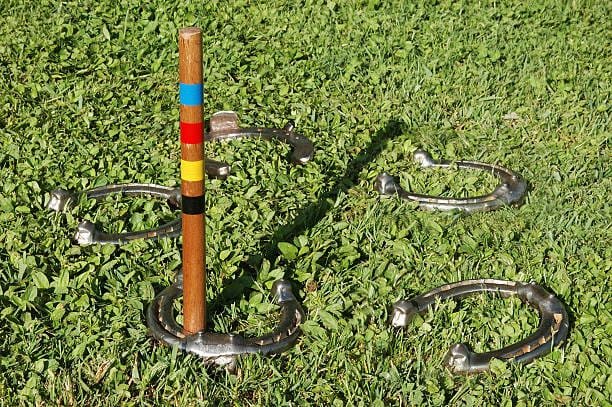
As the name suggests, the game is played with horseshoes, though modern sets use shoes made for the purpose rather than anything pulled from a stable. It is a lawn game for family gatherings and barbecues: the setup is simple, the rules are easy to pick up, and it works for children and adults at the same time.
Horseshoes is often traced back through a Greek throwing game played around the 2nd century BCE, where players aimed a discus at a stake, and the idea carried through Roman soldiers into the forged shoe we know. The exact lineage is disputed, but the game has clearly been around a long time.
In the United States it is a fixture of Fourth of July gatherings and has been played on White House lawns. Few lawn games carry that kind of history into a back garden.

A set needs four horseshoes, usually steel and weighing about 2.5 pounds each, shaped with rounded, open ends so they hook and balance on the stake.
Two stakes, typically steel, around 36 inches long with about 14 to 15 inches left showing above the ground once driven in.
The playing area, or pitch, is a flat level stretch with the stakes 40 feet apart. The ends are called the pits.
Drive the stakes in firmly, leaning slightly toward the opposite stake. The lean helps shoes catch and stay on.
For standard play the stakes sit 40 feet apart. Casual games can shorten that, but keep the ground open and clear of anything a missed throw could hit.
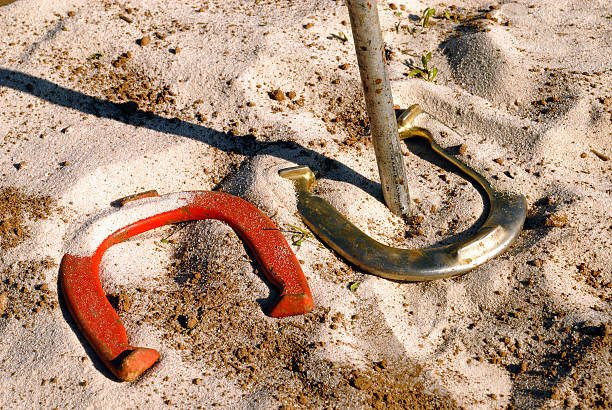
Points are awarded by closeness. A shoe that rings the stake, a ringer, scores 3 points; a shoe within 6 inches of the stake scores 1. The closest shoe wins the difference.
Most games are played to 21 points. Some versions require an exact 21, others just a lead of 2 at that mark. Agree it before you start.
Throwing accurately is mostly practice, but two styles dominate. A turn throw spins the shoe once in the air and arrives flat; a flip rotates it end over end. Players settle on whichever feels repeatable, because repeatable beats clever.

Regions have their own versions. The UK plays quoits with rings rather than shoes, and the US has muckers and other local twists on the same idea: throw, land close, score.
Horseshoes is a game with a history as long as its throw. Whether you are new to it or have played for years, the satisfaction is the same: a clean ringer. Next time there is a set at a gathering, take a throw. It is easier to enjoy than it looks.
The stakes in horseshoes are typically placed 40 feet apart.
Usually, a game of horseshoes is played until a player or team scores 21 points.
A horseshoe used in the game typically weighs about 2.5 pounds.
Yes, horseshoes can be played with two to four players, or two teams.
Yes, different regions have their unique variations of horseshoes, like 'quoits' in the UK or 'muckers' in the US.
That is the game. The kit is minimal, the rules fit on a postcard, and the only thing it asks for is a flat patch of ground and a willingness to miss a few times before the ringers come.
Get a free copy of our catalog
Trust our wooden game experts to deliver premium quality and unbeatable value, on-time and on-budget.
kangjiegardengame.com
Typically replies within minutes
How Can We Assist You Today?
WhatsApp Us
🟢 Online | Privacy policy
WhatsApp us
Get notified about new products
Custom garden games available—our expert design team brings innovative ideas to life.