
Main Menu
Wooden board games are having a moment in the garden, and the reason is straightforward: they look like furniture rather than equipment, so people leave them out where guests can see them.
The problem is that a board game needs four conditions a garden does not naturally provide. A flat, level surface. No wind. A fixed footprint. And dry weather. Every style of outdoor board game is a different answer to those four problems, and the style you choose decides whether the product works or sits in a shed.
This article covers the three styles that survive outdoors, why the obvious approach fails, and what to specify if you are buying rather than playing.
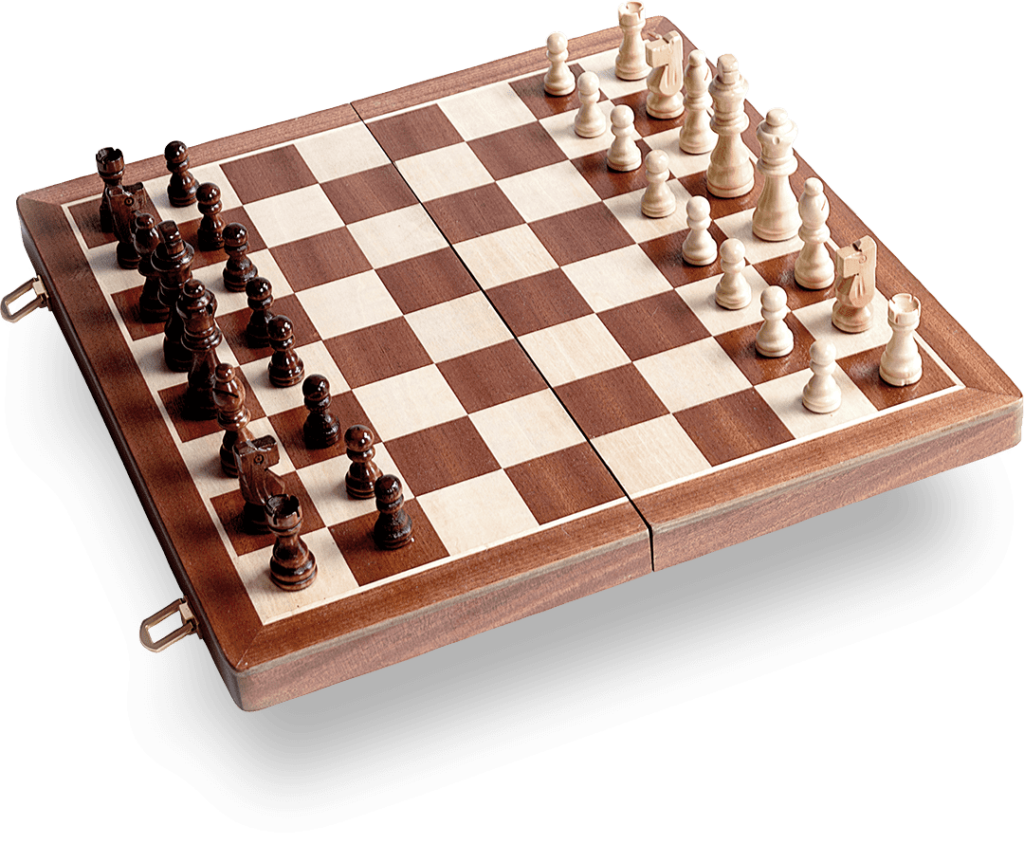
Take a wooden chess set outdoors and four things go wrong, in this order.
Wind. A standard chess piece is 30 to 60 mm tall and weighs a few grams. A gust takes the whole set off the board. This is the failure people notice first and it is the one that ends the game.
Level. A garden table is level to within a few millimetres at best, and grass is not level at all. On a 400 mm board, a 5 mm fall is enough to make pieces slide and to make a ball roll on a lawn game.
Size. A 400 mm board with 50 mm squares is fine indoors at arm’s length. Outdoors, with people standing around it, nobody can see it and nobody can reach it without leaning over someone.
Water. A solid timber board left out will take on moisture, cup, and open at the joints. A board that lives outdoors has to be built like a piece of garden furniture, not like a game.
| Problem | What it does | The fix |
|---|---|---|
| Wind | Lifts and scatters pieces | Heavier pieces, or a vertical playing plane |
| Level | Pieces slide, balls roll offline | A frame with levelling feet, or play on the ground |
| Scale | Nobody can see or reach the board | Oversize the grid rather than the board |
| Water | Cupping, joint failure, print loss | Sealed edges, solid timber, engraved grid |

The most successful outdoor board games remove the board. Giant four in a row and giant tic tac toe are grid games whose grid is either a frame standing vertically or lines marked on the ground. There is nothing to blow away because the pieces are 90 mm discs, and nothing to level because the game is played standing up.
This is the style that dominates garden retail, and it dominates for good reasons. It is also the style that fails fastest if the plywood edges are left unsealed, which is the single most common durability problem in the category.
Chess, draughts and backgammon work outdoors when the board is a piece of furniture: a pedestal table with a framed top and levelling feet. The board is then a garden table that happens to have a grid on it, and it can stay out because it was built to.
What does not work is a folding board laid on a garden table. It slides, it is never level, and the pieces are too light for the wind. The difference between the two is about 8 kg of timber and a frame.
Fabric boards and hinged slat boards lie directly on grass or on a patio. They solve the level problem by conforming to the ground and the storage problem by rolling up, and they solve the wind problem not at all, which is why they are usually supplied with weighted pieces.
The trade-off is lifespan. Fabric in a garden is a two-season material unless it is a coated synthetic, and a coated synthetic is no longer the natural product the customer thought they were buying.
| Style | Survives outdoors | Packed weight | Where it sells |
|---|---|---|---|
| Oversized lawn game | Well, if edges are sealed | 8 to 15 kg | Garden centre, pub, holiday park |
| Board on a stand | Well, as garden furniture | 10 to 18 kg | Hotel terrace, premium retail |
| Roll-up or slatted | Two seasons on fabric | 2 to 5 kg | Travel, gift, impulse |

Plywood edges. A board or frame cut from plywood has exposed end grain on all four edges, and water wicks into the laminations. Once the layers separate the product is finished and no recoating brings it back. Edge banding, a solid timber frame, or a properly sealed and painted edge prevents it, and nothing else does.
Printed grids. A grid printed onto a sealed surface wears where fingers land, and it fades in UV within two summers. A routed or engraved grid survives both, and on an outdoor board it is worth the extra machining.
Light pieces. A 30 mm disc weighs about 8 g. It will not stay where it is put on a breezy day, and the customer blames the game rather than the design. Pieces below about 45 mm in diameter are the wrong choice for outdoor use.
Film finishes that cannot be renewed. A factory-applied system that the customer cannot match is a product with one life. A finish that can be lightly sanded and recoated gives the product a second one.
Glued joints that see water. Exterior-grade adhesive costs a little more per unit and is the difference between a joint that opens in year two and one that does not.
Two of the games in this category are sold under brand names that most people use as if they were the name of the game. Four in a row and the tumble tower are the generic descriptions, and they are what we put on a specification. Using the generic name in your own copy avoids a trademark problem and costs nothing in search visibility, because customers search for both.
Kubb and the numbered pin game are the other two worth knowing. Kubb is Swedish and its rules are simple; the numbered pin game is Finnish and its rules are not, because the target is an exact total rather than a high score. They look similar in a photograph and they are not interchangeable products.
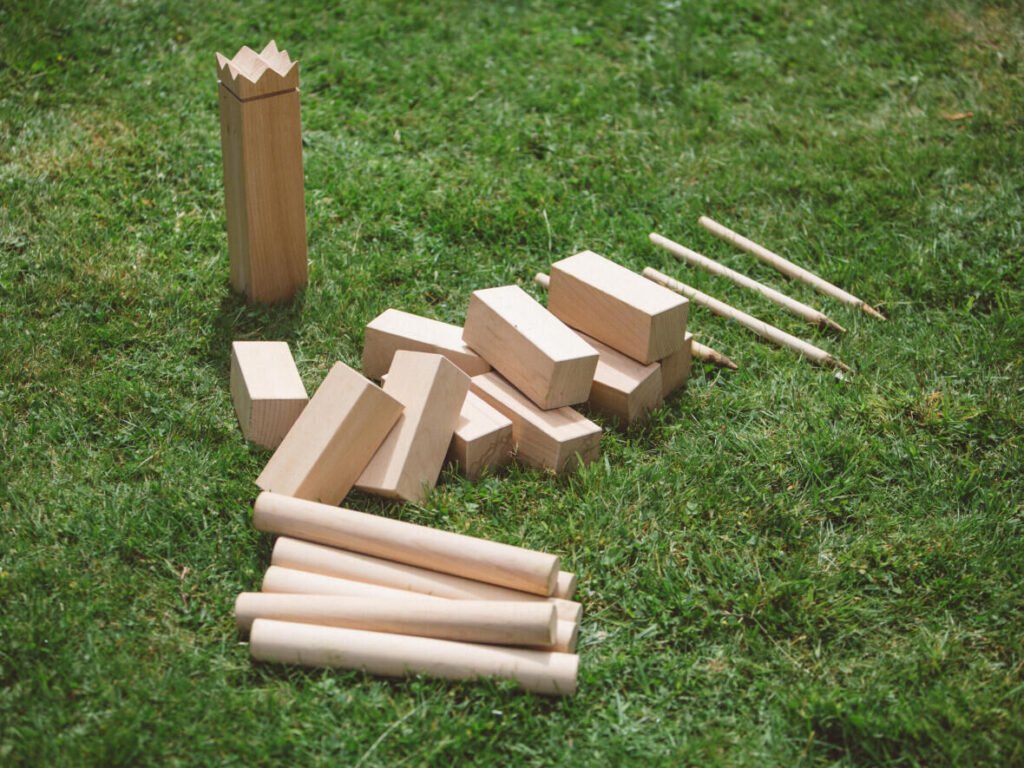
If you are buying rather than playing, these are the lines that decide whether the product holds up.
Minimum order 500 sets, samples in 5 to 10 days once the specification is agreed, bulk production 30 to 45 days, quotation within 24 hours.
The honest summary is that an outdoor board game is a piece of garden furniture with a grid on it. Products that are designed as games first and left outside second are the ones that come back as complaints.
Get a free copy of our catalog
Trust our wooden game experts to deliver premium quality and unbeatable value, on-time and on-budget.
kangjiegardengame.com
Typically replies within minutes
How Can We Assist You Today?
WhatsApp Us
🟢 Online | Privacy policy
WhatsApp us
Get notified about new products
Custom garden games available—our expert design team brings innovative ideas to life.